Vets' Pay Change Needs One Signature
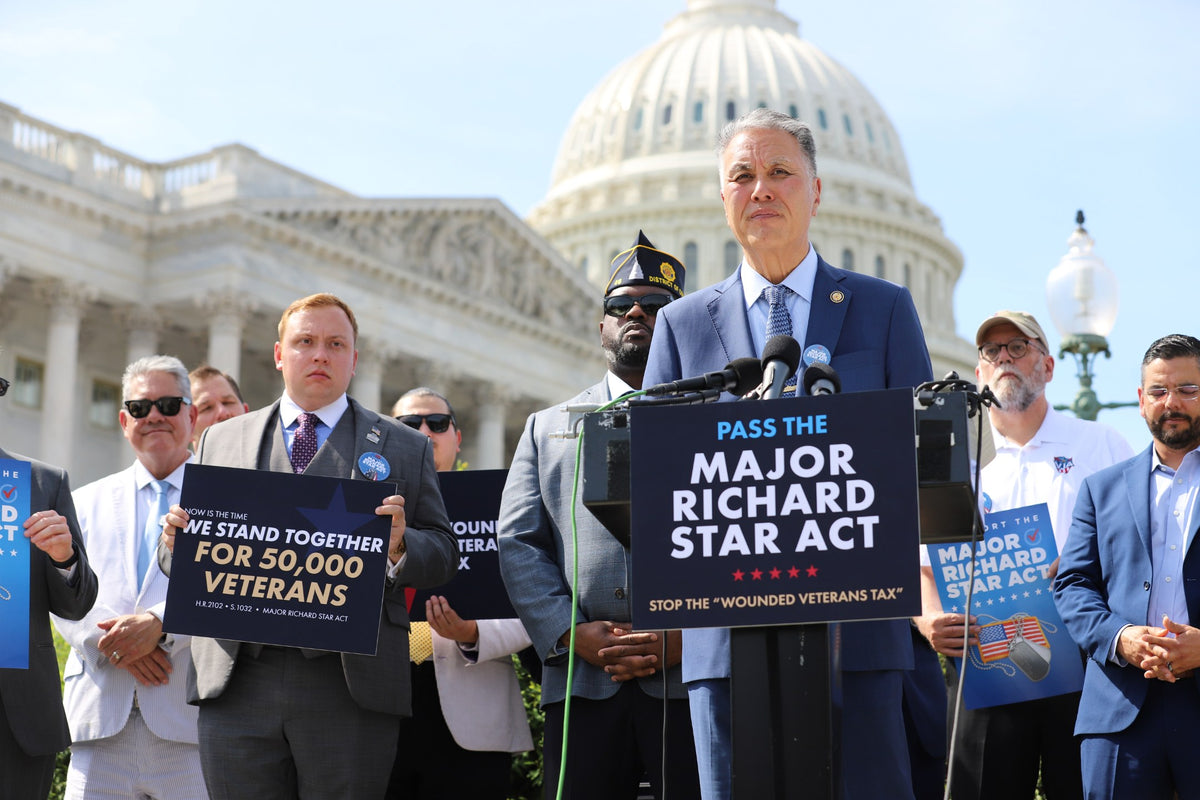
PHOTO CAPTION: Lawmakers and veterans advocates gather outside the U.S. Capitol on June 4, 2026, to push for passage of the Major Richard Star Act, which would change the retirement-pay offset affecting combat-injured veterans. Photo via the House Committee on Veterans’ Affairs.
Thousands of medically retired veterans can have their military retirement pay reduced because they also receive disability compensation from the Department of Veterans Affairs.
A congressional effort to change that system is now sitting one signature short of an important procedural threshold in the House.
As of Monday, Sept. 14, Discharge Petition No. 22 had 217 signatures. It needs 218.
The petition seeks to clear a path for the House to consider H.R. 2102, the Major Richard Star Act, as a standalone bill. The Veterans of Foreign Wars issued an action alert over the weekend after the petition reached 217 signatures and reiterated Monday that it remained one signature short.
The underlying issue affects service members who leave the military because of disabling injuries or illnesses rather than completing a traditional retirement career.
Under current law, certain military disability retirees receiving VA disability compensation cannot simply collect the full amount of both benefits.
Their military retired pay can be reduced by the amount of VA disability compensation they receive.
Combat-Related Special Compensation can restore some of that money for qualifying veterans with combat-related disabilities, but the amount restored is limited under existing law.
That creates outcomes that can be particularly severe for troops whose careers are cut short by combat injuries.
The Congressional Budget Office gives an example of a service member medically retired after only five years with a 100% disability rating.
That retiree could qualify for gross disability retired pay equal to 75% of salary. But under current limits governing Combat-Related Special Compensation, the amount of retirement pay ultimately restored can be tied to the much smaller amount earned based on years of service.
For a five-year veteran under the example CBO used, that years-of-service calculation could amount to only 10% of salary.
CBO said nearly 59,000 Chapter 61 retirees were receiving Combat-Related Special Compensation as of September 2025.
For that group, the average disability offset was approximately $2,300 per month, while the average CRSC payment restoring part of that offset was about $850 per month.
CBO estimates that under H.R. 2102, average total compensation for those retirees would rise by roughly $1,450 per month compared with current law.
Those figures are averages and individual veterans' situations vary.
The Major Richard Star Act would eliminate the disability offset for qualifying Chapter 61 retirees with combat-related disabilities, allowing them to receive their full military retired pay along with VA disability compensation.
The legislation is named for Army Reserve Maj. Richard Star.
Star began his military career in 1988, served as an enlisted soldier and platoon sergeant before becoming an Army engineer officer, and deployed in support of Desert Storm as well as later operations in Afghanistan and Iraq. His awards included the Bronze Star Medal and Air Assault Badge.
Years later, Star developed stage-four lung cancer linked to burn-pit exposure.
According to the House Committee on Veterans' Affairs, the illness forced him to retire with 19½ years of active-duty time, despite 32 years of total military service and nine deployments to combat zones.
Because he fell short of the 20-year threshold, Star was affected by the same retirement-pay offset he later spent his final years trying to change.
He died in 2021.
The issue has attracted broad bipartisan support and backing from major veterans organizations, but attempts to enact the change have repeatedly stalled.
This year's effort now centers partly on Discharge Petition No. 22.
The official House Clerk lists the petition as seeking to discharge a resolution that would provide for consideration of H.R. 2102.
Reaching 218 signatures would not automatically make the Major Richard Star Act law.
It would satisfy the signature threshold necessary for the discharge process to move forward and potentially bring the measure toward House consideration.
That distinction matters.
But for combat-injured veterans who have spent years pushing Congress to end the offset, advocates now find themselves remarkably close to a procedural breakthrough:
217 members have signed. They need 218.
(Source: OAF Nation)