Georgia Guard Expands Aerial Drug Searches
PHOTO CAPTION: Georgia Army National Guard UH-72 crews assisted civilian law enforcement with aerial marijuana-eradication operations in Georgia during summer 2026. U.S. Army National Guard photo by Maj. Amanda Russell.
Georgia National Guard helicopters spent part of this summer flying with civilian law-enforcement officers across the state looking for illegally grown marijuana — including searches over private property that officials say helped police establish probable cause for search warrants.
The missions are part of the Georgia National Guard Counter Drug Program, a longstanding partnership that uses military aviation and other Guard resources to support civilian law-enforcement agencies.
But officials say the approach expanded this summer.
Instead of restricting flights primarily to locations already identified by local law enforcement, civilian officers aboard Guard helicopters searched broader areas across all 159 Georgia counties, according to reporting by Task & Purpose.
Depending on the mission and aircraft availability, the Georgia Guard used UH-72 Lakotas or UH-60 Black Hawks with military aircrews. A civilian law-enforcement officer rode aboard and searched from the air for suspected outdoor marijuana grows.
When a grow was spotted and verified, the officer's observation could be used by law enforcement to establish probable cause and seek a search warrant.
The Georgia National Guard describes that support as assisting with "probable cause generation."
One operation in Dalton shows exactly how the process worked.
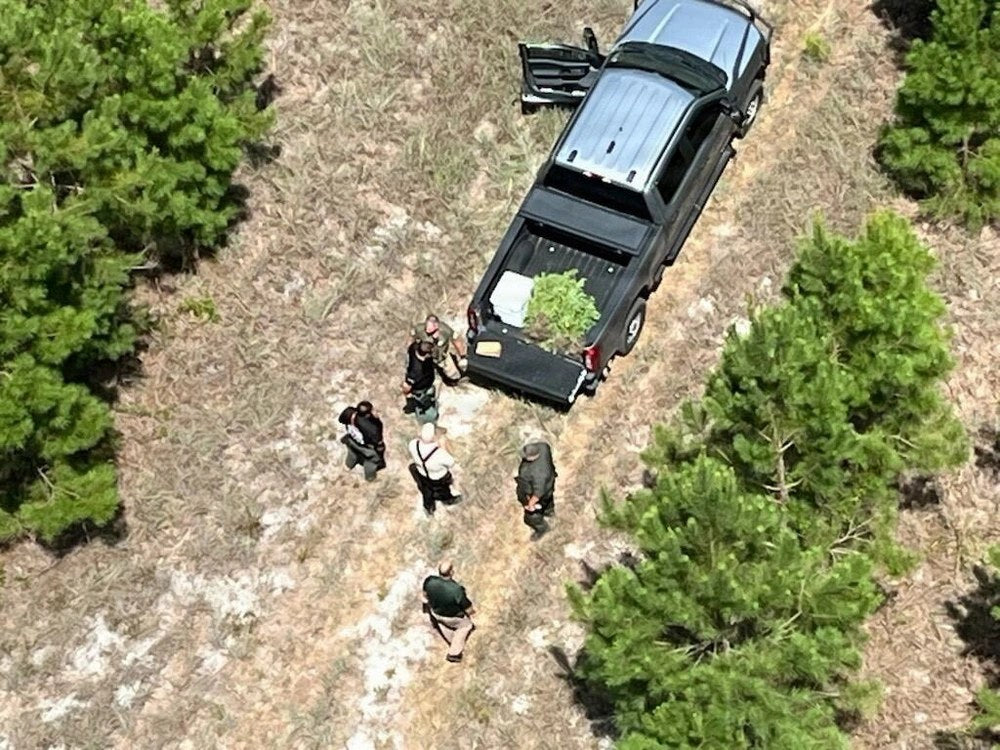
According to the Guard, a UH-72 crew and the civilian officer aboard the aircraft spotted marijuana growing behind a private residence. That observation directly enabled law enforcement to obtain a search warrant signed by a local judge.
Authorities ultimately seized 17 marijuana plants from the property along with two pounds of processed marijuana inside the residence.
The Guard estimated the plants at approximately $34,000 and the processed marijuana at another $9,000.
Across Georgia, the summer operations contributed to the seizure of 343 marijuana plants. The overwhelming majority — 326 plants — came from a separate operation in Polk County, where the Guard estimated their value at roughly $650,000.
The military's role has an important limitation.
Georgia National Guard personnel provide the aircraft, aviation capability and other support, while civilian law-enforcement officers perform the observations used in the warrant process.
The Guard revised its own Sept. 9 announcement the following day to clarify that distinction, describing the Counter Drug Program as supplementing law enforcement and specifying that a local or state officer can be aboard the aircraft to assist in gathering evidence needed for a search warrant.
The missions are conducted under federal National Guard counterdrug authorities.
Federal law allows National Guard personnel serving under Title 32 to perform drug-interdiction and counterdrug missions under a state plan submitted by the governor and approved by the Department of Defense.
A 2025 Government Accountability Office review found that reconnaissance and observation are among the counterdrug activities authorized under current National Guard guidance.
That means the existence of National Guard aerial drug-surveillance missions is not new.
Georgia Guard helicopters have participated in marijuana-eradication operations for decades.
What changed this summer, according to officials interviewed by Task & Purpose, was the method: aircraft searched general areas throughout the state rather than being limited to specific properties that sheriffs had already identified.
The Guard says the aerial approach saves civilian agencies time and resources because ground teams can be sent to precise locations after suspected marijuana is identified from the air rather than searching large areas on the ground.
Capt. Jimmy Williams, deputy director of the Georgia National Guard Counterdrug Task Force, called the Guard an "indispensable partner" in this year's eradication efforts.
For the public, however, the operation presents an unusual intersection of military resources, civilian policing and private property:
A National Guard helicopter overhead, a civilian police officer looking down, and what that officer sees potentially becoming the first step toward a judge signing a search warrant.
(Source: OAF Nation)