U.S. Plans Troop Presence in Venezuela
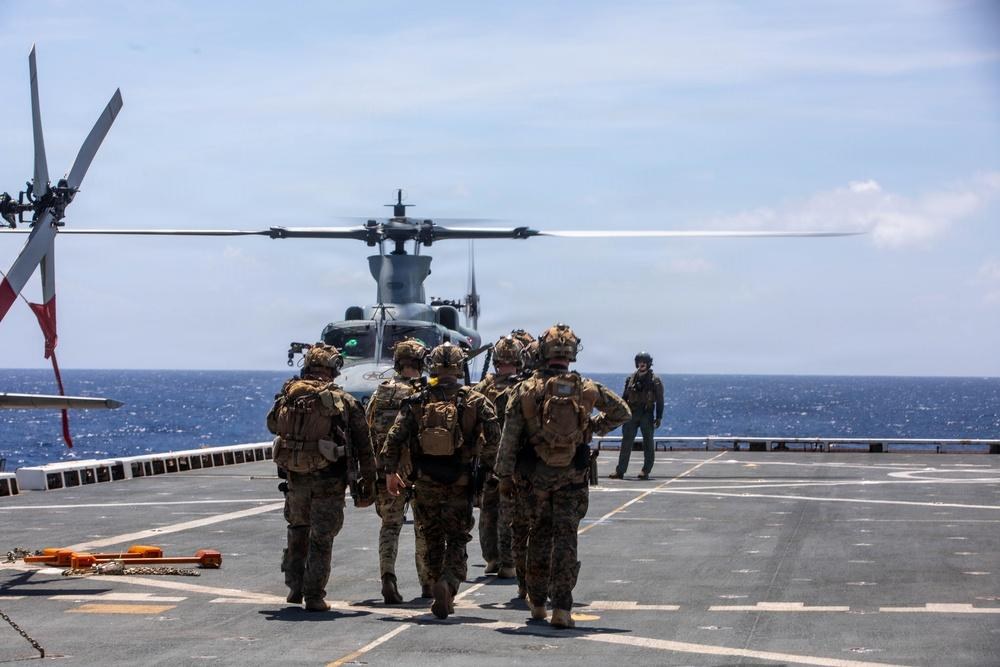
PHOTO CAPTION: U.S. Marines move toward a UH-1Y Venom helicopter during maritime interdiction training aboard USS Fort Lauderdale in the Caribbean Sea on May 22, 2026. The Trump administration is negotiating an agreement that could allow a longer-term American military presence in Venezuela as U.S. security cooperation in the region expands. (U.S. Marine Corps photo by Cpl. Daniel Garcia. File photo.)
The United States is negotiating an agreement that could eventually allow American troops to maintain a long-term military presence in Venezuela, as new reporting reveals U.S. involvement in a deadly drone operation targeting guerrilla fighters inside the South American country.
The developments mark a significant expansion of military cooperation between Washington and Caracas, less than a year after American forces captured Venezuelan leader Nicolás Maduro in a January military operation.
According to The New York Times, the Trump administration is pursuing a formal military agreement with Venezuela's new government that could establish the legal framework for American forces to conduct training, exercises and other operations on Venezuelan territory.
Separately, U.S. intelligence and drone capabilities reportedly supported an October 30 operation against a suspected installation belonging to Colombia's National Liberation Army, or ELN, in Venezuela's Apure state.
A Venezuelan human rights organization reported approximately 23 deaths, although the full casualty count and the precise American role in the attack have not been independently established.
Together, the developments raise a major question about the future of American military operations in South America: How far does the administration intend to expand its presence in Venezuela?
U.S. Negotiating Agreement That Could Allow Troops to Stay
The New York Times reported November 3 that the State Department, led by Secretary of State Marco Rubio, is negotiating a status-of-forces agreement with Venezuela.
Commonly known as a SOFA, such an agreement establishes the legal framework governing military personnel operating in another country.
Depending on its terms, it can address issues including the legal status of service members, jurisdiction over offenses, access to facilities and arrangements for military cooperation.
The proposed agreement could permit mutually approved activities such as ship visits, military training, exercises and humanitarian assistance.
It could also establish the groundwork for a more sustained American military presence.
However, negotiations are not the same as an approved deployment.
The reported agreement has not been finalized, and decisions about potential troop numbers, locations and missions would require additional arrangements.
A senior State Department official told The New York Times that any serious discussions about establishing American military bases in Venezuela remain far in the future.
The official said no negotiations over permanent bases were currently underway.
That distinction is important because a status-of-forces agreement does not automatically establish a military installation or authorize a particular number of troops.
Deadly Drone Operation Reported Near Colombian Border
The talks come amid reports of an October 30 military operation against suspected ELN guerrillas in Venezuela's Apure state, near the Colombian border.
The New York Times reported, citing American officials, that U.S. intelligence and drone capabilities were involved in the operation.
EL PAÍS subsequently reported that the strike targeted an ELN installation allegedly used in connection with cocaine trafficking.
The Venezuelan human rights organization Fundaredes reported 23 people killed and an undetermined number wounded.
Local investigative journalists reportedly identified eight of those killed using information gathered from hospitals, a morgue and a cemetery.
The reported deaths have not been confirmed through a complete, independently verified casualty assessment.
Public reporting also differs in its description of who carried out the strike.
Some accounts describe Venezuelan forces conducting the operation with U.S. intelligence and drone assistance. Other reporting describes American drones striking the installation in cooperation with Venezuelan authorities.
The distinction matters because providing intelligence or drone support is not necessarily the same as American personnel directly carrying out a lethal strike.
The publicly available accounts do not fully establish which personnel controlled the aircraft, selected the targets or authorized the weapons release.
Venezuelan authorities have not provided a complete public account of the attack.
Who Is the ELN?
The National Liberation Army is a Colombian guerrilla organization with a history stretching back more than six decades.
The group has operated in parts of Colombia and Venezuela, particularly near the countries' shared border.
It has been accused of involvement in drug trafficking, extortion, illegal mining and attacks on security forces.
The ELN has also used Venezuelan territory as a sanctuary, according to researchers and regional reporting.
For years, relations between the Maduro government and armed groups operating near the border generated accusations that Venezuelan authorities were tolerating or cooperating with guerrilla organizations.
Maduro's government denied sheltering such groups.
The latest operation suggests a major shift in Venezuela's security relationship with Washington.
Instead of confronting American military pressure, the new Venezuelan government is reportedly cooperating with U.S. operations against armed groups operating inside its territory.
Military Relationship Changed After Maduro's Capture
Relations between the two governments changed dramatically following the January 3 American military operation that captured Maduro and his wife, Cilia Flores.
Maduro was transferred to the United States to face federal criminal charges.
His former vice president, Delcy Rodríguez, subsequently assumed leadership of the Venezuelan government and established a working relationship with the Trump administration.
Rubio has been involved in discussions covering security cooperation, political reform, economic arrangements and potential future elections.
American military activity in the region has also expanded.
U.S. forces have conducted operations in the Caribbean and worked with governments in Colombia, Ecuador and other Latin American countries.
The New York Times reported that American forces participated in a June operation in Venezuela targeting Héctor Guerrero Flores, a leader associated with the Tren de Aragua criminal organization.
The October 30 operation, if confirmed as reported, would further demonstrate the expanding scope of American involvement.
But the administration has not publicly announced a comprehensive plan for permanently stationing combat forces in Venezuela.
What Would a Longer-Term U.S. Presence Mean?
A sustained military presence could take several different forms.
American service members might participate in training missions, provide technical assistance, support intelligence operations or conduct joint exercises with Venezuelan forces.
More extensive arrangements could potentially involve aircraft, naval access, logistics facilities or rotational deployments.
None of those specific arrangements has been publicly approved under the reported negotiations.
The United States already maintains a military presence and partnerships throughout the wider Caribbean and Latin American region.
Venezuela's location could make it strategically important for regional security operations.
The country has a long Caribbean coastline and shares borders with Colombia, Brazil and Guyana.
Those geographic features could be useful for maritime operations, counter-narcotics missions and cooperation with neighboring governments.
But establishing a sustained American military presence would also create practical challenges.
Military planners would need to address infrastructure, force protection, medical support, supply routes, legal arrangements and the reliability of their Venezuelan partners.
Potential Risks for American Troops
Any future deployment would depend on the mission assigned and the security environment.
Parts of Venezuela continue to face threats from armed criminal networks, guerrilla organizations and groups involved in illicit trafficking.
Operations against those organizations could expose American personnel to risks different from those encountered during conventional training missions.
A larger presence could also encounter political opposition.
The January operation that removed Maduro remains controversial, and some Venezuelans have expressed concerns about American influence over their country's government and natural resources.
A foreign military presence could become a source of domestic political tension, particularly if negotiations proceed without broad public support.
Those concerns do not establish that a future deployment would be unsafe or unsuccessful.
They do show why the scope, duration and purpose of any American mission would matter.
No Permanent Bases Have Been Approved
For now, the most important distinction is between what is already being reported and what remains a possibility.
U.S. and Venezuelan officials are discussing a military agreement that could support future cooperation.
American intelligence and drone involvement has been reported in a deadly operation against suspected guerrillas.
And the two governments have developed closer security ties since Maduro's removal.
But no permanent American bases have been approved, no large-scale deployment has been announced, and the proposed status-of-forces agreement has not been finalized.
The administration also has not publicly provided a detailed long-term military strategy for Venezuela.
For American troops and their families, the next questions concern whether these negotiations lead to new assignments, what missions those forces would perform and how long the United States intends to remain involved.
The developing relationship between Washington and Caracas is no longer simply a diplomatic issue.
It is becoming a question about the future reach of American military operations in South America.
(Source: OAF Nation)