Pentagon Admits Drone Warfare Unpreparedness
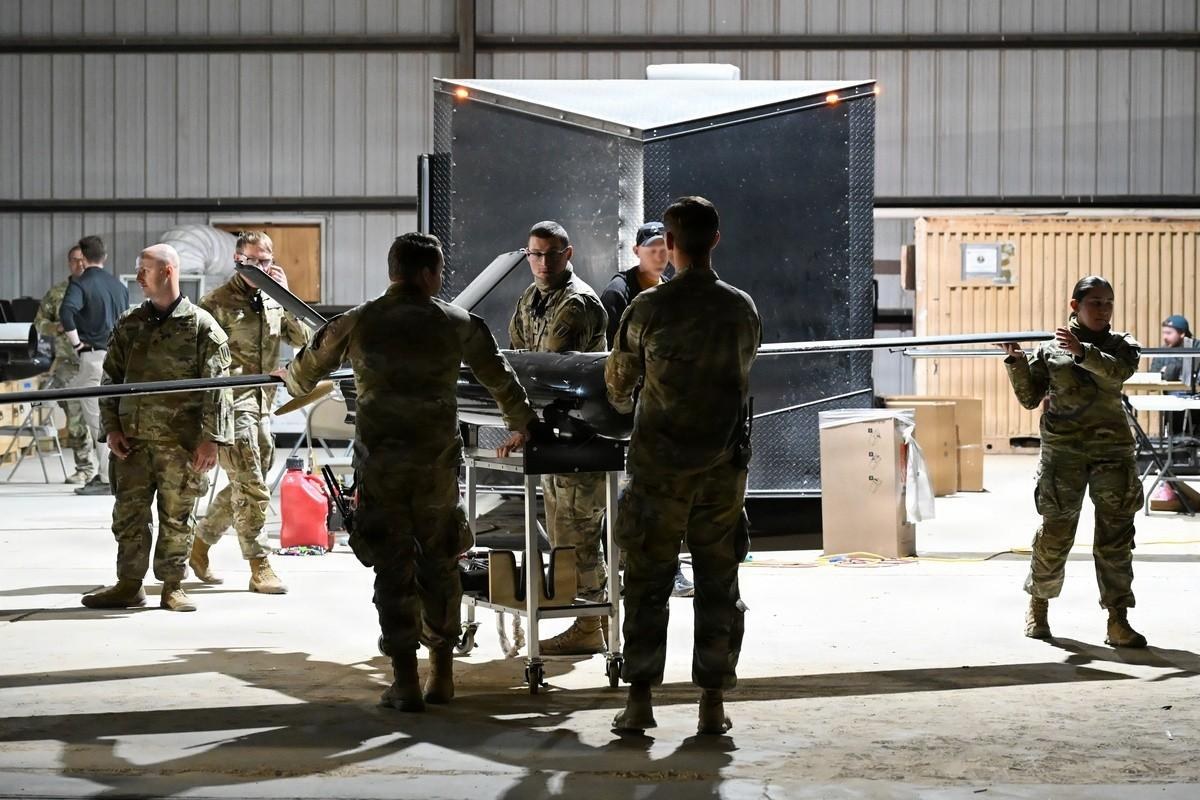
PHOTO CAPTION: U.S. Army soldiers prepare unmanned aerial systems during Exercise Arcane Thunder 26 in April 2026. The exercise highlighted the military's growing focus on drone warfare as Pentagon officials acknowledge the need to adapt more quickly to emerging battlefield threats. (U.S. Army file photo.)
A senior Pentagon official has acknowledged that the U.S. military and its defense contractors failed to anticipate the transformation of modern warfare by inexpensive, mass-produced drones, leaving American forces unprepared for the kind of fighting now dominating the battlefield in Ukraine.
Emil Michael, the Pentagon's under secretary for research and engineering and chief technology officer, made the admission Wednesday during a Wall Street Journal technology conference in Napa, California.
"We weren't prepared because we just didn't imagine it," Michael said.
His remarks offered a rare acknowledgment from a serving Pentagon leader that American defense planning had failed to anticipate an increasingly important form of warfare.
The admission comes as the military races to expand its drone inventory, accelerate procurement and prepare American troops for conflicts in which inexpensive unmanned aircraft can threaten equipment and personnel worth millions of dollars.
Pentagon Official Says Military Leaders Failed to Anticipate Drone Warfare
During the November 4 discussion, Michael was asked why American defense officials appeared to have been caught off guard by Ukraine's rapid adoption of inexpensive drones.
The interviewer questioned whether Ukraine developed those capabilities out of necessity or whether traditional American defense contractors had failed to anticipate the demand for cheaper weapons.
Michael acknowledged that both the Pentagon and the defense industry had been focused elsewhere.
He said American planners had not anticipated how effectively a smaller country could develop, manufacture and repeatedly improve inexpensive drones to defend itself against a larger military.
Ukrainian forces adapted commercially available technology, modified software and developed new approaches to using drones on the battlefield.
Those innovations moved quickly, often through repeated testing and modification under combat conditions.
Michael credited Ukraine for finding solutions that the United States had not been prepared to provide.
"We helped the Ukrainians a ton, but they invented what they actually needed because we didn't have it," he said.
The statement raises an important question for American military readiness: How did a country with the world's largest defense budget fail to anticipate the battlefield importance of comparatively inexpensive unmanned systems?
Ukraine Is Building Drones on a Scale the U.S. Has Not Matched
Michael provided several figures illustrating how quickly the United States is attempting to respond.
He said the U.S. manufactured approximately 1,000 drones under the previous administration.
He also estimated that the current American drone stockpile has grown to roughly 500,000 aircraft.
Meanwhile, Ukraine expects to manufacture approximately 8 million to 10 million drones during 2026, according to estimates cited in the Wall Street Journal's reporting.
Those numbers are striking, but they require an important distinction.
The approximately 500,000 American drones represent a reported inventory, while Ukraine's 8 million to 10 million figure is an estimate of annual production.
They are not equivalent measurements and cannot be used to calculate a direct production gap.
The publicly reported figures also do not provide a consistent breakdown of drone categories, capabilities or operational readiness.
What they do illustrate is how battlefield demand has pushed Ukraine toward manufacturing unmanned systems in enormous quantities.
For American planners, the challenge is no longer simply developing sophisticated aircraft. It is determining whether the United States can produce affordable systems quickly enough to replace those lost during combat.
Cheap Drones Have Changed the Cost of Warfare
The war in Ukraine has demonstrated how relatively inexpensive drones can threaten tanks, artillery systems, vehicles, supply routes and personnel.
Small first-person-view drones, often called FPV drones, can be equipped with explosive payloads and guided toward targets by operators.
Other unmanned aircraft conduct reconnaissance, identify targets, deliver supplies or support artillery operations.
Because many of these systems can be produced at a fraction of the cost of traditional military equipment, they have changed the economics of battlefield operations.
An expensive vehicle can be threatened by a weapon costing only a small fraction of its value.
Defending against large numbers of drones also creates its own challenges.
Traditional air-defense systems may be capable of destroying individual unmanned aircraft, but using expensive interceptors against large numbers of cheap drones can impose substantial costs.
Electronic warfare, drone detection, short-range defenses and rapid adaptation have therefore become increasingly important.
These developments do not make fighter jets, long-range missiles or other traditional weapons obsolete.
They do mean military forces must prepare to operate in an environment where small drones are common, persistent and potentially lethal.
Pentagon Is Racing to Change How It Buys Weapons
The Pentagon has already launched initiatives intended to address the problem Michael described.
In July 2025, Defense Secretary Pete Hegseth announced a policy intended to accelerate the development, acquisition and fielding of American-made military drones.
The department directed military organizations to reduce administrative barriers and place greater emphasis on affordable systems that can be delivered quickly.
In February 2026, the Pentagon announced that 25 vendors had been selected to compete in the first phase of its Drone Dominance Program.
The effort focuses on inexpensive, one-way attack drones that can be acquired and fielded in large numbers.
In July 2026, the department also announced a reorganization intended to consolidate oversight of unmanned and autonomous systems under a senior official reporting directly to the deputy defense secretary.
The stated goal is to accelerate procurement and move promising technologies from testing into military units.
But adopting new procurement policies does not automatically mean combat formations have the drones, training, electronic protection and replacement supplies they need.
The real measure will be whether the initiatives produce usable capabilities in the hands of troops.
Why This Matters for American Troops
For U.S. service members, the implications extend well beyond acquiring new equipment.
Drone warfare changes how troops move, conceal themselves, operate vehicles and protect their positions.
Units that once concentrated primarily on conventional threats must also account for small unmanned aircraft capable of spotting or attacking targets.
Training must address both operating friendly drones and defending against enemy systems.
That means developing counter-drone tactics, communications procedures, electronic warfare capabilities and realistic exercises.
Maintenance and logistics are equally important.
A military force that relies on large numbers of inexpensive drones must be able to replace destroyed aircraft, obtain batteries and components, and update software as enemy defenses change.
Those requirements place pressure on the American defense procurement system, which has traditionally emphasized lengthy development and acquisition programs for sophisticated weapons.
Michael's acknowledgment suggests senior Pentagon leaders recognize that the military needs to adapt more quickly.
Pentagon Is Trying to Anticipate the Next Battlefield
Michael also discussed Project Meridian, a Pentagon effort intended to examine what future conflicts might look like.
Rather than focusing only on technologies already in use, the initiative is examining potential changes in warfare, including operations underground and in space.
Michael connected that work to lessons from Ukraine and to the continuing conflict involving Iran.
The objective, he said, is to prevent the Pentagon from overlooking the next major transformation in warfare.
That is a significant challenge for an institution responsible for preparing for multiple potential conflicts across the world.
The military must continue developing sophisticated aircraft, ships, missiles and space systems while also preparing for threats that can be built cheaply and adapted rapidly.
It cannot assume that the weapons dominating previous conflicts will remain sufficient for the next one.
A Readiness Failure the Pentagon Now Has to Fix
Michael's comments do not establish that the U.S. military lacks effective drones or that American forces would be incapable of fighting an enemy equipped with large numbers of unmanned aircraft.
They do establish something narrower, but still significant.
One of the Pentagon's most senior technology officials believes the department and its contractors failed to anticipate an important change in modern warfare.
The U.S. is now trying to make up for that failure through expanded drone inventories, new procurement programs and changes in how military technology reaches combat units.
For service members who could face these weapons in future conflicts, the stakes are practical rather than theoretical.
The question is no longer whether inexpensive drones have transformed warfare.
It is whether the American military can adapt quickly enough to ensure its troops are prepared for the battlefield they will actually encounter.
(Source: OAF Nation)