U.S. Bases Faced Bomb Supply Issues
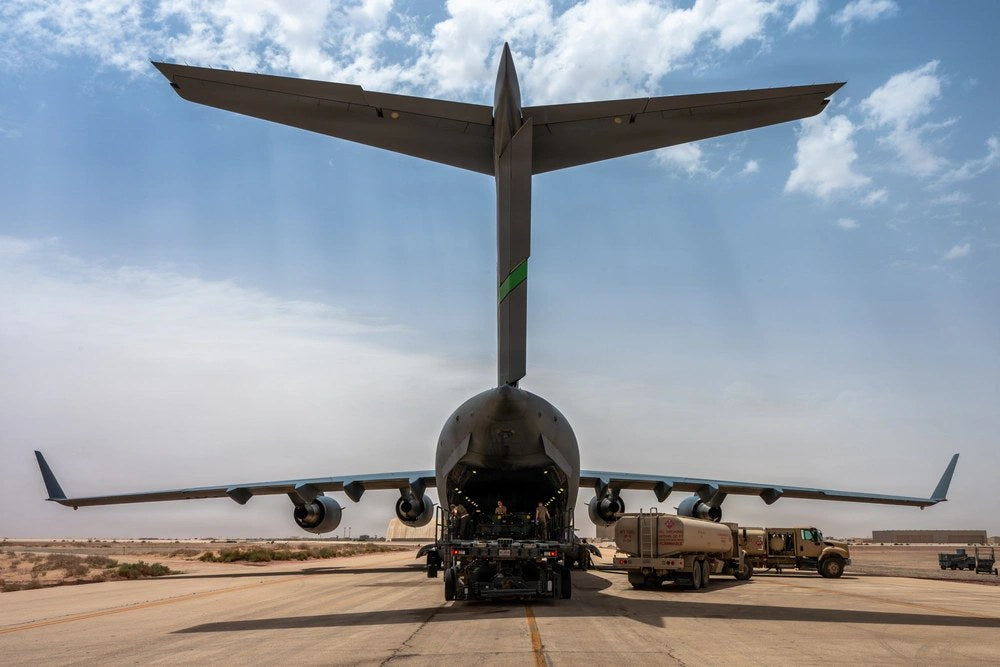
PHOTO CAPTION: U.S. Air Force Airmen load cargo aboard a C-17 Globemaster III at a Middle East base during Operation Epic Fury, April 18, 2026. The former commander of Air Forces Central says shortcomings in the munitions logistics system early in the war forced him to meter weapons use over time. (U.S. Air Force photo by Senior Airman Travis Knauss)
The U.S. Air Force had bases stocked with bomb bodies during the opening stages of the war with Iran.
Some of them still couldn't be used.
The reason, according to the general who commanded American air operations in the region, was considerably less dramatic than enemy action or a shortage of aircraft:
The other pieces hadn't arrived yet.
Lt. Gen. Derek France, who commanded U.S. Air Forces Central during Operation Epic Fury, says shortcomings in the military's munitions logistics system became serious enough during the early days of the war that he had to manage how quickly American forces consumed weapons.
France completed his tour as AFCENT commander and Combined Forces Air Component Commander on Aug. 4. In an interview published Sunday by Air & Space Forces Magazine, he offered a new look at problems encountered while directing the largest American air campaign in decades.
One of the biggest involved getting the right parts of a weapon to the right place at the same time.
France said the munitions supply system was insufficient early in the conflict, forcing him to “meter the use of weapons over time.”
“Our logistics system needs some serious revamping as far as its flexibility,” France told the magazine.
Then he gave a remarkably simple example.
Bases could report that they possessed bomb bodies but couldn't employ them because the required tail kits had not arrived yet.
That distinction matters.
A bomb body by itself is not necessarily a complete, ready-to-use precision weapon. Depending on the weapon being assembled, Air Force munitions personnel combine the bomb body with components that can include a guidance section, fuze and tail kit.
An Air Force explanation of the bomb-building process previously described those components as working together to determine the weapon's configuration and purpose.
In other words, having thousands of pounds of explosives sitting at a base does little good if the components needed to turn them into the weapon required for a mission are somewhere else in the logistics pipeline.
And Operation Epic Fury created an enormous demand on that pipeline.
U.S. Central Command launched the operation Feb. 28 with strikes against Iranian command-and-control sites, air defenses, missile and drone launch locations and military airfields. CENTCOM described the deployment as the largest concentration of American military firepower in the region in a generation.
France said U.S. forces ultimately struck more than 13,000 targets between the opening of the operation and an initial ceasefire in April.
That scale was radically different from the smaller counterterrorism campaigns the U.S. military had become accustomed to fighting over the previous two decades.
France compared the difference to switching from a sniper rifle to a belt-fed machine gun.
Instead of patiently tracking a relatively small number of high-value targets, American forces had to service huge numbers of targets involving Iranian ballistic missiles, coastal defenses, radars and defense-industrial infrastructure.
Moving the matériel required to sustain that pace was itself a massive operation.
For example, Air National Guard transportation personnel in Maine reported moving more than 747,000 pounds of cargo and hundreds of individual cargo pieces in support of Epic Fury by early June. Those shipments included explosives, aircraft parts and urgently needed mission-impaired-capability parts.
The problem France described wasn't that American forces suddenly had no weapons left.
It was more frustrating than that.
The logistics network sometimes failed to get all the components of a usable weapon to the same base at the same time.
That forced commanders to think about not just how many weapons existed, but where each component was located and how quickly another shipment could arrive.
France's disclosure comes amid a larger Pentagon debate over whether the U.S. military's logistics and industrial systems are prepared for prolonged combat against a major adversary.
The Iran campaign provided a real-world stress test.
France also identified other shortcomings exposed by the fighting, including gaps in warning against long-range threats and the need for protected underground command-and-control facilities at vulnerable bases. At the same time, he praised Airmen for keeping bases operating despite repeated Iranian missile and drone attacks.
But the munitions example may be the easiest problem for anyone who has spent time in the military to recognize.
The weapon existed.
The people were there.
The mission was waiting.
And somewhere in the system was the part needed to put everything together.
It just wasn't there yet.
(Source: OAF Nation)