Soldier's Father Detained Amid Parole Wait
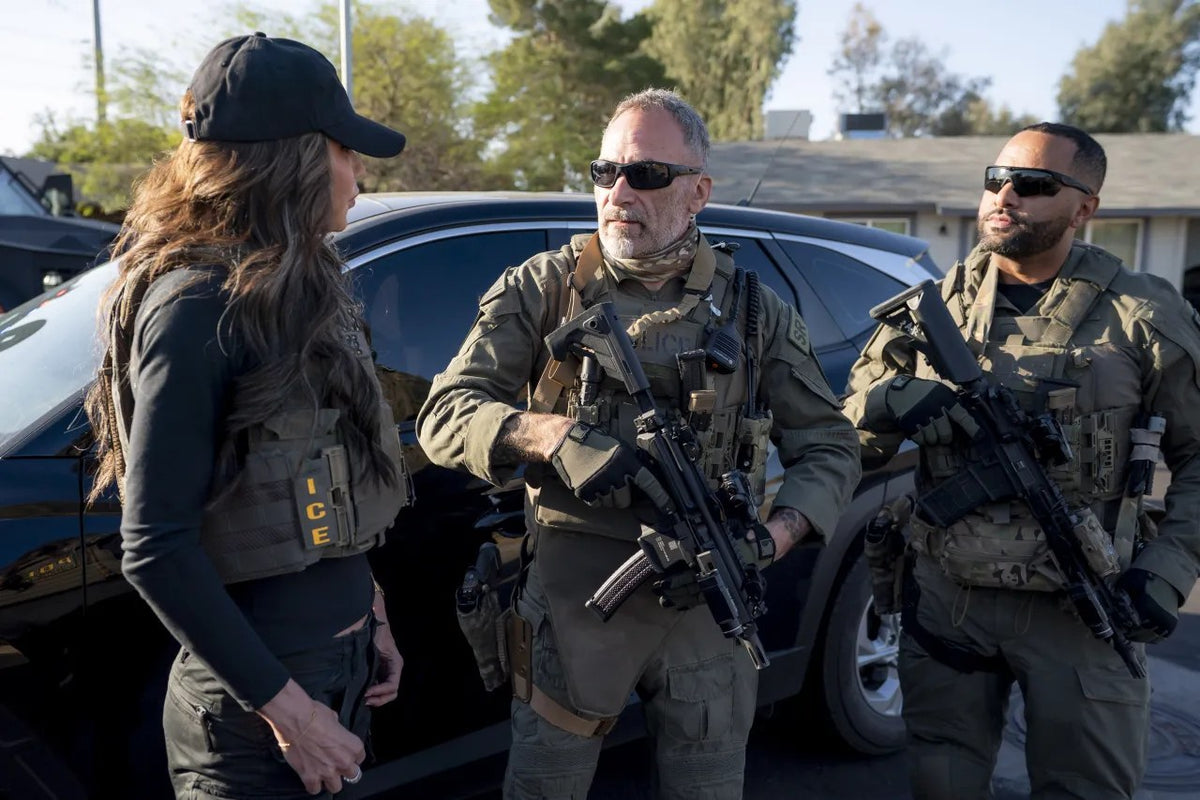
PHOTO CAPTION: U.S. Immigration and Customs Enforcement personnel during a Department of Homeland Security visit in Phoenix, Arizona. The image is illustrative and does not depict the May 16 detention of Aniceto Hernandez-Reyna. (DHS photo by Tia Dufour/Released)
Army Spc. Jasmine Hernandez says she joined the Army partly because she wanted to give something back to the country where her parents had built a life.
She also believed her military service might provide a way to help protect her undocumented father from deportation.
Shortly after enlisting in 2024, Hernandez submitted an application for her father, Aniceto Hernandez-Reyna, through Military Parole in Place, a longstanding immigration program that gives certain parents, spouses, sons and daughters of U.S. service members and veterans special consideration for temporary parole.
More than a year later, the application was still pending.
Then ICE arrested him.
On May 16, Immigration and Customs Enforcement officers detained Hernandez-Reyna at a gas station outside Phoenix while two of Hernandez’s younger brothers were with him.
Hernandez was roughly 2,000 miles away at Fort Stewart, Georgia.
Her father’s Military Parole in Place request had not been approved.
It had not been denied either.
It was still waiting for a decision.
That distinction is now at the center of a case highlighted Monday in a new ABC News investigation into immigration enforcement involving military families.
Military Parole in Place is not automatic legal status.
USCIS policy allows certain parents and other immediate relatives of active-duty troops, reservists and qualifying veterans to receive parole on a case-by-case basis. The fact that someone has a qualifying military relative can weigh heavily in favor of approval, but the ultimate decision remains discretionary.
And filing the paperwork alone does not provide the protection that an approved request would.
The Department of Homeland Security emphasized that point in a statement to ABC.
DHS said Military Parole in Place is not automatic and a pending application does not itself give someone legal status.
That means ICE did not arrest Hernandez-Reyna in violation of an already-approved Military Parole in Place grant.
But for Hernandez, the distinction has done little to ease the impact on her family.
ABC reported that Hernandez-Reyna came to the United States illegally from Guanajuato, Mexico, when he was 17.
A review by ABC found no record of violent criminal convictions. He has had traffic violations, however, including a DUI in 2002.
He remains detained at the Eloy Detention Center in Arizona.
Hernandez told ABC she has spoken with her father only once since his arrest.
She described what happened as a “slap in the face.”
The uncertainty, she said, has also followed her back to work.
Hernandez said she sometimes struggles to focus because she is worrying about her parents and siblings while continuing to serve at Fort Stewart.
That concern is one of the reasons military immigration programs exist in the first place.
An Army legal notice cited by ABC warned earlier this year that uncertainty surrounding a family member’s immigration status can interfere with a service member’s ability to concentrate on mission-essential duties.
Hernandez’s case is also unfolding as the Pentagon increasingly relies on immigrants to fill its ranks.
Defense Department data reviewed by ABC showed the military recruited nearly 11,000 green-card holders last year, up from approximately 6,800 in 2021 — an increase of about 62%.
Nearly 50,000 foreign nationals currently serve in the U.S. military, according to Congressional Research Service figures cited by ABC.
That creates an uncomfortable collision between two parts of the federal government.
The military is actively recruiting people from immigrant communities and provides special immigration options intended to reduce family uncertainty.
At the same time, immigration enforcement does not stop simply because a service member has filed one of those requests.
For Hernandez-Reyna, the difference between applying for military parole and actually receiving it became very real on May 16.
For his daughter, it leaves a much simpler question.
She is wearing an Army uniform while her father sits in federal immigration detention.
And the military-specific application she filed more than a year before his arrest was still waiting for an answer.
(Source: OAF Nation)