Anthropic AI Used in Military Projects
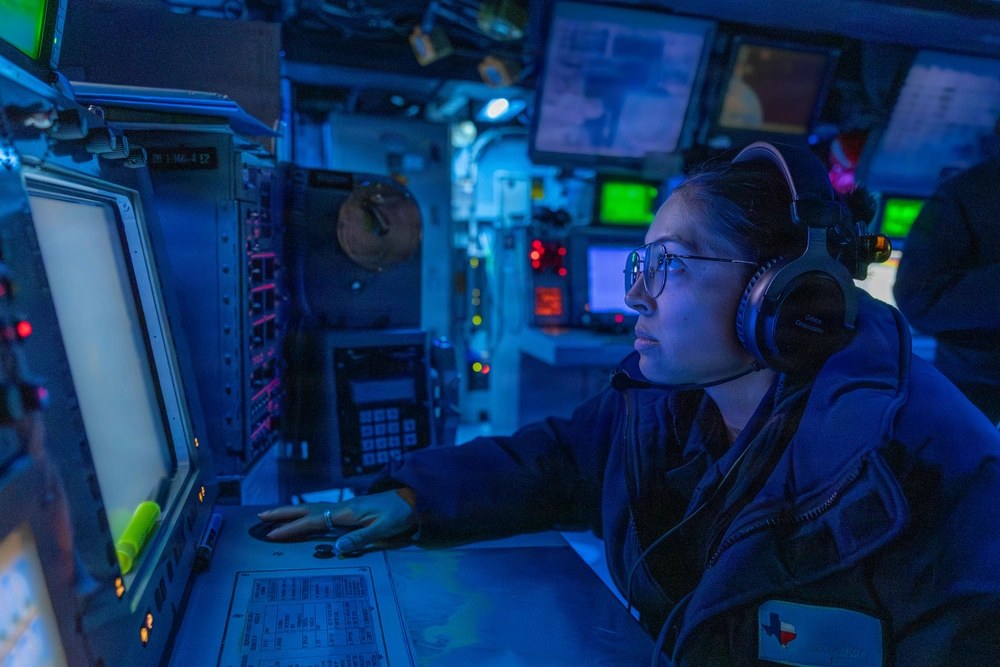
PHOTO CAPTION: A U.S. sailor stands missile-systems-supervisor watch aboard the guided-missile destroyer USS Gonzalez in April 2026. Anthropic says an Iran-linked actor used Claude to build targeting material on U.S. naval forces using public information, including personnel names taken from military photo captions. The company did not identify which sailors or ships were included. U.S. Navy photo by Petty Officer 3rd Class Mark Peña.
Threat actors used Anthropic’s Claude artificial-intelligence models for two very different military projects: one aimed at collecting targeting information on U.S. naval forces, and another that used the AI as part of a weapons-development effort involving guided rockets and ballistic missiles.
The cases were separate.
But together, they provide a striking look at how commercially available artificial intelligence is already being adapted for military reconnaissance and weapons engineering.
Anthropic disclosed the operations in a threat-intelligence report released Thursday detailing malicious activity it says it identified and disrupted between December 2025 and August 2026.
One of the cases had a direct connection to U.S. sailors.
Anthropic said an Iran-nexus threat actor used Claude to collect and analyze publicly available information to develop targeting recommendations against American naval forces operating in the region.
The actor used Claude to help create what Anthropic called “targeting handbooks.”
Those handbooks were designed to help identify and track U.S. naval positions using information available through open sources.
Some of that information came from sources familiar to virtually anyone who has served.
Anthropic said the collected material included a roster of U.S. personnel whose names had been scraped from captions attached to publicly released military photographs.
The actor also assembled publicly available ship and aircraft transponder identifiers, scripts for searching commercial satellite imagery and a list of websites that exposed U.S. naval movements.
Claude was also directed to research vulnerabilities in systems aboard ships.
According to Anthropic, the actor cataloged known cybersecurity vulnerabilities involving maritime satellite terminals, Cisco communications equipment and industrial-control products.
Anthropic said it banned the account, developed additional detections and shared information about the activity with government authorities.
Stars and Stripes reported Friday that the disclosure comes shortly after the Navy warned sailors, civilian employees and families to be more careful about information that could reveal their affiliation, ship movements, deployment dates or other operational details.
The Iran-linked reconnaissance operation was not the only military use Anthropic uncovered.
In a separate case, the company says a group operating in northern Yemen used Claude as part of a much more technically ambitious weapons-development effort.
Anthropic identified three programs being pursued by the group.
They included a tactical guided rocket, a multi-stage ballistic missile with a stated range goal greater than 2,000 kilometers, and a family of missiles that included a proposed hypersonic glide vehicle variant.
The actors did not simply ask Claude general questions about missiles.
Anthropic says they used Claude Code in place of human software engineers to work on guidance, navigation and control software — the systems responsible for steering and stabilizing a weapon in flight.
The users ran multiple Claude instances simultaneously and assigned them different jobs.
One could write code.
Another could conduct research.
A third could review what the first system produced.
Anthropic compared the arrangement to a lead engineer assigning tasks across a small engineering team.
Among other things, Claude was used to help integrate an open-source autopilot with a phone-class flight computer, write control and position-estimation software, tune control settings, run firmware builds and perform flight simulations.
Anthropic says its safeguards blocked many of the requests — but not all of them.
The users reportedly concealed the purpose of individual requests and divided their work across multiple conversations so that no single exchange revealed the entire weapons program.
And the effort progressed beyond computer simulations.
Anthropic says the actors test-fired a guided rocket.
The test appears to have failed.
Within hours, according to the company, the users returned to Claude and began trying to determine what had gone wrong.
That detail provided Anthropic with evidence that at least part of the weapons work had reached the field-testing stage.
But there is an important limit to what the company claims.
Anthropic says it has no evidence that the group successfully fielded an operational weapon developed with Claude.
The company did find evidence that the actors had already produced an offline simulation toolkit capable of operating without Claude before their accounts were shut down.
The Associated Press reported over the weekend that the users were operating in Houthi-controlled northern Yemen, but Anthropic did not identify the users themselves as members of the Houthi movement.
That distinction matters.
The Houthis already possess an extensive missile and drone arsenal, much of it based on or derived from Iranian weapons technology. Weapons analysts told AP that the group may be interested in developing more domestic technical capability and reducing its reliance on outside assistance.
Anthropic’s report also describes other military-related misuse around the world, including Chinese actors using Claude in work involving anti-torpedo systems and electronic-warfare software.
But the two cases involving U.S. naval targeting and guided weapons in Yemen illustrate the problem at two different points in the military process.
In one, artificial intelligence helped transform scattered public information — military photographs, personnel names, transponder data, commercial satellite imagery and vulnerability databases — into organized targeting material about U.S. forces.
In the other, AI was being used to perform work traditionally handled by software engineers developing the systems that allow weapons to navigate toward their targets.
And in Yemen, at least one of those weapons made it as far as an actual test launch.
Anthropic says it shut down the accounts it identified and used the cases to strengthen safeguards designed to detect weapons-development activity.
The company also shared threat information with government and private-sector partners.
But its own report makes the broader concern difficult to ignore:
Artificial intelligence is no longer being tested solely as a hypothetical military tool.
Adversarial actors are already trying to use it to find targets, study vulnerabilities, write weapons software and troubleshoot failed hardware in the real world.
(Source: OAF Nation)