Trump's Troops Rarely Stop Crime
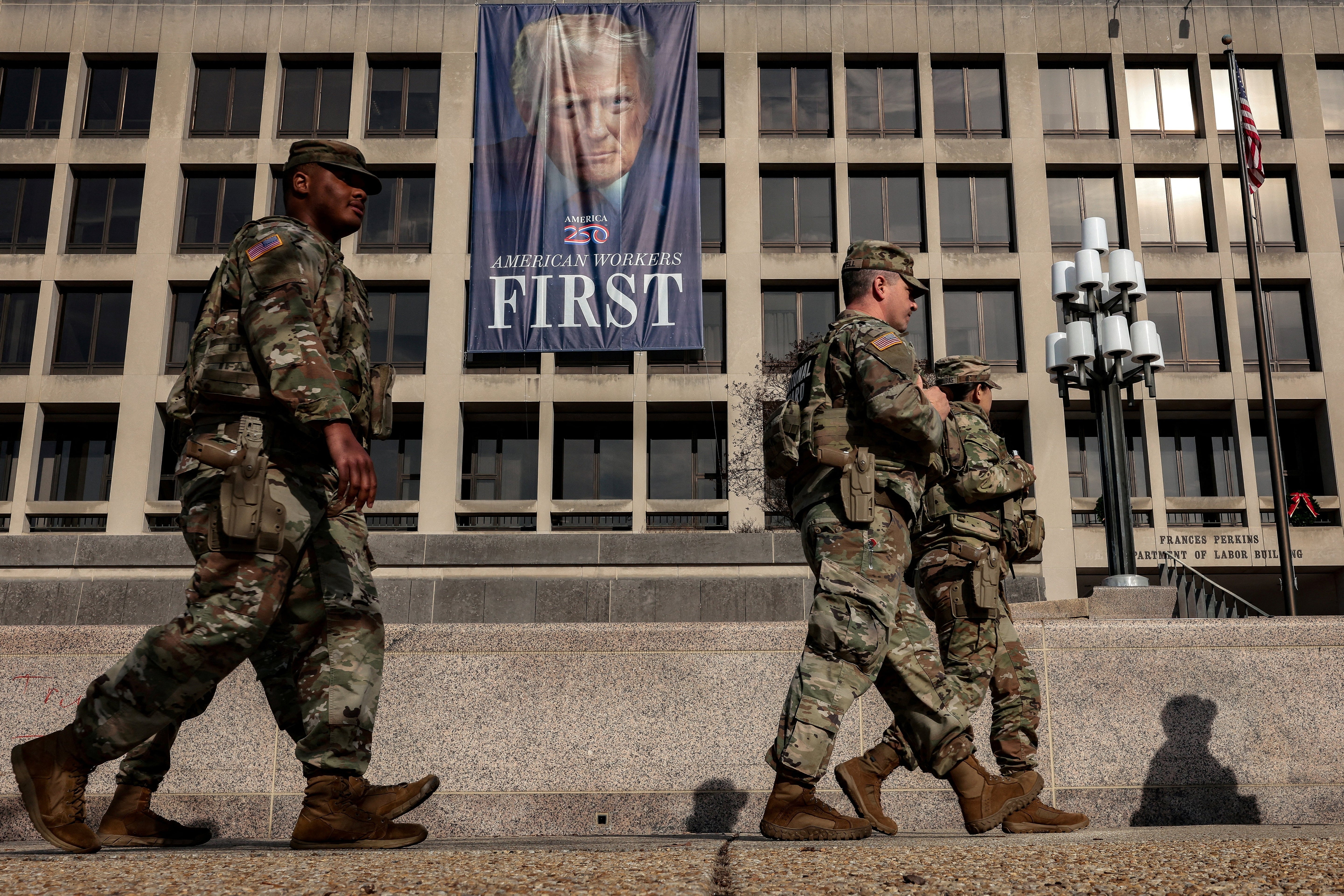
PHOTO CAPTION: Members of the National Guard walk past the U.S. Department of Labor, which published its weekly initial jobless claims report for the week ending January 3, in Washington, D.C., U.S., January 8, 2026. REUTERS/Evelyn Hockstein
WASHINGTON, Aug. 19 — Thousands of National Guard troops deployed to Washington by President Donald Trump have become a highly visible presence across the capital, but a Reuters review of criminal court records found they are rarely involved in stopping crime.
Since arriving last August, National Guard members have been mentioned in only about 1.3% of criminal cases filed in the Superior Court of the District of Columbia, which handles nearly all criminal prosecutions in the city. In dozens of those cases, the soldiers were victims rather than the people making arrests.
One police report from this spring described three officers arriving outside a nightclub where a man was stomping on a young woman lying on the sidewalk. Police arrested the suspect, but officer Xavier Jimenez noted that about 15 National Guard members had been nearby on routine patrol and “did not take any action.”
Trump deployed the Guard to Washington last summer as a centerpiece of his effort to combat crime, particularly in Democratic-run cities. Small groups of troops in camouflage and body armor now regularly patrol tourist-heavy areas including national monuments, subway stations and the neighborhood around the city’s professional baseball stadium.
About 4,500 soldiers are currently deployed in Washington, compared with roughly 3,200 city police officers. The Trump administration told Congress last year that the deployment cost about $1.65 million per day before the number of troops was doubled this summer, while the city’s most recent police budget amounted to about $1.5 million per day.
The administration has told Congress it plans to continue sending troops to Washington through the end of Trump’s presidency in 2029, at a projected cost of $1.4 billion, though it has not said how many soldiers would remain deployed.
Reuters reviewed every publicly available charging document filed in Superior Court and interviewed lawyers, residents, service members and others familiar with the deployment. The review found that soldiers most often responded to minor incidents in areas that were wealthier, whiter and less dangerous than the city as a whole.
Reuters found no reference in court records to soldiers performing law-enforcement work in neighborhoods where about 82% of Washington’s 859 murders over the previous five years occurred.
The White House did not respond to questions about the soldiers’ activities. White House spokeswoman Lauren Bis said Trump’s efforts in Washington had “driven down crime, beautified the city, and improved quality of life for countless individuals.”
D.C. Mayor Muriel Bowser, who has described the deployment as “problematic,” declined to comment, as did the city’s police department. The National Guard task force overseeing the deployment also did not respond to questions about its work or cost.
Most interventions involve minor offenses
Reuters identified 217 Washington criminal cases in which police reports mentioned National Guard involvement. In 62 of them, troops stopped suspects without police initially present, frequently in cases involving shoplifting or fare evasion, while in another 43 they assisted police officers with arrests.
Some incidents were minor. Soldiers chased a man in October after he took two slices of pizza and offered $2 as partial payment, and a week later they stopped a man accused of throwing a rock at a bus. In April, troops detained a man accused of stealing two beef jerky sticks worth about $7 from a pharmacy, while last month six soldiers held a woman who drank a bottle of root beer without paying.
Videos obtained by community groups also showed groups of 20 or more soldiers outside subway stations at night preventing teenagers from entering as part of enforcement of a city curfew.
The Rev. William Young, who lives in the Navy Yard neighborhood where soldiers frequently patrol, said their presence did not make him feel safer.
“It’s a way of keeping fear in all of us,” Young said. “This is not how a capital of democracy should be protected, by having soldiers marching to protect the streets.”
The troops have been deputized as U.S. Marshals but have limited law-enforcement authority. The Defense Department describes their work as “presence patrols” intended primarily to deter crime. They may detain suspects but must call police officers to make formal arrests.
Court records described 35 cases in which soldiers witnessed crimes, sometimes watching until police arrived. Incidents they reported included a drug transaction, public urination, a man exposing himself to a subway police officer and two men writing with chalk on a monument, including one who was dressed in a banana costume.
One case raised questions about whether troops could have done more. Evelyn Jones said her nephew, Keon Jones, was stabbed to death in April near the city’s waterfront after soldiers found him unresponsive following a fight and called emergency services.
The soldiers later told police they initially believed he was intoxicated and did not realize until officers arrived that he had suffered severe stab wounds. Jones died at a hospital about two hours later.
“They could have done more to help him,” his aunt said.
Soldiers have also become crime victims
Reuters found 62 cases in which people were charged with pushing, punching or threatening National Guard members. Nine people were accused of spitting on soldiers.
One man allegedly tried to grab a soldier’s handgun while being detained for stealing baseball caps in a subway station. Another was charged after threatening a group of troops with a bazooka, according to a police report.
Two off-duty soldiers were also arrested by Washington police for alleged violations of the city’s firearms laws, although the U.S. Attorney’s Office later dropped both cases.
The risks faced by Guard members were highlighted last year when two soldiers from West Virginia were shot near the White House, killing one.
This summer, soldiers were also assigned to guard the Lincoln Memorial Reflecting Pool after the Trump administration spent millions of dollars renovating it. Trump initially said vandals had sabotaged the pool after algae appeared and its liner began peeling, but U.S. Attorney for the District of Columbia Jeanine Pirro later said a government contractor had “botched” the project.
Little presence in highest-crime neighborhoods
The United States has long used National Guard forces for disaster response, major events such as the Super Bowl and, on occasion, riots. Routine street-level crime enforcement has not traditionally been a Guard mission.
Trump has also authorized smaller deployments in Memphis and New Orleans and has discussed sending soldiers to additional cities.
“You do not want armed soldiers on the streets of America,” said retired Gen. Randy Manner, who served as second-in-command of the National Guard Bureau before retiring in 2012. Manner said soldiers were not well prepared for ordinary police work and cost more than hiring additional officers.
Measuring the deployment’s effect on Washington crime is complicated because the Trump administration also sent hundreds of additional federal agents into the city, many of whom operated in roles similar to local police.
Washington’s homicide total fell for a third consecutive year, but killings also declined in cities that did not receive troops or additional federal agents. Meanwhile, the total number of violent crimes reported by D.C. police between January and mid-August — including serious assaults, robberies and sex offenses as well as homicides — was about 4% higher than during the same period last year.
A May study by the nonpartisan Niskanen Center found that deploying troops to Washington was associated with fewer vehicle thefts but had no effect on violent crime.
Charles Stimson, a senior fellow at the pro-Trump Heritage Foundation, argued that the troops’ visibility itself deterred criminal activity.
“When you’re speeding and you see a cop, you slow down,” Stimson said. “If those National Guard went poof and left town tomorrow, crime would go up.”
Reuters’ review nevertheless found little evidence of Guard involvement in the neighborhoods where Washington’s most serious violence has been concentrated. Cases involving soldiers were more likely to occur in higher-income neighborhoods with larger white populations and higher levels of college education, particularly around the downtown core and subway stations.
Salim Adofo, an outreach coordinator with the Anacostia Coordinating Council in a lower-income section of the city, said the findings matched what he had seen.
“I haven’t seen them all year,” he said.
(Source: Reuters)