DOJ Plans Gun Rights Restoration
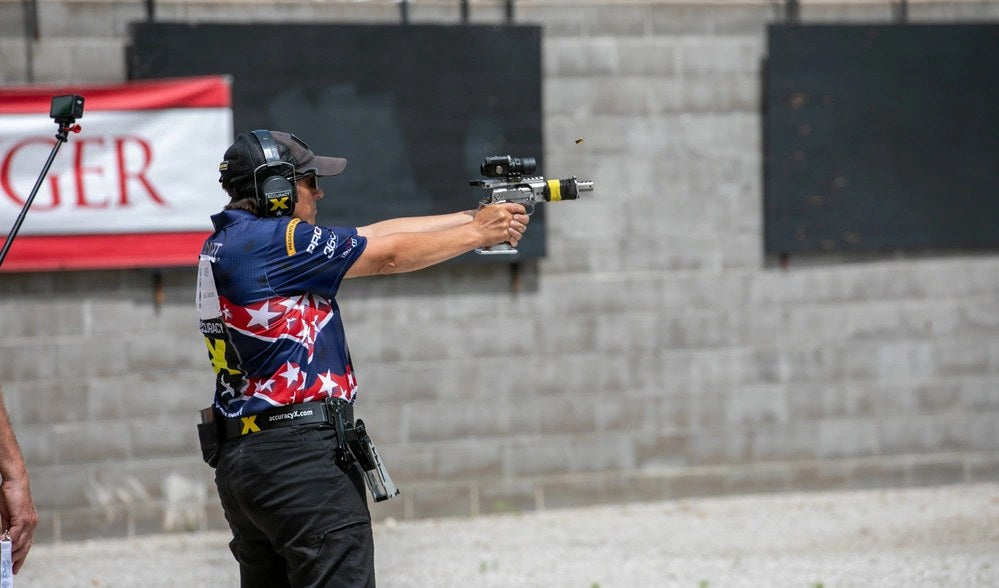
PHOTO CAPTION: Retired U.S. Army Sgt. 1st Class Sally Talbott competes in the 2026 Bianchi Cup in Hallsville, Missouri, May 23, 2026. The image is illustrative; Talbott is not connected to the Justice Department's new firearm-rights restoration program.
Some veterans who are federally prohibited from possessing firearms will soon have a new way to apply to have those rights restored under a Justice Department rule finalized Aug. 17.
The new Federal Firearm Rights Restoration program revives a process that had effectively been unavailable to most applicants for more than three decades. Restoration will not be automatic, and approval will depend on an individualized review of an applicant's record, reputation, conduct and potential risk to public safety.
Federal law allows the attorney general to grant relief from certain firearm prohibitions under 18 U.S.C. 925(c). But since 1992, Congress has barred the Bureau of Alcohol, Tobacco, Firearms and Explosives from using appropriated funds to process those applications, effectively shutting down the traditional pathway.
The Justice Department's new rule establishes a different process administered through DOJ.
For veterans, the program could be relevant in several circumstances. Federal law prohibits firearm possession by people in a number of categories, including people convicted of certain felonies, those discharged from the armed forces under dishonorable conditions, certain people subject to domestic-violence restrictions and some people whose firearm disability stems from a qualifying mental-health adjudication or commitment.
Veterans whose prohibition resulted from a general court-martial felony conviction or a dishonorable discharge may apply under the new process. DOJ says applicants in those categories will generally need military records including a DD Form 214, DD Form 214-1 or DD Form 215, along with applicable court-martial documents.
Veterans who served within the past 25 years, or since age 18 if that period is shorter, are also instructed to provide their discharge documentation as part of an application regardless of the specific reason for their federal firearm restriction.
Being allowed to apply does not mean an applicant is likely to win.
DOJ has created a series of "presumptive disqualifiers" for applicants whose past conduct or current circumstances raise heightened public-safety concerns. People subject to those presumptions will ordinarily be denied unless they can demonstrate extraordinary circumstances.
Permanent presumptions against relief apply to people convicted of felonies involving conduct such as homicide, sexual assault, kidnapping, domestic violence, burglary, robbery, arson, terrorism, stalking and other violent offenses. The rule also establishes five- and 10-year presumptive waiting periods for several other categories of convictions and conduct.
The Justice Department says each applicant must convince the attorney general that the circumstances behind the original prohibition, together with the person's subsequent conduct and reputation, show that the applicant is unlikely to act dangerously and that restoring firearm rights would not be contrary to the public interest.
Applications will require substantial documentation.
All applicants must provide criminal-record information covering as much as the previous 25 years, or since age 18 if that period is shorter. Depending on the case, DOJ may also require conviction records, sentencing documents, military records, medical documentation and other official records.
For applicants whose federal firearm prohibition resulted from a qualifying mental-health commitment or adjudication, DOJ requires current certification from a licensed mental-health professional stating that the underlying condition no longer exists or has been successfully treated or stably managed so the applicant is unlikely to pose a danger to themselves or others.
The program is also not opening to everyone immediately.
DOJ says the rollout will happen in stages. Thirty days after the final rule is published, the department plans to invite selected candidates to apply. After 75 days, the public application system is scheduled to open to the first 5,000 applicants. Another 500 application slots are expected to become available after 120 days, when DOJ also plans to begin charging an application fee.
Even a successful federal application would not necessarily allow someone to legally possess a firearm everywhere.
The Justice Department says relief granted through the program removes applicable federal firearm disabilities only. It does not automatically override separate restrictions imposed by a state or tribal government.
Attorney General Todd Blanche described the new system as a way to give people who no longer present a danger a meaningful opportunity to regain a constitutional right while maintaining restrictions on dangerous individuals.
Gun-safety advocates have raised concerns about whether the government can reliably determine which applicants can safely regain access to firearms. Second Amendment advocates, meanwhile, have long argued that people with old or nonviolent convictions should not necessarily face lifetime firearm prohibitions after completing their sentences and demonstrating rehabilitation.
For some veterans, the new rule could now provide a federal path that has been effectively closed since the early 1990s.
But eligibility to apply is only the first step. Each case will be reviewed individually, and the Justice Department says restoration is neither automatic nor guaranteed.
(Source: OAF Nation)