ARMY CUTS RECOVERY UNITS TO FIVE
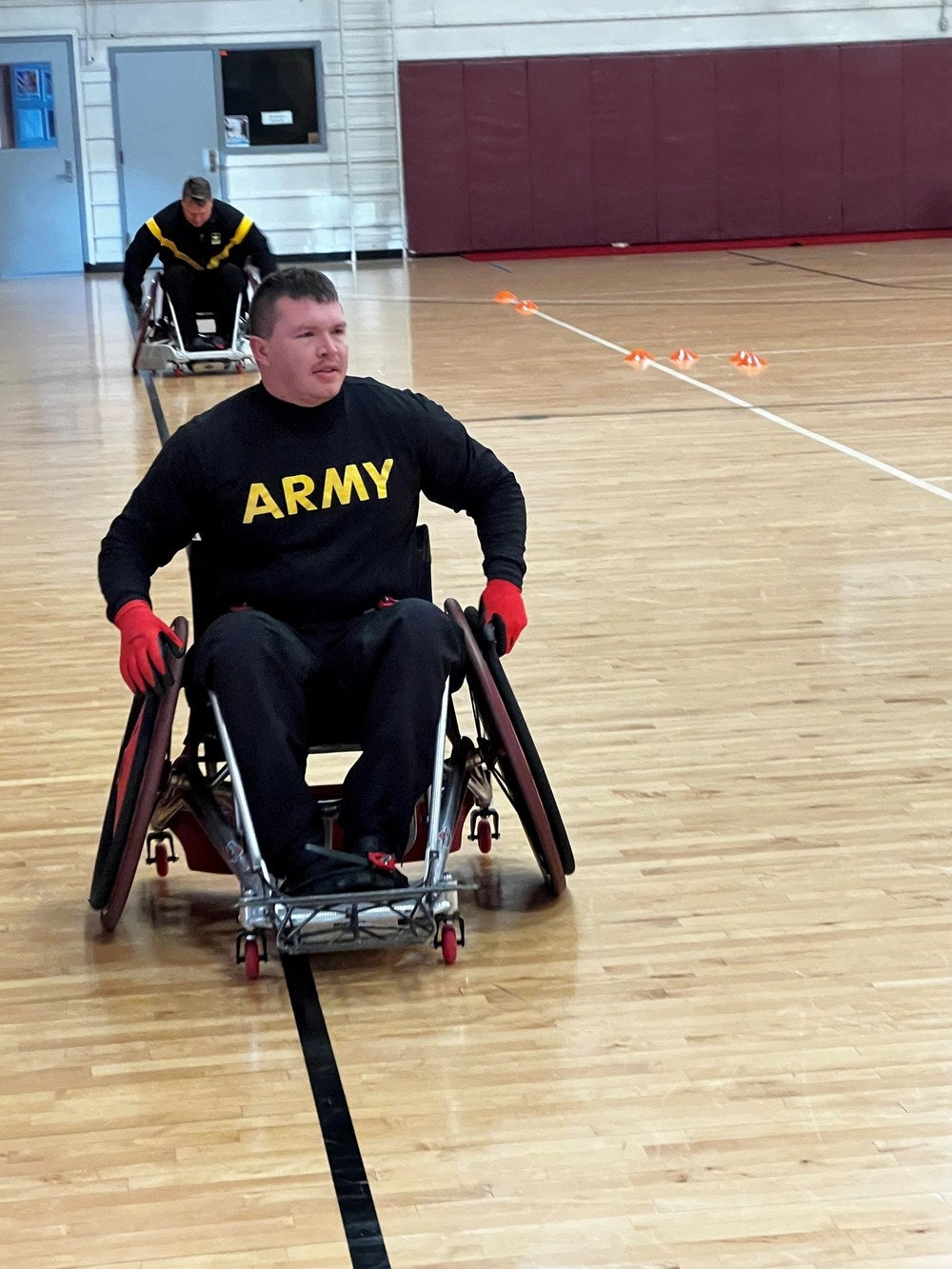
PHOTO CAPTION: Illustrative file photo — Staff Sgt. Travis Beeghley, a Soldier assigned to the Fort Belvoir Soldier Recovery Unit, participates in wheelchair rugby during a recovery program in January 2024. Photo by MaryTherese Griffin/Army Recovery Care Program
The Army has begun a major restructuring of the system that provides specialized care to wounded, ill and injured soldiers, reducing the number of full Soldier Recovery Units from 14 to five while creating a second tier of units for troops who need less complex care.
The first change became visible Aug. 14, when Fort Riley's Soldier Recovery Unit cased its colors during an inactivation ceremony in Kansas. The unit is scheduled to fully deactivate Oct. 1 after nearly two decades supporting recovering service members across a seven-state region.
Fort Riley is the first Soldier Recovery Unit to deactivate under the Army-wide overhaul. Other units will either close or transition under the new model through fiscal 2027.
Under the new structure, five Soldier Recovery Units will remain to handle soldiers with complex medical conditions or those assessed as high risk.
Another five locations will become Definitive Care Units, or DCUs, which will manage wounded, ill and injured soldiers whose conditions do not require the intensive case management provided by a full SRU. Other troops may receive care through Remote Medical Management or return directly to their units depending on their medical needs.
The Army says the restructuring is not being driven by budget cuts.
Instead, officials say the recovery system was built for a much larger population of seriously wounded and medically complex soldiers during the wars in Iraq and Afghanistan. Since 2008, the number of soldiers requiring intensive case management has fallen by more than 90%, according to the Army.
Soldier Recovery Units trace their roots to the Warrior Transition Units created during the height of the post-9/11 wars.
Fort Riley established its Warrior Transition Unit in June 2007 with 39 soldiers and a small staff. In 2010, the installation opened a $54 million Warrior Transition Battalion complex designed specifically to support wounded, ill and injured troops.
The Army renamed Warrior Transition Units as Soldier Recovery Units in 2020.
The units combine medical care with administrative and transition support, using teams that can include nurse case managers, social workers, physical therapists and transition coordinators. Soldiers may eventually return to duty or transition out of military service depending on their condition and recovery.
Across the Army, the recovery system and its predecessor programs have served more than 91,900 soldiers, according to Army figures cited by Stars and Stripes.
Army officials began reviewing the system in early 2024, bringing together Army Medicine, Forces Command, the Army Reserve and National Guard to determine whether the existing network still matched the number and complexity of soldiers requiring care.
That review concluded that the existing structure had more capacity than the Army's current patient population required.
At Fort Riley, the drawdown was planned for more than a year.
The unit reduced its footprint from roughly 120 assigned personnel to 11 ahead of the Aug. 14 ceremony, according to Col. Jason Marquart, commander of Irwin Army Community Hospital. Army officials said soldiers assigned to the unit were transitioned individually to ensure their care continued before the Oct. 1 inactivation date.
The timing nevertheless puts the restructuring under renewed scrutiny.
The Army designed the smaller recovery-care system before the latest increase in U.S. combat casualties overseas. Stars and Stripes reported that it remains unclear how the reduced network of full SRUs would absorb a significant future surge of soldiers requiring complex recovery care.
Army leaders argue the new model preserves that capability by concentrating the most complex patients at five full SRUs while using Definitive Care Units and remote management for soldiers who do not require the same level of intensive support.
The service also says soldiers already receiving care will not simply lose that support because their current unit changes status. Those who continue to meet the criteria for an SRU can remain in intensive case management, while others can transition to a DCU or another appropriate form of care.
At Fort Riley, commanders described the Aug. 14 ceremony as the end of a nearly 20-year chapter rather than the end of the Army's obligation to recovering soldiers.
The larger question now is whether five full Soldier Recovery Units, supplemented by five lower-level care units and remote management, will give the Army enough capacity if the number of seriously wounded, ill or injured soldiers rises again.
(Source: OAF Nation)