Article: Trump's Arch Plans Face Shadow Concerns
Trump's Arch Plans Face Shadow Concerns
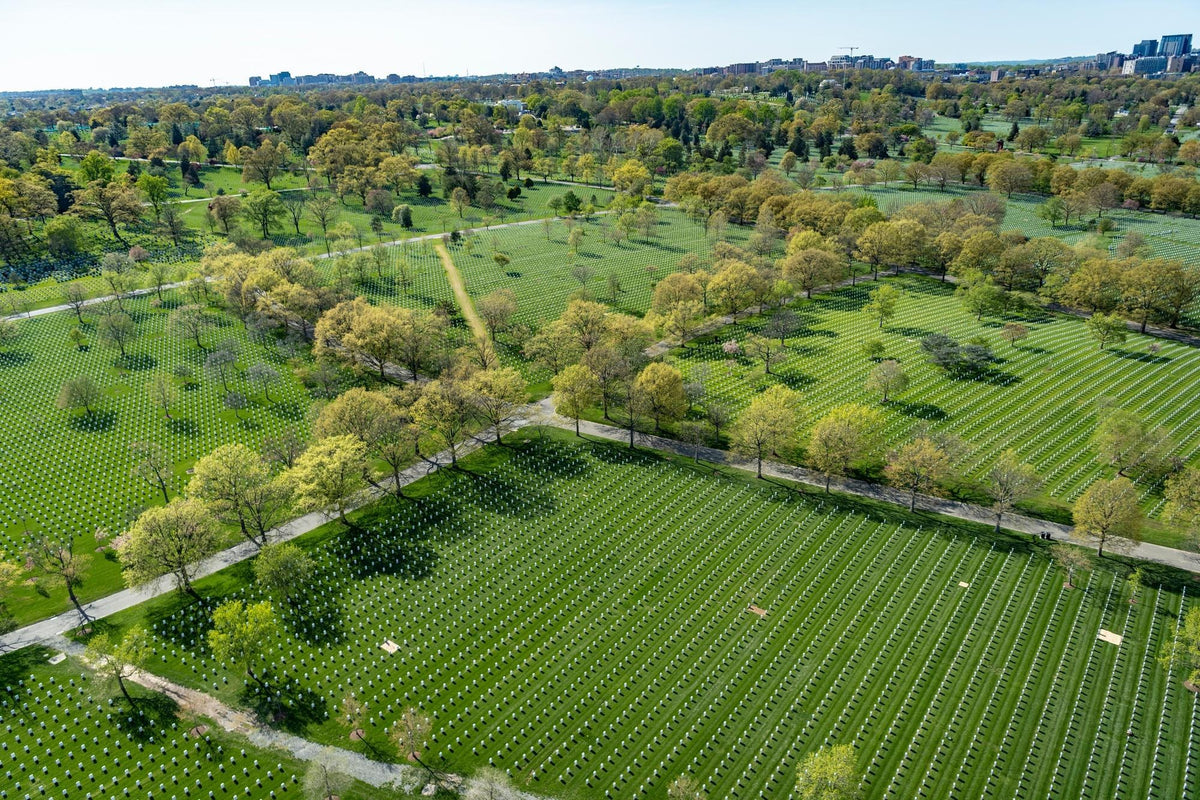
PHOTO CAPTION: An aerial view of Section 68 at Arlington National Cemetery in Virginia on April 20, 2022. A new Washington Post computer analysis projects that President Trump's proposed 250-foot triumphal arch could cast shadows across more than 75,000 Arlington graves at different times throughout the year. The monument has not been built. (Archival U.S. Army photo by Elizabeth Fraser / Arlington National Cemetery)
President Donald Trump's proposed 250-foot triumphal arch near Arlington National Cemetery could cast shadows over more than 75,000 graves throughout the year, according to a new computer-modeling investigation published Tuesday by The Washington Post.
The October 27 analysis projects that the monument, planned for Memorial Circle near Arlington Memorial Bridge, would send a moving shadow across portions of the military cemetery on 284 days annually.
The projected shadow could also briefly cross President John F. Kennedy's eternal flame and other historic memorials.
The findings add a new dimension to an ongoing dispute over the monument, which has drawn opposition from military veterans, preservationists and local officials.
The structure has not been built, and the Interior Department disputes the significance of the projected effects.
Computer Model Projects Shadows Across Arlington Graves
The Washington Post developed a three-dimensional model using the monument's proposed dimensions and location to calculate how sunlight would interact with the structure throughout the year.
According to the analysis, the arch's shadow would move across different sections of Arlington National Cemetery as the sun rises.
On one modeled morning, the shadow would remain on cemetery grounds for more than an hour and pass over more than 2,000 graves.
The model projects that the shadow could reach more than 75,000 graves at some point during the year, including burial sites associated with veterans of conflicts ranging from the Civil War through the Vietnam War.
That figure represents the cumulative number of graves potentially affected across multiple days. It does not mean 75,000 graves would be shaded simultaneously.
Most of the projected shading would occur early in the morning, before the cemetery opens to visitors at 8 a.m.
However, the analysis found that the shadow could remain within the cemetery after opening on 26 days annually.
The findings are projections based on a computer model, not measurements of an existing structure.
Kennedy's Eternal Flame Could Also Be Affected
One of the investigation's most notable findings concerns President John F. Kennedy's gravesite.
The model predicts that the proposed arch could briefly cast a shadow across Kennedy's eternal flame on 18 days each year.
Kennedy's memorial is among Arlington's most recognizable landmarks, drawing visitors from around the world.
The projected effects extend beyond the former president's grave.
According to the analysis, the nearby Military Women's Memorial could experience shading on more than 100 days annually.
The model also indicates that the monument's shadow could extend toward the Lincoln Memorial and other prominent landmarks across the Potomac River at certain times of the year.
Those projections have renewed questions about how the monument would affect Washington's historic landscape and the experience of visiting national memorials.
Interior Department Disputes Significance of Findings
The Trump administration has defended the proposed arch, arguing that it would celebrate American achievements and enhance the monumental landscape surrounding the nation's capital.
The Interior Department conducted its own shadow simulations and reached a different assessment of the impact during cemetery visiting hours.
The department said only a small portion of Arlington would experience shading after the cemetery opens, with those effects occurring for fewer than two weeks annually.
Officials also emphasized that shadows around sunrise are unusually long and would overlap with shadows cast by existing trees.
The White House has maintained that the arch would be a major national landmark and improve the experience of visitors to Arlington.
The Washington Post reported that Interior provided visual simulations but did not fully disclose the methods used to produce them.
The competing assessments leave questions about the precise extent and practical significance of the proposed monument's shadow.
Three Vietnam Veterans Challenge the Monument
The latest investigation comes as a federal lawsuit seeks to stop construction.
Three Vietnam War veterans, Michael Lemmon, Shaun Byrnes and Jon Gundersen, joined retired architectural historian Calder Loth in challenging the project earlier this year.
The veterans, who later served as American diplomats, argue that the arch would disrupt historic views between Arlington National Cemetery and the Lincoln Memorial.
Their lawsuit raises questions about whether the administration has the legal authority to proceed without congressional authorization.
On October 22, the plaintiffs asked U.S. District Judge Tanya Chutkan to block construction while the legal challenge remains pending.
Arlington County has filed a separate lawsuit challenging the approval process and raising concerns about transportation, public safety and environmental impacts.
The administration disputes the legal challenges and maintains that the project is proceeding through the required federal reviews.
Proposed Monument Would Rise 250 Feet
The triumphal arch would stand in Memorial Circle, a prominent location at the western end of Arlington Memorial Bridge.
Plans submitted to federal officials call for a structure approximately 250 feet tall, including the statue at its highest point.
The monument is intended to celebrate the accomplishments of the American people and serve as a major architectural landmark.
However, its proposed height and location have prompted objections from historic preservation organizations concerned about changes to established views and the surrounding ceremonial landscape.
The National Park Service has acknowledged adverse effects on historic properties in its federal preservation review, while separately concluding that the project would not cause significant environmental impacts under its environmental assessment.
Those findings address different federal review requirements and do not, by themselves, authorize construction.
Construction Could Begin in November
The National Capital Planning Commission is scheduled to consider final site and building plans on November 5.
According to court filings reported by The Associated Press, the National Park Service has indicated that construction could begin as early as that date, provided the necessary approvals and final authorization are completed.
A federal judge is considering the veterans' request to stop work while their case proceeds.
The monument's ultimate construction schedule therefore remains uncertain.
For now, the newly published shadow analysis adds another issue to the debate over the proposed arch: how a monument intended to celebrate American achievements might physically affect one of the nation's most important military burial grounds.
Whether the projected effects will influence the final approval process remains to be seen.
(Source: OAF Nation)