Pentagon Details Iranian Strike Damage
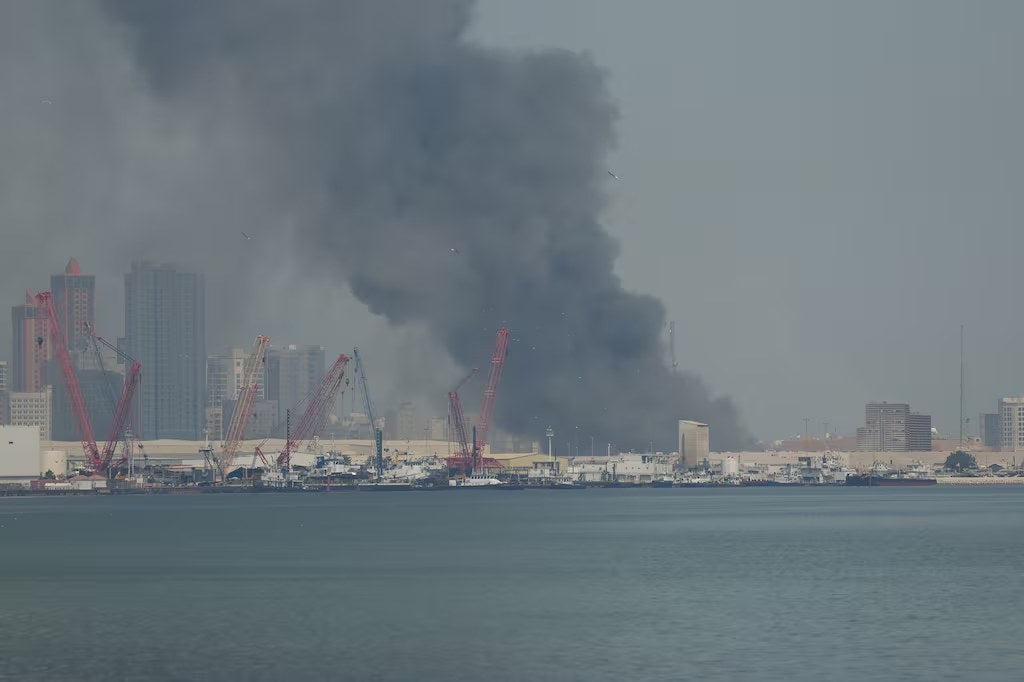
PHOTO CAPTION: Smoke rises from the U.S. Navy’s Fifth Fleet headquarters in Manama, Bahrain, following an Iranian missile strike on Feb. 28, 2026. A newly released Pentagon inspector-general report says earlier Iranian attacks damaged or destroyed hundreds of structures at U.S. bases across eight countries. Anadolu via Getty Images
A newly released Pentagon inspector-general report is providing the broadest official accounting yet of damage caused by Iranian attacks earlier this year, finding that the strikes damaged or destroyed hundreds of buildings and structures at U.S. bases across eight Middle Eastern countries.
The report does not describe a new round of attacks. It consolidates information about earlier Iranian strikes during Operation Epic Fury and covers Defense Department activity through June 30.
According to the Defense Department Office of Inspector General, U.S. Central Command reported damage at American installations in Bahrain, Iraq, Jordan, Kuwait, Oman, Qatar, Saudi Arabia and the United Arab Emirates.
The publicly released report does not identify every affected installation or provide a base-by-base inventory of the damage. It also does not include a complete estimate for repairing or replacing the damaged military infrastructure.
The assessment does, however, offer a clearer picture of the operation’s scale.
Iranian attacks destroyed or damaged dozens of American manned and unmanned aircraft, according to aircraft-loss information included in the report. The listed losses included four F-15E Strike Eagles, one A-10 Thunderbolt II, four AH-6 helicopters, one AH-64 Apache, one MH-60 helicopter, one MQ-4C Triton and as many as 30 MQ-9 Reapers.
Those aircraft losses were not newly sustained when the report was published. The inspector general said the figures were drawn from earlier Congressional Research Service data that CENTCOM had reviewed as of Aug. 24.
The report also documented damage beyond military installations. U.S. diplomatic facilities in four countries sustained an estimated $184 million in physical damage. American diplomatic sites in Iraq experienced more than 600 attacks, while U.S. embassies in Kuwait City and Riyadh were also struck.
The Defense Department estimated that Operation Epic Fury had cost approximately $33.4 billion through June 29. That total included $22.3 billion in expended munitions, $3.7 billion in equipment losses and another $7.4 billion in costs above CENTCOM’s normal operating expenses.
The estimate remains incomplete. It does not include military construction or infrastructure-repair expenses because the Pentagon had not yet determined its future regional posture, how reconstruction would be handled or how much allied governments might contribute.
Transportation operations added another major expense. U.S. Transportation Command conducted more than 1,500 missions supporting the operation at a cost of nearly $2.4 billion through June 30, according to the inspector general.
The report said the operation did not receive a dedicated congressional appropriation during the period examined. Instead, the military services used funding from existing accounts, including money normally allocated to training and maintenance. Transportation Command anticipated delayed payments as service funding became depleted without supplemental appropriations.
The inspector general’s report lists 18 U.S. service members killed as of Aug. 27. The Pentagon had separately reported 417 wounded personnel as of June 30.
Taken together, the findings provide a consolidated official assessment of attacks and losses previously reported in pieces. The new development is the watchdog’s accounting of their geographic reach, material damage and cost—not a new wave of Iranian strikes.
(Source: OAF Nation)