Ukraine Claims Drone Strike Killed Russian General
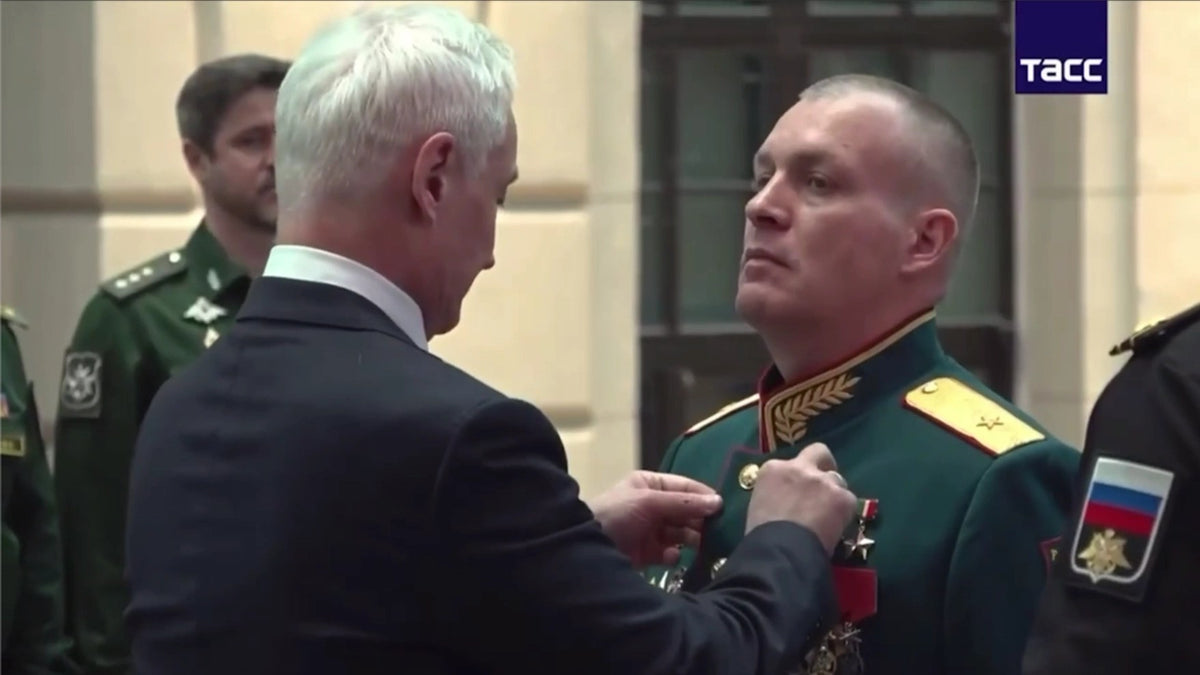
PHOTO CAPTION: Russian Defense Minister Andrei Belousov presents Maj. Gen. Anton Grunis with the Gold Star of the Hero of Russia during an August 2026 ceremony. Grunis’ death was confirmed weeks later. Screenshot from Russian Defense Ministry footage.
A Russian general who recently received his country’s highest honorary title has been killed in occupied eastern Ukraine, according to officials on both sides of the war.
What remains disputed is exactly how he died.
Ukraine’s Unmanned Systems Forces said Maj. Gen. Anton Grunis was killed during a nighttime drone strike against his position in the occupied portion of Ukraine’s Donetsk region on September 12.
A senior Russian commander subsequently confirmed Grunis’ death but did not reveal when, where or how he was killed.
The announcement came only weeks after Grunis received the title Hero of the Russian Federation, the country’s highest honorary distinction.
Russian Defense Minister Andrei Belousov presented Grunis with the accompanying Gold Star medal during an August 27 ceremony. Russian Defense Ministry footage released around the ceremony showed Grunis receiving the award and expressing confidence in Russia’s eventual victory.
Ukraine now says the newly decorated general was tracked to a command position and killed by drones operated by the 427th Separate Unmanned Systems Regiment, known as Rarog.
“General Grunis was eliminated on September 12, 2026,” Robert Brovdi, commander of Ukraine’s Unmanned Systems Forces, announced Wednesday.
Brovdi said Grunis was the seventh Russian commander at the brigade, division or army level killed in operations conducted by Ukraine’s drone forces.
Reuters and Ukrainian news organizations said they could not independently verify Ukraine’s description of the operation.
Footage released by Ukrainian sources reportedly shows drones striking buildings near Kindrativka in the Donetsk region, followed by explosions and fires. However, the footage does not conclusively establish that Grunis was inside one of the buildings.
Russia has nevertheless confirmed that the 46-year-old general is dead.
Apti Alaudinov, commander of Russia’s Akhmat special forces and deputy head of the Russian Armed Forces’ Main Military-Political Directorate, described Grunis as a patriot who died after fulfilling his duty.
Russia’s Defense Ministry had not publicly confirmed that a Ukrainian drone strike caused his death.
Grunis commanded Russia’s 4th Separate Guards Motor Rifle Brigade and had become a prominent figure in Russian state media.
In July, he appeared during a televised military briefing with Russian President Vladimir Putin and reported on his brigade’s role in Russia’s claimed capture of Kostiantynivka, a strategically important city in the Donetsk region.
Ukraine rejected Russia’s assertion that the city had been completely captured. Independent battlefield analysts also disputed Moscow’s account, reporting that Ukrainian forces continued to maintain positions in the city.
Putin had previously praised Grunis publicly, describing him as an officer who “fights brilliantly.”
Grunis’ rapid rise in prominence culminated with the Hero of Russia award in late August. The title is Russia’s highest honorary distinction and is awarded for acts the government considers heroic service to the state.
Within weeks of receiving the Gold Star, he was dead.
The circumstances surrounding the reported strike illustrate the growing threat that relatively inexpensive unmanned aircraft pose to even the most senior officers on a modern battlefield.
Drones that were once primarily used for surveillance are now routinely locating command posts, following troop movements and directing precision strikes against individual targets.
Ukraine has invested heavily in specialized drone formations while attempting to compensate for shortages of troops, artillery ammunition and conventional aircraft.
If Ukraine’s account is accurate, Grunis’ death demonstrates that rank, distance from the front line and the concealment provided by a command position may no longer offer senior commanders the protection they once did.
(Source: OAF Nation)