Okinawa Extends Curfew for E-4s
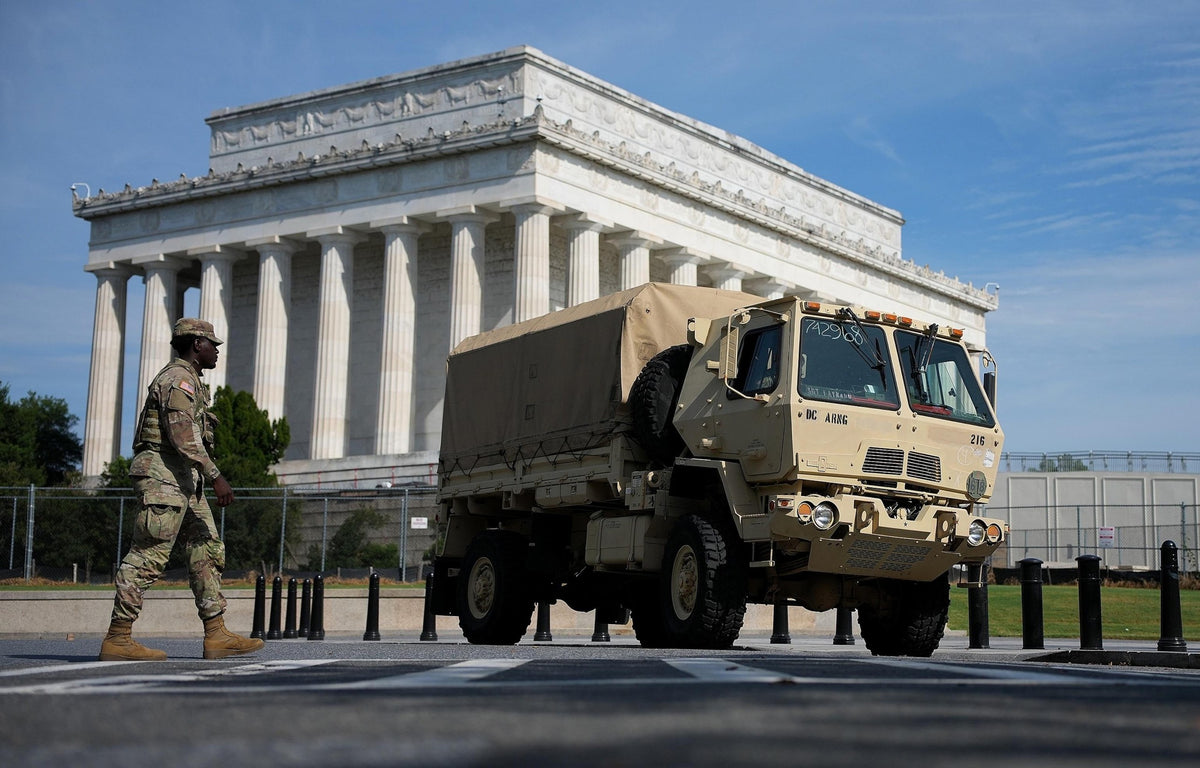
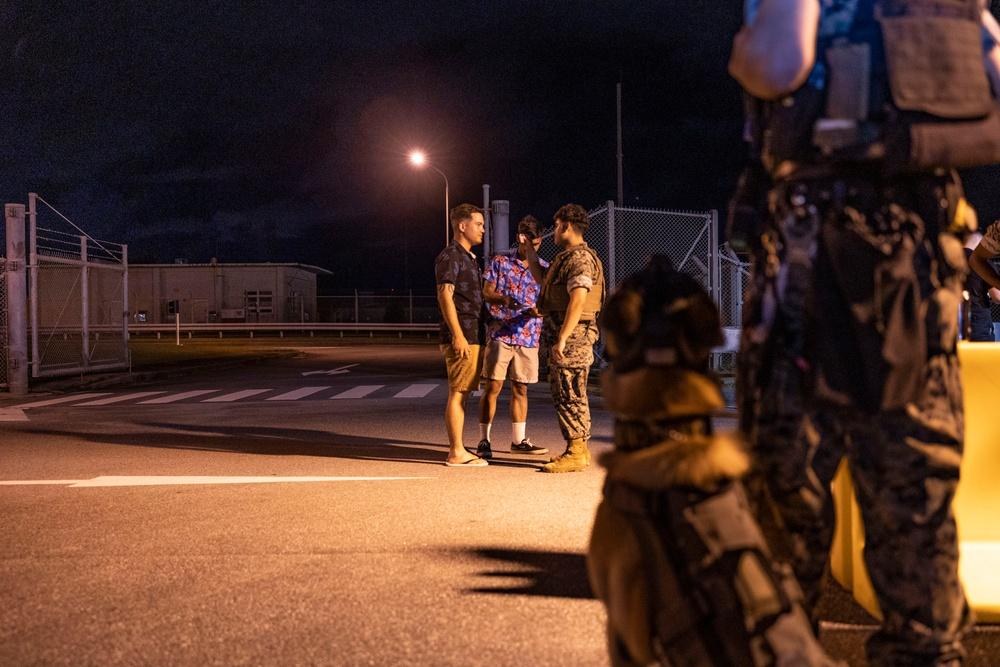
PHOTO CAPTION: U.S. Marines conduct a nighttime liberty checkpoint at Camp Hansen in Okinawa, Japan, in July 2024. The military has extended its midnight-to-5 a.m. curfew for service members ranked E-4 and below through December 7, 2026, while lifting the islandwide curfew for higher ranks. (U.S. Marine Corps file photo.)
The U.S. military is extending its overnight curfew for junior enlisted troops on Okinawa while lifting the same restrictions for higher-ranking personnel, following a review that commanders say found approximately 70% of significant liberty incidents involved service members in grades E-1 through E-4.
The new order, announced November 6 by III Marine Expeditionary Force commander Lt. Gen. Benjamin Watson, applies to all military branches stationed on the Japanese island.
Beginning November 8, personnel ranked E-1 through E-4 must continue following a midnight-to-5 a.m. curfew through December 7.
Service members in higher pay grades will no longer be subject to the islandwide overnight curfew. However, troops of every rank will be prohibited from purchasing or consuming alcohol outside their primary residence during those same hours.
The decision marks a significant change from the restrictions imposed on all American troops last month after the arrest of a Marine accused of killing and robbing a Japanese woman.
It also raises a familiar question for military personnel: When misconduct leads to widespread liberty restrictions, how should commanders determine who faces the consequences?
The New Rules Draw a Line at E-4
Watson's November 6 memorandum changes the restrictions that have governed American troops on Okinawa since early October.
Under the revised order, service members in grades E-1 through E-4 must remain in an authorized location between midnight and 5 a.m.
Those locations include assigned quarters on military installations, private off-base residences and hotels.
The order also allows specified exceptions for travel between airports and lodging, as well as transportation for emergency medical care.
Personnel ranked E-5 and above are no longer subject to the general islandwide curfew, although commanders can impose stricter requirements within their own units.
The alcohol restrictions are broader.
Regardless of rank, all service members are prohibited from purchasing or consuming alcohol outside their primary residences between midnight and 5 a.m.
The new requirements begin at 12:01 p.m. on Sunday, November 8, and continue until noon December 7.
Commanders retain the authority to establish additional restrictions when conditions warrant.
Command Says Junior Enlisted Troops Accounted for 70% of Incidents
The Marine Corps says the decision was based on a review of significant liberty incidents involving personnel across the different military services on Okinawa.
III MEF spokesman Maj. Jordan Fox told Stars and Stripes that approximately 70% of those incidents involved service members ranked E-1 through E-4.
The figure provides the command's clearest public explanation for why the continuing curfew is concentrated on junior enlisted personnel.
But it leaves an important question unanswered.
What percentage of the American military population on Okinawa falls within those same ranks?
If E-1 through E-4 personnel constitute a large majority of the force, their involvement in a majority of recorded incidents might partly reflect the size of that population.
If they represent a much smaller proportion, the figure would suggest a different pattern.
Without that denominator, the 70% statistic cannot establish the relative rate of incidents among junior and senior personnel.
The publicly available reporting also does not provide a complete breakdown of the incidents by category, severity, branch or time of day.
Those details would help determine whether the midnight-to-5 a.m. curfew is addressing the circumstances in which significant misconduct most frequently occurs.
The command says its review also considered feedback from joint and interagency leaders and received concurrence from U.S. Forces Japan.
Why the Curfew Started
The restrictions followed the October 4 arrest of Marine Lance Cpl. Devin Jacob Ballard, then 20, in connection with the death of Anna Yagi, 39, at a hotel in Naha.
Japanese authorities allege that Ballard killed and robbed Yagi on October 3.
He was subsequently indicted on October 25 on a charge of robbery causing death.
Ballard has denied the allegations, according to Japanese police.
The case prompted serious concern among Okinawan officials and renewed scrutiny of the conduct of American military personnel stationed on the island.
In response, Watson ordered a temporary operational pause and standards training before imposing a monthlong Period of Reflection.
During that period, all American service members on Okinawa were required to observe an overnight curfew.
Military leaders also increased supervision, conducted training on conduct and discipline, and reviewed liberty policies with Japanese and American officials.
The original restrictions were scheduled to expire November 8.
Instead, the new order continues the curfew for junior enlisted personnel for approximately another month.
Another Marine Was Arrested During the Original Curfew
The initial restrictions did not prevent every reported incident.
On October 31, Okinawa police arrested a Marine assigned to Camp Hansen on suspicion of driving under the influence of alcohol.
Authorities also investigated the Marine's possible involvement in a hit-and-run incident involving another vehicle.
No injuries were reported.
The alleged drunken-driving incident occurred shortly after midnight, during the curfew that applied to all service members.
Two additional Marines were reportedly passengers in the vehicle.
III MEF acknowledged that the incident occurred during the restricted period and said it would be included in the broader assessment of liberty policies.
The arrest provides a specific example of the challenges commanders face in enforcing restrictions.
However, one alleged violation does not establish whether the curfew has reduced incidents overall.
That determination would require comparing incident data before and after the restrictions, including how many troops were affected and whether enforcement practices changed.
Kadena Air Base Had Already Imposed Stricter Rules
The islandwide order is not the first time junior enlisted personnel have faced additional restrictions during the current period.
At Kadena Air Base, 18th Wing commander Brig. Gen. John Gallemore implemented stricter requirements beginning October 22.
Those rules prohibited E-1 through E-4 personnel from consuming alcohol and required them to remain on base between 10 p.m. and 5 a.m.
The Kadena restrictions were scheduled to run through the Period of Reflection.
According to Stars and Stripes, the wing plans to end those additional restrictions at noon November 8 and follow the revised islandwide order.
That would replace Kadena's earlier 10 p.m. restriction with the midnight curfew applying to junior enlisted personnel throughout Okinawa.
The broader policy still allows commanders to impose stricter local rules if necessary.
Why Okinawa Liberty Rules Matter Beyond the Bases
Okinawa hosts a substantial American military presence, and incidents involving U.S. personnel have long affected relations with surrounding communities.
Japanese officials have repeatedly demanded stronger discipline and more effective prevention measures following serious criminal allegations involving American service members.
The current restrictions were introduced after an especially serious incident involving the death of a civilian.
For Okinawan residents, the issue is not simply whether troops should be allowed to remain out late.
It concerns public safety, accountability and confidence that military leaders will respond effectively when misconduct occurs.
For American personnel, the restrictions affect ordinary off-duty activities, including travel, recreation and time spent in the local community.
Those interests are not necessarily incompatible.
Commanders have responsibilities to maintain discipline and protect relations with the host nation while also considering how restrictions affect service members who have not committed misconduct.
The difficulty is determining whether a broad policy produces meaningful improvements.
Is a Rank-Based Curfew Fair?
The new order appears intended to concentrate restrictions on the group command officials say accounts for most significant liberty incidents.
Supporters of such an approach could argue that junior enlisted personnel generally have less military experience and may benefit from additional supervision.
They could also point to the command's reported incident data as justification for directing preventive measures toward the ranks most often involved.
Critics could question whether pay grade is an appropriate substitute for individual responsibility.
An E-4 who has never violated liberty rules will still face the curfew, while an E-5 without additional command restrictions may remain out after midnight.
The policy therefore imposes different conditions on service members based on rank rather than their personal disciplinary records.
That is not unusual in military organizations, where privileges and responsibilities frequently differ according to rank, assignment and experience.
But the question of fairness becomes more consequential when the restrictions affect thousands of personnel in response to misconduct committed by a much smaller number.
The command's 70% statistic helps explain its decision, yet the absence of a publicly available comparison with the rank distribution limits what can be concluded from the figure alone.
Will Another Month of Restrictions Work?
The current order is scheduled to expire at noon December 7.
Before then, the Okinawa Area Coordinator is expected to forward the results of the broader Period of Reflection assessment and its recommendations to U.S. Forces Japan.
Those findings could help explain whether the initial curfew reduced significant liberty incidents and whether additional changes are needed.
The effectiveness of the new rank-based policy remains to be established.
The military has identified junior enlisted personnel as responsible for a substantial share of incidents and adjusted its restrictions accordingly.
But commanders have not publicly released enough data to determine whether the affected ranks are responsible for a disproportionately high rate of incidents or whether the original curfew meaningfully reduced misconduct.
For now, junior enlisted troops on Okinawa will remain subject to a midnight curfew while senior personnel regain their overnight liberty.
The question is whether that distinction will improve discipline and community safety, or simply leave a large group of service members carrying restrictions because of the actions of others.
(Source: OAF Nation)