Hegseth Expands D.C. Guard Mission
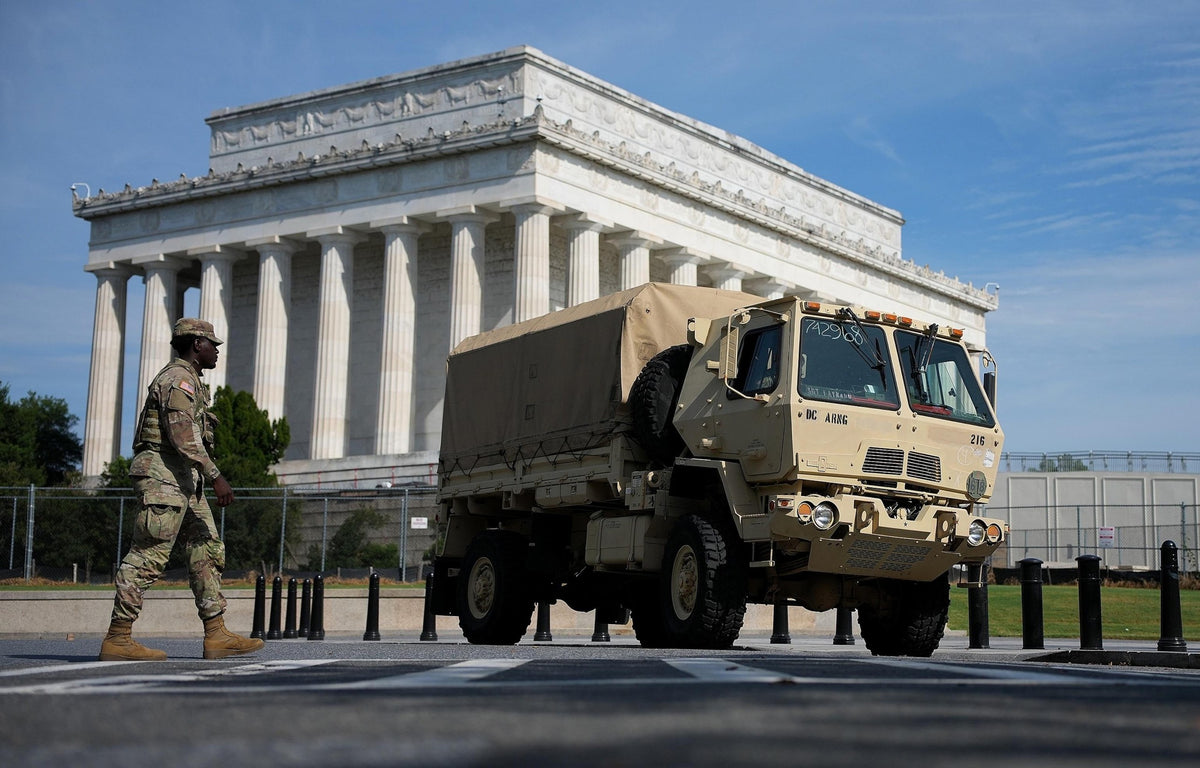
PHOTO CAPTION: National Guard soldiers and airmen stand beside a Humvee near the Lincoln Memorial in Washington, D.C., on May 23, 2026. Defense Secretary Pete Hegseth has authorized expanded Guard operations in the capital, including additional military vehicles, patrol boats and armed security support. (U.S. Army National Guard photo by Staff Sgt. Tianna Wilson. File photo.)
Defense Secretary Pete Hegseth has authorized an expanded National Guard mission in Washington, D.C., allowing troops to use military vehicles, patrol boats and additional firearms while supporting federal and local law enforcement operations in the nation's capital.
Two memorandums signed October 29 and obtained by The Associated Press outline the changes, which include up to 60 marked military police patrol cars, tactical vehicles, two patrol boats and 20 portable light towers.
The new authorization also allows certain Guard personnel supporting anti-gang and drug-trafficking operations to carry rifles in addition to their service pistols.
Approximately 3,100 National Guard members are currently deployed in Washington as part of President Donald Trump's ongoing federal crime initiative.
The changes come as the city's government continues challenging the military deployment in federal court, arguing that the administration has exceeded its legal authority by involving troops in domestic law enforcement.
Humvees, Patrol Cars and Military Trucks Authorized
Under the new guidance, National Guard troops may use a wider range of vehicles during their operations throughout Washington.
The authorized equipment includes up to 60 marked patrol cars, Humvees, light-medium tactical vehicles and portable lighting equipment.
The patrol cars must be clearly marked as National Guard vehicles, and troops must remain identifiable as military personnel.
Those requirements are intended to distinguish service members from civilian police officers.
The expanded equipment could allow Guard units to provide greater mobility, visibility and logistical support during patrols and coordinated law enforcement activities.
However, the memorandums do not authorize troops to operate as ordinary police officers.
Guard members cannot conduct high-speed vehicle pursuits or independently make arrests.
Their responsibility remains supporting authorized law enforcement operations under the restrictions established for the deployment.
Two Military Patrol Boats Will Support Drug Operations
One of the more unusual additions is the authorization for two D.C. National Guard patrol boats.
According to reporting by Task & Purpose, the boats are intended to provide perimeter security and other maritime support for law enforcement personnel conducting operations against suspected gang leaders and drug traffickers near Anacostia Park.
Federal officers must be aboard the vessels to handle any arrests.
Guard personnel operating the boats are also prohibited from firing their service-issued weapons while aboard.
The authorization represents an expansion beyond the Guard's more familiar land-based patrols at parks, transportation hubs and other public locations.
It does not establish that Guard troops will independently conduct drug raids or serve as federal law enforcement officers.
Some Troops Can Carry Rifles During Certain Missions
The memorandums also expand the circumstances in which deployed Guard personnel may carry rifles.
Previously, troops could carry service-issued pistols under established mission requirements.
Under the new guidance, personnel supporting specified operations involving gangs and drug trafficking may also be equipped with rifles.
That authority is limited.
For example, the memorandums prohibit troops from carrying rifles inside Metro rail stations.
The guidance also maintains restrictions on military equipment and tactics, including prohibitions on issuing bayonets and using military helicopters for the expanded mission.
The authority to carry a rifle does not automatically grant a soldier the authority to use force, conduct searches or arrest suspects.
Military personnel remain subject to applicable rules governing their mission and the use of force.
Guard Units Will Support Federal Investigations and Security
The changes extend beyond equipment.
The Pentagon is continuing to provide six analysts supporting efforts to address organized drug distribution in Washington.
Another provision authorizes the U.S. Marshals Service to use personnel from the D.C. National Guard's 260th Special Purpose Brigade to help protect senior federal officials and secure important federal facilities.
The brigade has previously served as a quick reaction force.
These assignments reflect a continued effort to integrate military support capabilities with federal and local law enforcement activities.
The memorandums also show limits on that cooperation.
According to AP reporting, a separate request for Guard helicopters and assistance removing abandoned tires was denied.
That suggests the Pentagon is reviewing individual requests rather than approving every proposed use of military personnel and equipment.
Approximately 3,100 Guardsmen Remain in Washington
The current deployment includes approximately 3,100 National Guard personnel from the District of Columbia and several states.
Hegseth's memorandums maintain a maximum authorized strength of 3,500 troops.
That means the expanded responsibilities do not automatically authorize an increase beyond the existing troop ceiling.
The deployment began in August 2025 when Trump ordered National Guard forces into Washington as part of an initiative to address crime and improve public safety.
The mission has continued through 2026, with troop numbers changing as temporary assignments and additional security operations concluded.
Some Guard personnel have conducted visibility patrols in public areas, while others have supported federal officers, guarded facilities and assisted with logistical operations.
National Guard members have also been authorized to temporarily detain individuals until law enforcement officers arrive, subject to the mission's legal restrictions.
They do not possess general authority to independently arrest members of the public.
Washington Is Fighting the Deployment in Court
The expanded authorization comes amid an ongoing legal dispute between the Trump administration and Washington's local government.
District officials sued in September 2025, arguing that the use of National Guard troops for the city's crime-fighting mission amounts to unlawful military involvement in domestic law enforcement.
The District maintains that the deployment undermines local authority and crosses important legal boundaries governing the use of armed forces within the United States.
The administration argues that federal authorities can use the Guard to support its security mission in Washington.
A federal district court previously sided with the city, but an appeals court has allowed the deployment to continue while the case proceeds.
A federal appeals court panel heard arguments on October 14.
The dispute is significant because the legal status of the D.C. National Guard differs from that of Guard forces operating under the authority of a state governor.
The case also raises broader questions about the separation between military operations and civilian policing.
The latest equipment authorization does not resolve those legal questions.
D.C. Officials Continue Opposing the Mission
Local leaders have repeatedly criticized the deployment, arguing that Washington should rely on civilian police agencies rather than an extended military presence.
D.C. Councilmember Brooke Pinto, who chairs the council's public safety committee, reiterated those concerns during a November 5 hearing.
Pinto expressed hope that incoming state governors and congressional leaders would help end or reduce the deployment.
She also called for additional oversight of federal law enforcement operations.
Supporters of the administration's approach argue that a visible federal security presence can assist police, deter crime and protect federal facilities.
Opponents question whether the expanded military role is necessary, effective or legally appropriate.
The competing positions reflect a continuing debate about how far military support for domestic security should extend.
What the New Orders Mean for Guardsmen
For the soldiers and airmen assigned to Washington, the memorandums introduce additional operational capabilities without removing the restrictions that distinguish their mission from civilian policing.
Troops may operate in marked patrol vehicles, support maritime security and carry additional weapons during qualifying missions.
They may also support certain federal investigations and protective operations.
But their powers remain limited, and they must continue operating under the applicable military rules and legal authorities.
The expanded authorization also raises practical questions about training, command responsibility, coordination with police and the handling of encounters with civilians.
Whether the new equipment meaningfully changes public safety outcomes remains to be seen.
The immediate development is clear: the Pentagon has approved a broader set of military capabilities for a National Guard mission that has already lasted more than a year.
With approximately 3,100 troops still deployed and the courts considering the legality of their presence, the question of what role military personnel should play in America's capital remains unresolved.
(Source: OAF Nation)