Military Urine Test Research Funded
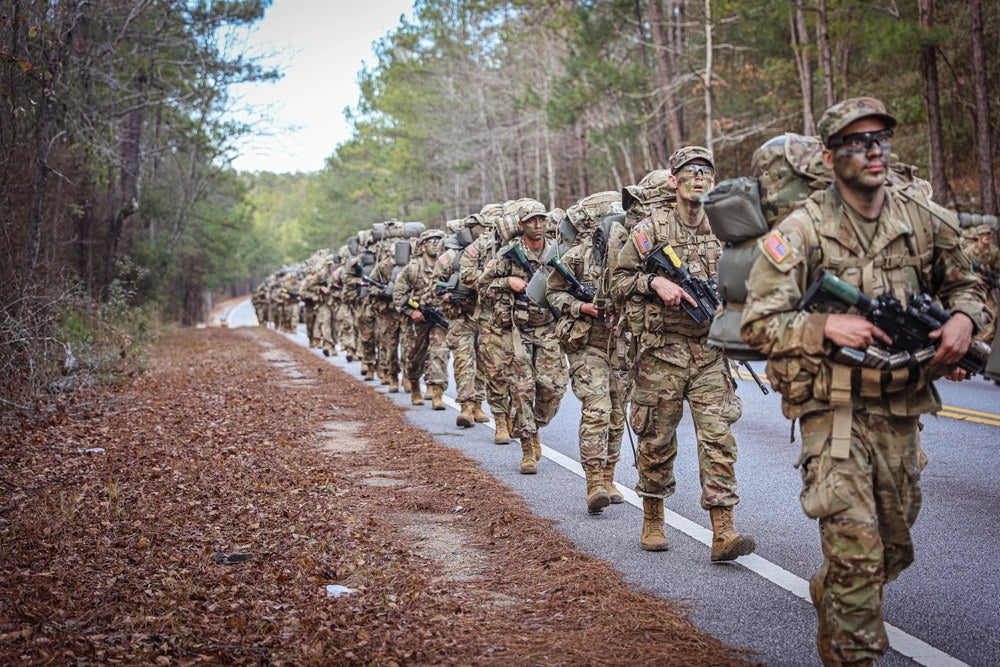
PHOTO CAPTION: U.S. Army trainees conduct a 12-mile ruck march at Fort Moore, Georgia, Jan. 11, 2024. U.S. Army photo by Capt. Stephanie Snyder.
Researchers are working to develop a urine-based test that could help identify military recruits at risk of bone-stress injuries before those injuries become severe, potentially giving clinicians another tool to prevent training setbacks and improve readiness.
A team from Rosalind Franklin University of Medicine and Science and Old Dominion University received a four-year, $3.42 million military research grant for the project, which will study proteins found in urine for signs associated with bone adaptation and stress injuries.
Bone-stress injuries occur when repeated physical loading damages bone faster than the body can repair it. They are a persistent problem during military training, where recruits are rapidly exposed to running, marching and other demanding physical activity.
Rosalind Franklin University said an estimated 1% to 8% of military recruits sustain stress fractures, with the injuries costing the military about $100 million each year, not including broader readiness costs.
Diagnosing a suspected stress fracture can require repeated clinical visits and imaging such as X-rays, MRI scans or bone scans. Researchers hope urine biomarkers could eventually help identify developing injuries earlier and determine which recruits face greater risk before a stress fracture fully develops.
The project is called “Urinary Proteomic Biomarkers of Adaptive Bone Formation and Stress Injuries in Military Recruits.”
Researchers will look for patterns of proteins in urine that distinguish normal bone adaptation to training from the biological changes associated with a developing bone-stress injury.
The team plans to use data from military recruits followed over time and advanced proteomic techniques to identify and validate potential biomarkers. Researchers will also analyze results by sex to determine whether the biological signals differ between male and female recruits.
Shawn Flanagan, director of the Human Performance Laboratory at Rosalind Franklin University’s Center for Lower Extremity Ambulatory Research, is leading the work with Chris Connaboy, a professor of health sciences at Old Dominion University.
The researchers ultimately hope to create a clinically useful panel of urinary biomarkers that could help doctors recognize bone-stress injuries sooner, reduce reliance on expensive imaging and identify recruits who may need changes to training or rehabilitation before an injury becomes more serious.
The concept could be particularly useful during basic and other high-intensity military training, where bone-stress injuries can remove otherwise healthy recruits from training for extended periods.
But the research is still at an early stage.
There is not currently a validated urine test that can predict stress fractures in military recruits, and the newly funded project has not yet shown that the proposed biomarkers can reliably diagnose or predict an injury. The four-year project is intended to identify, validate and translate those biological signals into something that could eventually be used clinically.
The grant was awarded through the military’s Peer Reviewed Medical Research Program, which supports research addressing medical problems affecting service members, veterans and military readiness. The project is scheduled to begin Sept. 1, 2026.
Source: Rosalind Franklin University of Medicine and Science; Congressionally Directed Medical Research Programs.