Israel Expands Gaza Military Zone
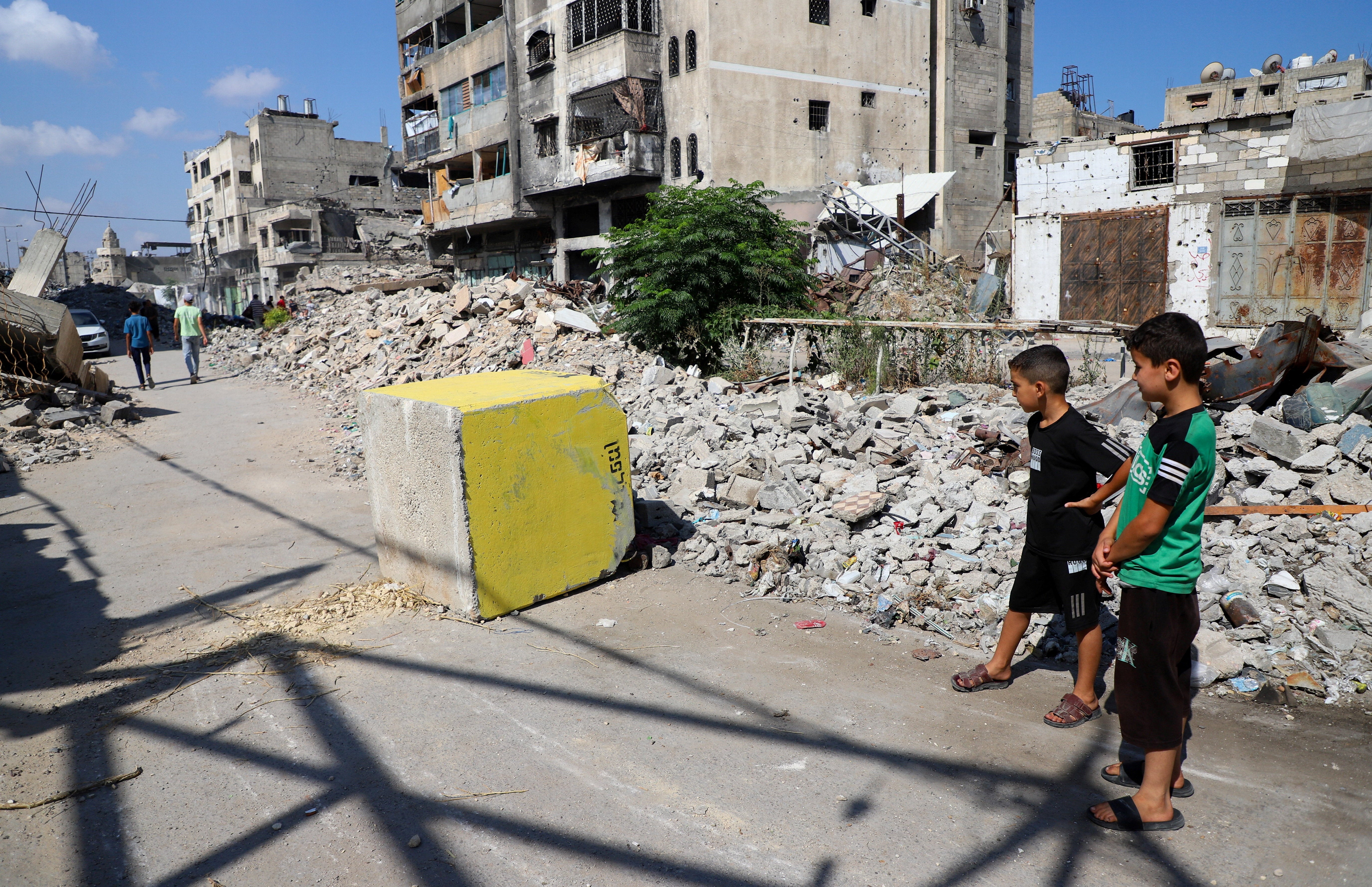
PHOTO CAPTION: Palestinian boys look at a yellow concrete block marking the "yellow zone" under Israeli military control, in Tufah neighborhood, in Gaza City, July 27, 2026. REUTERS/Ebrahim Hajjaj
CAIRO/GAZA, July 28 — Palestinian residents in several parts of Gaza say Israeli forces have moved forward the concrete markers defining an Israeli-controlled military zone, forcing families to leave their homes and shelters once again.
In Gaza City’s Zeitoun district, Assem Dawla loaded mattresses and bags onto a truck as yellow concrete blocks stood among the rubble nearby.
Dawla said it was the seventh or eighth time since the war began that his family had been forced to move because of Israeli evacuation orders and the advance of what residents call the yellow line.
Zeitoun is one of at least five areas where residents and Hamas officials say Israel has expanded the territory under its control in recent days by moving the line forward.
The military demarcation was established under a U.S.-brokered ceasefire reached in October.
As relatives carried their belongings through the debris, Dawla said continued Israeli military activity had made it too dangerous to remain.
“We are taking our belongings out and going to leave the place because the occupation has moved the yellow line all the way to Salah al-Din Street,” he said.
President Donald Trump’s October peace plan largely halted major fighting after two years of war in Gaza triggered by Hamas’ attack on southern Israel.
The plan called for increased humanitarian aid, governance by a civilian Palestinian administration, the disarmament of Hamas, the withdrawal of Israeli forces and the deployment of an international security force.
Progress on the plan has since stalled.
Israel effectively controlled an estimated 64% of Gaza by late April. Nearly all of the territory’s roughly 2 million residents are concentrated in a narrow coastal area under Hamas control, many living in damaged buildings or makeshift shelters under dire humanitarian conditions.
Hamas has refused to disarm. Israeli Prime Minister Benjamin Netanyahu said on May 28 that Israel intended to expand the area under its control to 70% of the enclave.
Israeli forces have also continued near-daily military strikes across Gaza.
Residents in Deir al-Balah, Khan Younis, Gaza City’s Zeitoun, Tuffah and Shejaia neighborhoods, and northern Rafah told Reuters that Israeli forces had advanced the yellow markers during the previous 10 days.
The reported movements triggered new displacement in areas already heavily damaged by months of conflict.
At least seven people interviewed by Reuters said some residents received warnings by text message or through drone-mounted loudspeakers before leaving.
The Israeli military said its forces were deployed in Gaza to protect Israel from attack and that the yellow line was being clearly marked to reduce the risk of contact between troops and civilians.
The military said its defensive posture included a security zone, physical barriers, intelligence and technological capabilities, and operations by Israeli troops.
For many families, displacement has become a repeated process of gathering the few belongings that survived earlier moves and leaving for another area designated as safe by the Israeli military.
Near the ruins of buildings in Zeitoun, Dawla’s mother, Umm Sami, walked through what remained of the family’s property and collected items that could still be salvaged.
“Why am I leaving? They became close, they put the yellow line here. The day before, they struck there, and we left,” she said of the Israeli military.
Like much of Gaza’s population, Dawla’s family has been displaced several times since the war began, rebuilding temporary shelters before being ordered to leave again.
In a July 20 statement, the United Nations Office for the Coordination of Humanitarian Affairs said an Israeli displacement order in Zeitoun forced 30 families from their tents. Residents said the tents were later destroyed.
As trucks carried away what remained of families’ belongings, residents faced another uncertain move.
“The whole war is displacement, displacement,” Dawla said. “You can’t stay anywhere without Israel telling you, ‘Get out of here, we want to come in.’”
(Source: Reuters)