Iran Claims Capture of U.S. Underwater Drone
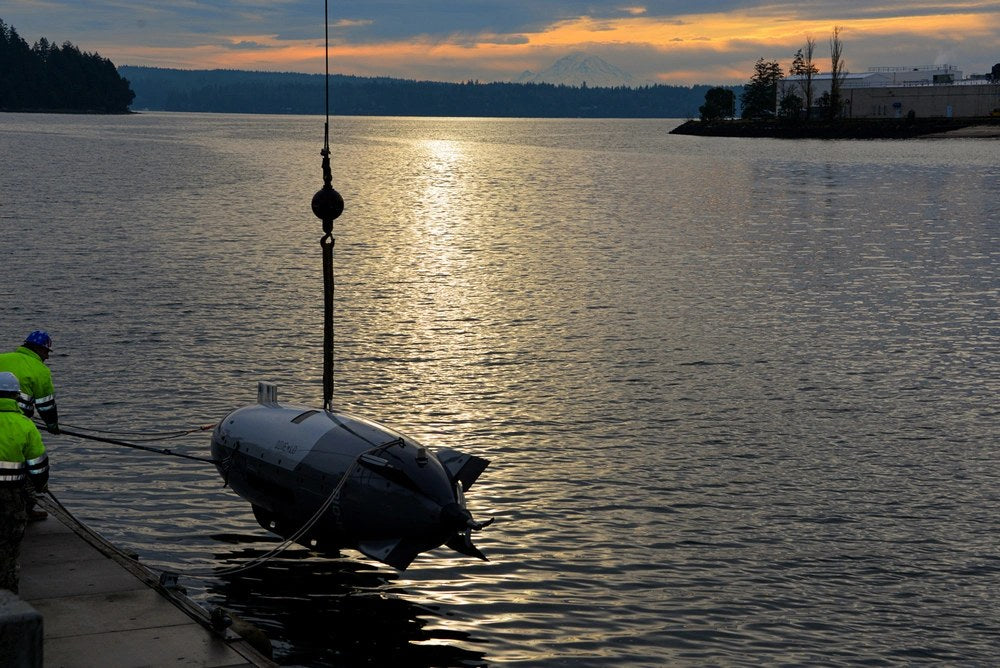
PHOTO CAPTION: U.S. Navy sailors train with an Anduril Dive-LD large unmanned undersea vehicle in December 2024. CENTCOM says a Dive-LD that malfunctioned near the Strait of Hormuz was later recovered by Iran. (U.S. Navy photo)
Iran announced Tuesday that its forces had captured an American unmanned underwater vehicle near the entrance to the Strait of Hormuz, portraying the recovery as a significant intelligence and military success.
U.S. Central Command tells a considerably different story: the underwater drone had malfunctioned more than a day earlier, was an older defective model, and wasn't carrying classified sonar or radar equipment.
Iran's Islamic Revolutionary Guard Corps Navy said the unmanned vehicle was taken during what it described as a complex intelligence and operational mission early Tuesday. Iranian state media described the vehicle as a highly advanced American system and said it had been seized as a "prize."
Photographs released by Iran show a large underwater vehicle matching the appearance of Anduril Industries' Dive-LD autonomous underwater vehicle. Naval analyst H.I. Sutton also reported that multiple visible details in the Iranian imagery closely match the American-built Dive-LD.
But when asked about Iran's announcement, CENTCOM spokesman Navy Capt. Tim Hawkins confirmed that an Anduril Dive-LD had malfunctioned while surveying waters in the region more than a day earlier.
CENTCOM said the U.S. military no longer possessed the vehicle, but its description undercut Iran's portrayal of the drone as a major intelligence windfall. Hawkins described it as an older, defective model that did not collect sensitive information and carried no classified sonar or radar.
CENTCOM also said the vehicle was operating in a commercially available configuration and that the military was not concerned about its loss.
That distinction matters because the Dive-LD itself isn't some secret submarine whose existence was revealed by Iran. Anduril openly markets the roughly 19-foot autonomous vehicle for both military and commercial missions, with published specifications including autonomous missions lasting up to 10 days and operating depths of up to 6,000 meters.
Its modular payload system allows it to perform missions ranging from surveillance and mine warfare to hydrographic surveys and underwater pipeline or cable inspections. Anduril says the platform relies heavily on commercial components and was designed to be produced at scale.
The U.S. Navy has nevertheless incorporated the Dive-LD into its unmanned undersea operations. Navy imagery from December 2024 shows sailors from Unmanned Undersea Vehicle Group 1 and Undersea Vehicle Squadron 3 training with what the service described as its newest large unmanned undersea vehicle, an Anduril Dive-LD.
The biggest unresolved question is exactly how the vehicle ended up in Iranian possession.
Iran says its forces deliberately detected, intercepted and captured the system. CENTCOM has confirmed the malfunction and acknowledged the United States no longer has the vehicle, but it has not publicly confirmed Iran's version of how the recovery occurred.
So for now, the two narratives could hardly be further apart.
Iran is presenting the Dive-LD as an advanced American underwater system successfully captured near one of the world's most contested maritime chokepoints.
CENTCOM's version is essentially: an older robot submarine broke, it wasn't carrying classified equipment, and Iran ended up with it.
(Source: OAF Nation)