Gun Owners Challenge AR-15 Bans
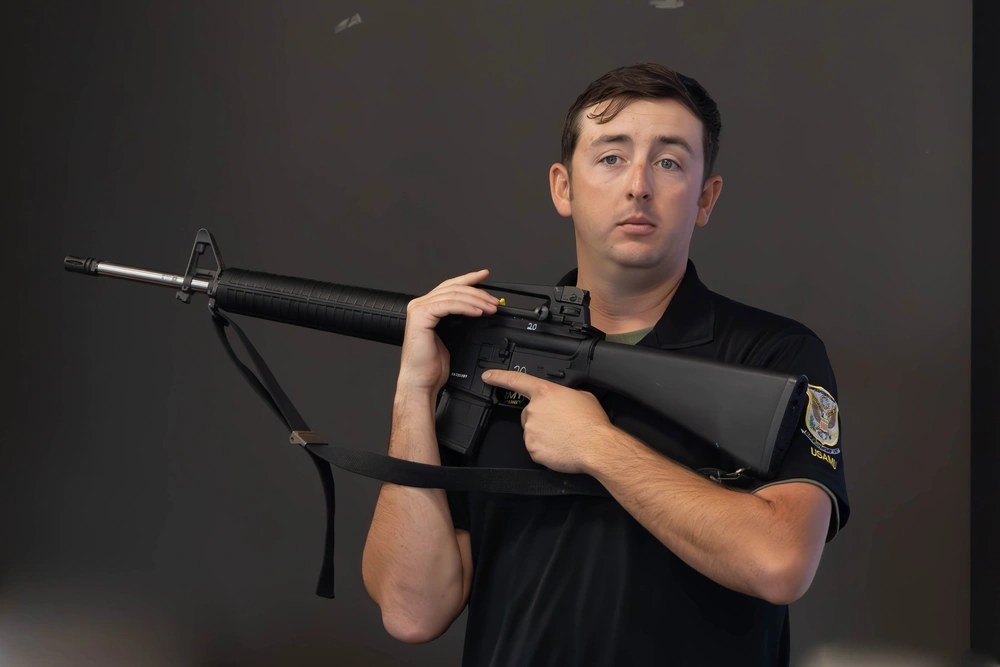
PHOTO CAPTION: U.S. Army Staff Sgt. Verne Conant, an instructor with the U.S. Army Marksmanship Unit, demonstrates with an AR-15 during a Civilian Marksmanship Program Rifle Marksmanship 101 course at Talladega Marksmanship Park in Alabama, Nov. 7, 2024. (U.S. Army photo by Serena Juchnowski)
Gun-rights challengers are asking the Supreme Court to rule that AR-15-platform rifles and similar semiautomatic firearms are protected by the Second Amendment, setting up one of the most consequential firearms cases to reach the justices in years.
The challengers filed their opening merits brief Aug. 28 in two consolidated cases challenging semiautomatic-rifle bans in Cook County, Illinois, and Connecticut. The Supreme Court agreed in June to hear the cases, but the new filing marks the beginning of the arguments over how the justices should ultimately rule.
The question before the Court is unusually direct: whether the Second and Fourteenth Amendments guarantee the right to possess “AR-15 platform and similar semiautomatic rifles.” The cases are Viramontes v. Cook County and Grant v. Higgins.
In their brief, the gun owners and gun-rights organizations argue that the Supreme Court’s previous Second Amendment decisions already establish the framework necessary to strike down the bans. They contend that AR-15s qualify as “arms” under the Constitution and cannot be prohibited because the rifles are commonly possessed by law-abiding Americans for lawful purposes.
The challengers point heavily to the Supreme Court’s 2008 decision in District of Columbia v. Heller, which struck down Washington, D.C.’s handgun ban. They argue that the same principle protecting firearms that are in common lawful use should apply to AR-15-platform rifles.
“Tens of millions of Americans choose them for lawful purposes like self- and home-defense, hunting, and target shooting,” the challengers wrote, arguing that the rifles are legal to own in a large majority of states.
Lower courts reached the opposite result in the cases now before the Supreme Court. The Seventh Circuit allowed Cook County’s restrictions to stand, while the Second Circuit upheld Connecticut’s ban after concluding that its restrictions were consistent with the nation’s historical tradition of firearm regulation. The challengers are asking the Supreme Court to reverse both decisions.
The outcome could extend well beyond Illinois and Connecticut. Several states and local governments restrict firearms they classify as assault weapons, and other pending Second Amendment cases could be affected by how the Supreme Court defines the constitutional protection afforded to semiautomatic rifles. A recent Justice Department filing in a separate machine-gun case acknowledged that the ruling in Viramontes and Grant could affect other firearms litigation.
The Supreme Court has not yet decided that AR-15s are constitutionally protected. Its June 30 action only agreed to hear the dispute, making the Aug. 28 brief the challengers’ argument for why the justices should now rule in their favor.
Cook County and Connecticut have until Oct. 21 to file their merits briefs defending the restrictions. The cases have been consolidated for one hour of oral argument during the Supreme Court’s 2026 term.
(Source: OAF Nation)