WWII Remains Head to Hawaii Lab
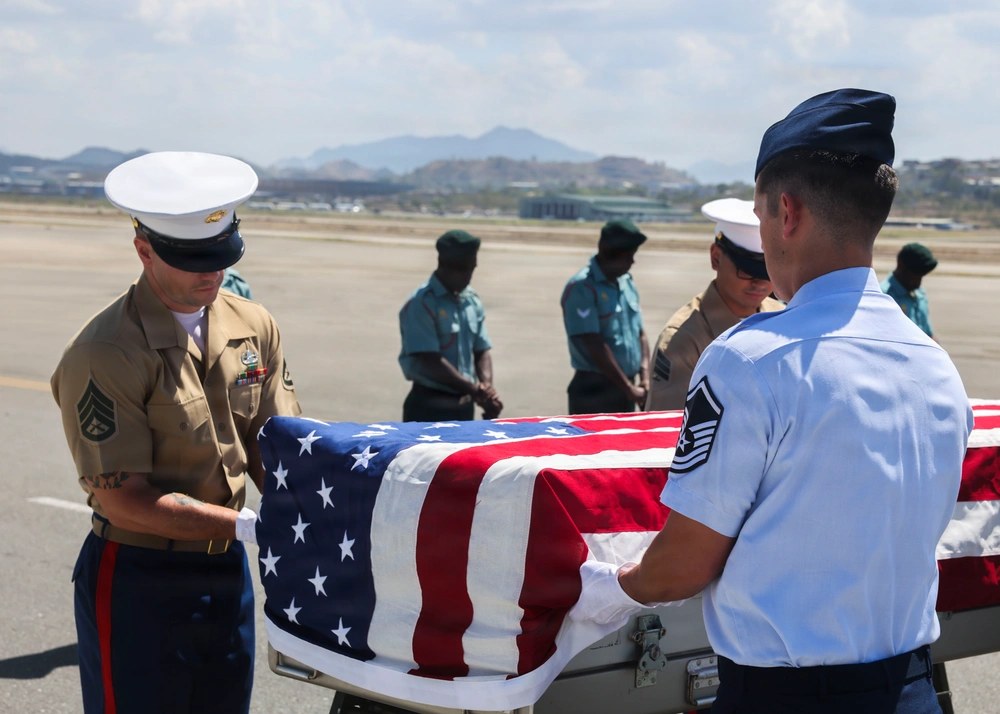
PHOTO CAPTION: U.S. service members prepare a flag-draped transfer case during a Defense POW/MIA Accounting Agency repatriation ceremony in Port Moresby, Papua New Guinea, Sept. 2, 2026. The case will be transported to DPAA’s laboratory in Hawaii for possible identification and accounting. (U.S. Air Force photo by Staff Sgt. David Busby)
Possible remains of U.S. service members missing since World War II are on their way from Papua New Guinea to Hawaii after a recovery mission searching for Americans who disappeared during some of the Pacific war’s most brutal fighting.
U.S. personnel with the Defense POW/MIA Accounting Agency and members of the Papua New Guinea Defence Force held a repatriation ceremony in Port Moresby on Wednesday, Sept. 2. A transfer case was prepared for transportation to DPAA’s laboratory at Joint Base Pearl Harbor-Hickam, where scientists will work to determine whether the recovered material can be identified and accounted for.
The recovery effort took personnel into Papua New Guinea searching for evidence of Americans lost during World War II. Local reporting said teams worked with Papua New Guinean personnel in East New Britain and New Ireland as part of the latest mission.
Approximately 3,300 U.S. personnel from World War II remain unaccounted for in Papua New Guinea alone, according to DPAA. Across the entire war, roughly 71,680 Americans remain unaccounted for.
Papua New Guinea was the site of some of the Pacific theater’s hardest campaigns, with U.S. and Allied forces fighting across jungles, mountains, islands and coastlines. Many of the Americans who never returned were lost in remote terrain where wreckage and burial sites could remain hidden for decades.
The United States has conducted recovery work in Papua New Guinea for decades, relying heavily on cooperation from local communities and government agencies to locate potential burial sites, aircraft wreckage and other evidence. DPAA teams were still excavating and screening soil for evidence of missing WWII personnel in the country this summer.
Wednesday’s ceremony does not mean the recovered remains have been positively identified. The transfer case is being sent to DPAA’s Hawaii laboratory for scientific analysis and possible identification, a process that can involve forensic anthropology, dental records, DNA testing and other evidence before a missing service member can be formally accounted for.
For families whose relatives disappeared more than eight decades ago, those identifications can finally answer questions that have lasted generations.
Source: Defense POW/MIA Accounting Agency; The National, Papua New Guinea