Carlson Claims Trump Nuclear Strike Plan
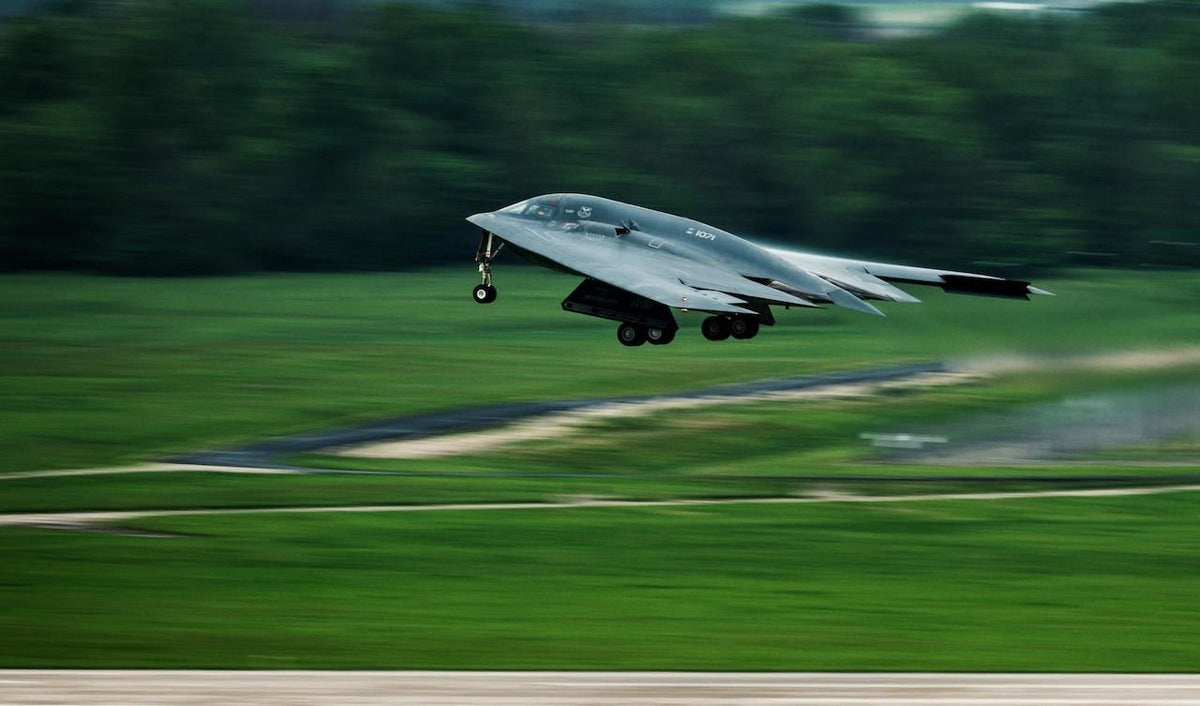
PHOTO CAPTION: A U.S. Air Force B-2 Spirit bomber takes off during Exercise Spirit Vigilance at Whiteman Air Force Base, Missouri, on August 27, 2026. The aircraft can carry conventional and nuclear weapons. The White House has rejected Tucker Carlson's claim that a nuclear strike on Iran is being planned. (U.S. Air Force photo by Senior Airman Joseph Garcia. File photo.)
Tucker Carlson has sparked widespread concern after claiming President Donald Trump could authorize a nuclear strike against a deeply buried Iranian facility, warning that such an attack could trigger catastrophic consequences across the Middle East and potentially beyond.
The allegation, circulated in a lengthy November 1 social media post, attracted tens of millions of views and intensified debate over whether the United States is preparing to escalate its eight-month war with Iran.
Carlson specifically identified Pickaxe Mountain, a heavily fortified underground complex near Iran's Natanz nuclear facility, as a possible target.
But a review of public statements, military reporting and independent nuclear research reveals an important distinction.
Trump has repeatedly threatened to attack Pickaxe Mountain. The United States has also continued conventional military operations against Iran.
However, no publicly verified evidence establishes that the president has ordered, approved or is preparing a nuclear strike.
In fact, Trump explicitly ruled out using a nuclear weapon against Iran in an October interview, and the White House has rejected Carlson's suggestion that he has inside knowledge of military planning.
What Tucker Carlson Actually Claimed
In his November 1 post, Carlson alleged that Israeli Prime Minister Benjamin Netanyahu was pressuring Trump to launch a nuclear strike against Pickaxe Mountain.
He argued that the underground facility was too heavily protected to be destroyed using conventional weapons.
"The only military option is a nuclear strike," Carlson asserted.
He also suggested a nuclear attack could occur within days and warned that radioactive fallout could contaminate regional water supplies and provoke a wider international conflict.
The post attracted more than 50 million views by November 2, according to reporting by The Times of Israel.
That figure demonstrates the reach of the allegation, not its accuracy or the number of people who believe it.
Carlson cited an unnamed observer for part of his account of Netanyahu's alleged pressure campaign.
He did not publicly provide documentary evidence, identified officials with direct knowledge, or independently verifiable military planning records establishing that a nuclear attack was being prepared.
His predictions about the consequences of nuclear escalation are separate from the question of whether the administration is actually considering such an attack.
The White House Rejected His Claim
The White House responded to Carlson's allegation on November 2.
In a statement to The War Zone, an administration official said Trump had multiple options available concerning Iran and would make decisions based on American national security.
The official also rejected Carlson's claimed access to military planning and the president's thinking.
That response did not mean the administration ruled out additional conventional strikes against Iran.
It challenged the suggestion that Carlson's account accurately reflected internal plans for nuclear-weapons use.
The distinction is important because the administration has publicly discussed attacking Pickaxe Mountain, even while rejecting the nuclear scenario.
Trump Has Threatened Pickaxe Mountain but Ruled Out Nuclear Weapons
On October 16, Reuters reported that Trump had discussed potentially attacking the underground complex during a Newsmax interview.
Trump said the United States might need to strike Pickaxe Mountain to prevent Iran from developing nuclear weapons.
He also explicitly ruled out nuclear use.
"I wouldn't use nuclear. We don't have to," Trump said.
That statement directly contradicts the idea that nuclear weapons are the only option he is prepared to consider.
Trump has continued discussing the facility.
During a November 2 interview with Fox News host Sean Hannity, the president again suggested the United States might attack Pickaxe Mountain, claiming American forces could act quickly if ordered.
But he did not announce a nuclear strike.
Public threats of conventional military action are not evidence that nuclear weapons have been selected for the mission.
Nor do public denials prove what every classified military contingency plan contains.
The available evidence supports the conclusion that Pickaxe Mountain is a potential American target, not that a nuclear attack has been authorized.
What Is Pickaxe Mountain?
Pickaxe Mountain, also known as Kuh-e Kolang Gaz La, is an underground complex near Iran's Natanz nuclear installation.
Satellite imagery has revealed an extensive network of tunnels, reinforced entrances, access roads and construction activity.
Its depth and surrounding rock make it a difficult target for conventional weapons.
The complex has attracted attention because of concerns that Iran could use it to protect sensitive nuclear equipment or activities from airstrikes.
However, the exact contents and operational status of the underground facility remain uncertain.
A September assessment by the Center for Strategic and International Studies found extensive construction and reinforcement activity but said satellite imagery could neither confirm nor disprove claims that Iran had moved centrifuges into the complex.
Researchers also said the available imagery suggested the facility was not yet capable of conducting enrichment operations.
An October 16 assessment from the Institute for Science and International Security found that access to the tunnel entrances remained restricted.
The organization concluded that the complex was not conducting major construction or normal operations at that time, although it could contain valuable equipment or materials.
Those assessments highlight the limits of publicly available evidence.
Pickaxe Mountain is a real, heavily fortified facility associated with Iran's nuclear infrastructure. But precisely what is happening deep inside it has not been independently established.
Does Its Depth Mean Nuclear Weapons Are the Only Option?
Carlson's central military argument is that the underground complex is beyond the reach of conventional American weapons, leaving a nuclear strike as the only possible means of attacking it.
Military analysts dispute that conclusion.
The United States possesses large conventional bunker-penetrating weapons developed for hardened underground targets.
The effectiveness of those weapons against Pickaxe Mountain's deepest chambers is uncertain.
But a strike does not necessarily have to destroy every underground chamber to interfere with a facility's operations.
Conventional attacks could potentially damage entrances, access routes, support infrastructure or other vulnerable components.
Such measures could also fail to permanently disable the installation.
The War Zone interviewed nuclear-weapons and arms-control specialists who described non-nuclear alternatives and emphasized that a deeply buried target does not automatically require a nuclear attack.
Those alternatives carry their own military risks and limitations.
The central point is that uncertainty about conventional weapons' effectiveness is not evidence of a decision to employ nuclear weapons.
The U.S. Is Still Conducting Military Operations Against Iran
Although the nuclear allegation remains unverified, renewed American military action is not hypothetical.
On November 2, U.S. forces conducted strikes against targets on Iran's Qeshm Island in the Strait of Hormuz.
American officials described the operation as defensive, saying it targeted capabilities that threatened U.S. forces.
The strikes occurred as the administration continued considering its options in the prolonged conflict.
The military campaign began in February with coordinated American and Israeli attacks on Iran.
Since then, fighting has affected shipping, regional security, energy prices and American military operations throughout the Middle East.
According to November 5 Associated Press reporting, the administration faces decisions about whether to continue limited operations, pursue negotiations or authorize further escalation.
Pickaxe Mountain remains among the potential targets being publicly discussed.
But the existence of ongoing conventional strikes does not substantiate the separate allegation that nuclear weapons are being prepared.
What Would a Nuclear Strike Mean?
Using a nuclear weapon against Iran would represent an extraordinary escalation.
The United States has not used a nuclear weapon in combat since the atomic bombings of Japan in August 1945.
Nuclear-weapons experts interviewed by The War Zone warned that an attack against a deeply buried installation could cause devastating destruction and spread radioactive material beyond the immediate target area.
The extent of fallout would depend on factors including weapon yield, detonation characteristics, terrain and weather.
There would also be major diplomatic, humanitarian and strategic consequences.
However, Carlson's more specific predictions, including inevitable world war and hundreds of millions of deaths, are not established outcomes.
Nuclear escalation could create severe international risks without making one particular global chain of events certain.
The catastrophic potential of nuclear weapons is well documented. A prediction about how other governments would respond remains an assessment rather than a verified fact.
What the Evidence Actually Establishes
As of November 5, the public record supports several conclusions.
Carlson alleged that Trump could soon authorize a nuclear strike against Pickaxe Mountain under pressure from Netanyahu.
The allegation attracted enormous attention, but Carlson did not publicly establish its central claims with verifiable evidence.
Trump has repeatedly identified Pickaxe Mountain as a possible target, while explicitly ruling out nuclear weapons in an October interview.
The White House has challenged Carlson's claimed insight into military decision-making.
Independent researchers confirm that the underground facility is heavily fortified, but its precise operational status remains uncertain.
American forces have also conducted additional conventional strikes against Iran, confirming that military activity in the region continues.
What remains unverified is the central allegation that Trump is preparing to use nuclear weapons.
For American troops serving in the Middle East and their families, the difference matters.
Additional conventional strikes would carry serious operational and regional risks. A nuclear attack would represent a far more consequential escalation.
The evidence warrants scrutiny of the administration's military decisions and threats against Pickaxe Mountain.
It does not currently justify presenting a nuclear strike as imminent or approved.
(Source: OAF Nation)