Judge Upholds Colorado Gun Law
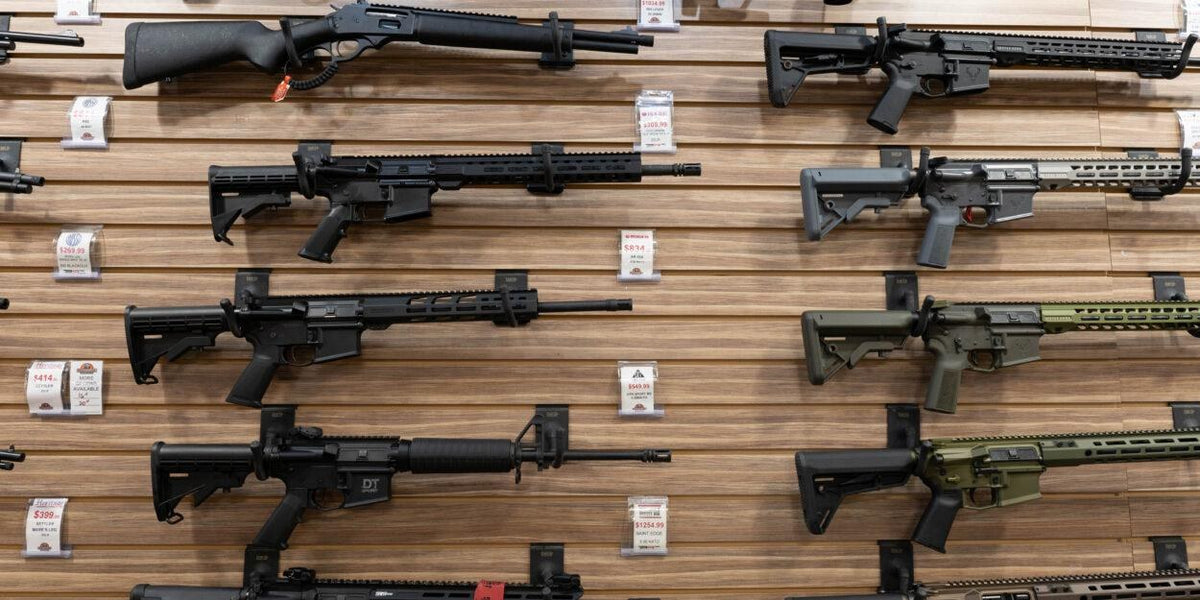
PHOTO CAPTION: Semiautomatic rifles are displayed for sale at Bristlecone Shooting, Training and Retail Center in Lakewood, Colorado, on January 16, 2025. A federal judge ruled November 4, 2026, that Colorado can continue enforcing training and eligibility requirements for purchases of certain semiautomatic firearms while a Second Amendment lawsuit proceeds. (Jesse Paul/The Colorado Sun. File photo.)
A federal judge has refused to block Colorado's restrictions on the purchase of certain semiautomatic firearms, allowing the state to continue enforcing mandatory firearms training and eligibility requirements while a Second Amendment lawsuit moves forward.
Senior U.S. District Judge William J. Martínez issued the 35-page ruling Wednesday, November 4, rejecting a request for a preliminary injunction filed by six individuals and the Colorado State Shooting Association.
The restrictions, which took effect August 1, 2026, generally prohibit the sale and purchase of specified semiautomatic firearms unless buyers complete an approved training process and receive an eligibility card.
The law covers many popular rifles that accept detachable magazines, including configurations of AR-15-style firearms.
Challengers argue that the requirements impose unconstitutional burdens on law-abiding gun owners.
Colorado officials maintain that the measures are lawful public safety regulations.
The judge concluded that the plaintiffs had not demonstrated a sufficient likelihood of succeeding on their Second Amendment claims to justify suspending the restrictions before the case is resolved.
The ruling keeps the existing law in place. It does not end the lawsuit or permanently settle the question of its constitutionality.
What Colorado's New Gun Law Requires
Colorado Senate Bill 25-003 was signed into law in April 2025 and took effect on August 1, 2026.
The law restricts the manufacture, distribution, sale, transfer and purchase of specified semiautomatic firearms, subject to exceptions.
Affected firearms include certain semiautomatic rifles and shotguns with detachable magazines and certain gas-operated semiautomatic handguns.
Under the law, qualifying buyers must complete approved firearms safety education and obtain an eligibility card before purchasing a covered firearm.
There are two principal training pathways.
Applicants who meet the qualifying hunter-education requirements must complete an additional four-hour firearms safety course.
Other applicants generally must complete a more extensive 12-hour course conducted over two days.
The courses must be taught by appropriately verified instructors, and completion information is entered into a statewide system.
A county sheriff generally must issue an eligibility card to an applicant who satisfies the statutory requirements.
However, the sheriff may deny the card based on documented previous behavior indicating that the applicant is likely to present a danger to themselves or others.
The law also creates criminal penalties for prohibited transactions.
A first violation can be charged as a class 2 misdemeanor, while subsequent violations may result in a class 6 felony.
Does the Law Ban Existing Rifles?
The distinction between buying a firearm and already owning one is important.
Colorado's new restrictions primarily address specified transactions involving covered semiautomatic firearms.
They do not establish a general requirement that every person who legally owned an affected rifle before August 1 surrender it.
The law also contains exemptions and exceptions for certain firearms, transfers and qualifying activities.
A firearm's exact configuration matters when determining whether it is covered.
That means the legislation should not be described as a blanket prohibition on all semiautomatic rifles or all existing firearm ownership in Colorado.
For prospective buyers, however, the restrictions can impose additional steps, costs and delays before a covered purchase can be completed.
Those requirements are at the center of the federal lawsuit.
Gun Owners Argue the Requirements Violate the Second Amendment
Six individuals and the Colorado State Shooting Association challenged the law in federal court in a case known as Del Toro v. Polis.
The plaintiffs argue that Colorado has imposed excessive conditions on purchasing firearms protected by the Second Amendment.
They raised concerns about the time and money required to complete training, the availability of approved courses, and the responsibilities assigned to county sheriffs.
Their argument also relies on the Supreme Court's 2022 decision in New York State Rifle & Pistol Association v. Bruen.
That ruling established an approach to Second Amendment cases that examines whether challenged firearm regulations are consistent with the nation's historical tradition of firearm regulation.
The challengers maintain that semiautomatic rifles are commonly possessed by law-abiding Americans for lawful purposes, including self-defense.
They argue that the state cannot impose burdensome licensing and training requirements on the acquisition of constitutionally protected firearms.
The plaintiffs sought a preliminary injunction that would have temporarily stopped enforcement of the challenged provisions while the lawsuit continued.
Judge Says Plaintiffs Have Not Shown They Are Likely to Win
Judge Martínez rejected that request.
In his November 4 opinion, Martínez concluded that the challengers had not demonstrated they were substantially likely to succeed on their constitutional claim.
A central issue was whether the firearms covered by the law were shown, on the evidence presented, to be commonly used by law-abiding citizens for self-defense.
The judge concluded that the plaintiffs had not made the necessary showing.
He also discussed the destructive capabilities of certain semiautomatic firearms and their use in mass shootings.
Because the plaintiffs had not satisfied the initial stage of the constitutional analysis, Martínez did not proceed to a full historical comparison of the law with earlier American firearm regulations.
The court also found that the remaining factors governing preliminary injunctions did not justify blocking the restrictions.
As a result, Colorado can continue enforcing the challenged provisions.
The ruling does not prevent the plaintiffs from pursuing their constitutional claims as the case proceeds.
Colorado Defends the Restrictions as Public Safety Measures
Colorado officials have defended the law as a measure intended to reduce gun violence while allowing qualified individuals to purchase covered firearms after completing safety education.
The state has argued that requirements imposed on the purchase of certain weapons are compatible with constitutional protections.
Supporters of the legislation say training and eligibility screening can help establish whether prospective buyers understand firearm safety and meet the state's qualifications.
Opponents counter that training requirements, fees and administrative delays can make exercising a constitutional right more difficult, particularly for residents with limited access to approved courses.
The disagreement extends beyond whether firearms training is valuable.
It concerns whether the government can require particular training and approval procedures before a qualified person may purchase commonly owned semiautomatic firearms.
That constitutional question remains contested.
The Case Could Become Part of a Larger National Gun Rights Debate
The Colorado lawsuit comes amid continuing disagreement in federal courts over how the Second Amendment applies to restrictions involving AR-15-style rifles and similar firearms.
Different federal appeals courts have reached differing conclusions about whether particular restrictions on these weapons are constitutional.
Those disagreements have increased attention on potential Supreme Court review.
The outcome of future federal cases could affect how lower courts evaluate state firearm restrictions, including Colorado's law.
But Wednesday's order applies to an immediate request for relief in this particular lawsuit.
It is not a final decision by the Supreme Court and does not resolve every challenge involving semiautomatic firearms nationwide.
What Happens Next?
For now, Colorado residents seeking to purchase covered semiautomatic firearms must continue following the state's eligibility and training requirements.
Existing exemptions remain relevant, and the precise rules depend on the firearm and transaction involved.
The plaintiffs can continue litigating their lawsuit and may pursue further legal options concerning the injunction ruling.
Future court decisions could change the law's enforceability, but no such change resulted from Wednesday's decision.
For gun owners and Second Amendment advocates, the immediate consequence is straightforward.
Colorado's new requirements remain in place, and a federal court has declined to suspend them while the constitutional challenge continues.
The larger question of whether those restrictions ultimately withstand judicial review has not yet been settled.
(Source: OAF Nation)