Article: Bukele's Social Media Strike on Gang
Bukele's Social Media Strike on Gang
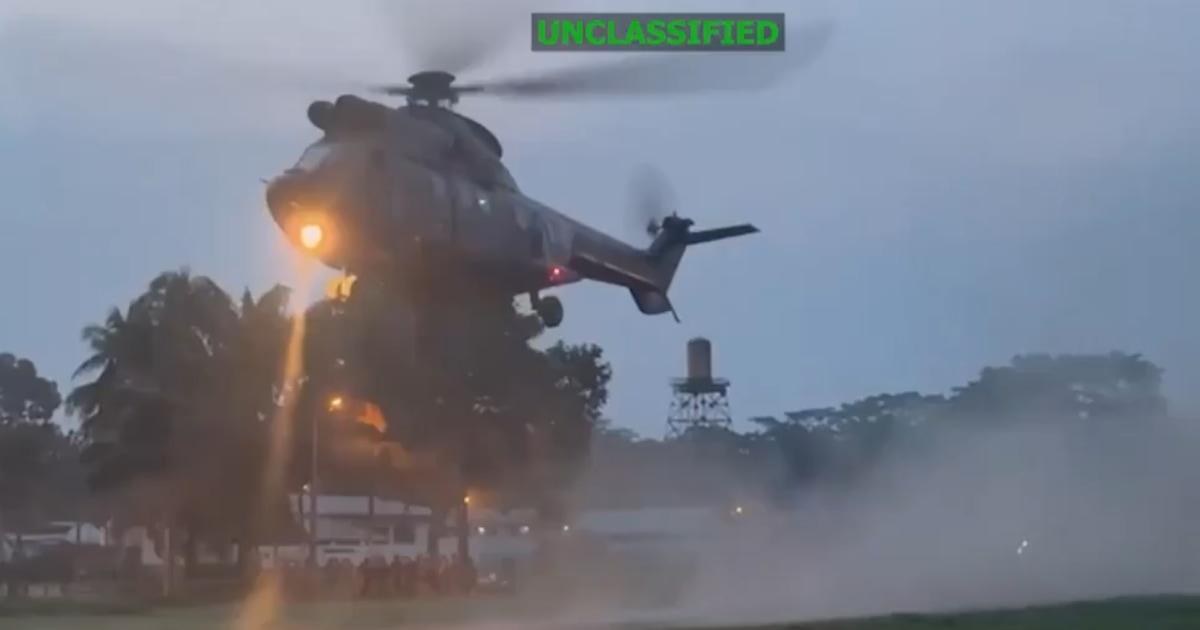
PHOTO CAPTION: Helicopters fire on a compound in Croix-des-Bouquets, Haiti, in footage released November 10, 2026, by Salvadoran President Nayib Bukele. He identified the property as the headquarters of the 400 Mawozo gang and the residence of its leader, Wilson Joseph. The operation reportedly occurred November 8 and involved Haitian and Salvadoran forces. Joseph was not killed, and the full extent of the casualties and damage remains unverified. (Video still released by Nayib Bukele.)
El Salvador's president publicly asked social media users where a notorious Haitian gang leader's compound was located.
Days later, helicopters were filmed firing on the property.
President Nayib Bukele released footage November 10 that he said showed Salvadoran and Haitian forces destroying the headquarters of the 400 Mawozo gang, one of Haiti's most powerful armed criminal organizations.
The operation reportedly took place November 8 in Croix-des-Bouquets, northeast of Port-au-Prince.
The extraordinary sequence began when Bukele responded to an online photograph of a large residence reportedly linked to gang leader Wilson Joseph, known as Lanmò San Jou.
Bukele asked for its exact address and said the property would be destroyed.
Social media users responded with possible locations.
Within days, the Salvadoran president posted a video of helicopters firing on a compound that he identified as the gang leader's residence.
Haitian authorities have welcomed Salvadoran military assistance in their fight against the gangs.
However, the operation has raised questions about how the foreign troops are operating, the legal framework governing their deployment and the risk to civilians.
President Publicly Asked for the Compound's Location
On November 6, Bukele responded to an X post displaying a large residence allegedly belonging to Wilson Joseph.
Writing in Haitian Creole, the president asked where the house was located and requested its exact address.
He said his forces would destroy it.
Users subsequently responded with possible coordinates and descriptions of the property.
The exchange drew attention because it appeared to show a sitting president publicly identifying a potential military target through social media.
But the posts alone do not establish how Salvadoran or Haitian military planners selected or verified the target.
There is no public confirmation that the coordinates provided by online users were used to direct the eventual strike.
Military targeting normally involves intelligence collection, verification and assessment of potential risks to civilians.
Whether those processes were followed in this operation has not been fully disclosed.
Helicopters Fire on Suspected Gang Headquarters
On November 10, Bukele published a video showing helicopters operating above a large compound.
The footage includes aerial views of the property, helicopters firing toward the site, explosions and smoke rising from the area.
The video also shows people apparently fleeing.
Bukele announced that the residence and headquarters of 400 Mawozo had been destroyed.
He claimed most gang members fled rather than fighting.
Local reporting places the operation on November 8, two days before Bukele released the footage.
The Associated Press subsequently reported that Haitian police and Salvadoran troops had attacked the property and that Wilson Joseph was not killed.
Some media outlets reported approximately 20 deaths associated with the operation.
However, the identities of those killed, the full casualty count and the extent of civilian harm have not been independently established in the reporting reviewed.
The president's published video supports that an armed operation was recorded, but a promotional video is not a substitute for an independent assessment of the strike's results.
Who Is Wilson Joseph?
Wilson Joseph, also known as Lanmò San Jou, leads the 400 Mawozo gang.
The organization has operated in and around Croix-des-Bouquets, an area northeast of Haiti's capital.
It has been associated with kidnappings, extortion, killings and armed control of communities.
The gang gained international notoriety in 2021 when 17 missionaries and family members, including American citizens, were abducted in Haiti.
Since then, Haiti's security situation has deteriorated as armed groups expanded their influence.
Gangs control major routes, disrupt commercial activity and threaten residents in and around Port-au-Prince.
Haitian police have struggled to restore government authority in numerous neighborhoods.
International partners have attempted to reinforce security operations, but violence has continued.
Joseph remains a prominent figure among the country's armed criminal groups.
Despite the attack on the property reportedly associated with him, authorities have not announced his capture or death.
Four Missing Salvadoran Technicians Triggered Deployment
The latest operation follows a major Salvadoran military deployment to Haiti.
On October 18, four Salvadoran aviation technicians supporting a United Nations-backed gang suppression mission disappeared following an attack in gang-controlled territory.
Their fate remains unresolved.
Bukele's government responded by sending substantial reinforcements to Haiti.
Approximately 2,500 Salvadoran military personnel have since been deployed.
The Salvadoran president has pledged to recover the missing technicians and confront the armed groups responsible for violence.
The deployment represents an unusually large foreign military commitment by El Salvador.
Bukele has portrayed the mission as an opportunity to apply the aggressive anti-gang strategy used in his own country.
His administration credits its security campaign with dramatically reducing homicide rates in El Salvador.
But human rights organizations have documented allegations of arbitrary detention, due process violations and mistreatment associated with the country's prolonged state of emergency.
The challenge in Haiti is also different from the one El Salvador faced domestically.
Haitian gangs have developed entrenched territorial control, access to substantial weaponry and complex connections to political and economic networks.
Haiti's Government Supports Cooperation
Haitian Prime Minister Alix Didier Fils-Aimé publicly thanked Bukele following the operation.
He said cooperation with Salvadoran troops, Haitian police, Haitian soldiers and international partners would continue as the government attempts to reclaim territory.
The Dominican Republic, which shares the island of Hispaniola with Haiti, has also announced logistical and intelligence support for the Salvadoran deployment.
President Luis Abinader said his government is coordinating with El Salvador and called for stronger cooperation among the forces operating in Haiti.
This regional support is significant because the Salvadoran troops have been operating alongside several different organizations and security forces.
Those include Haiti's own police and military, a United Nations-backed Gang Suppression Force and private security personnel.
Their presence creates challenges involving command structures, intelligence sharing and the prevention of unintended confrontations.
Questions Remain About the Military Mission
Amnesty International has urged the governments of Haiti and El Salvador to publish the agreement governing the Salvadoran deployment.
The organization has also requested clarification of the troops' rules of engagement, oversight mechanisms and procedures for addressing alleged abuses.
The concern is that many Salvadoran troops reportedly operate outside the formal command structure of the United Nations-backed force.
A deployment can have the host government's support while still raising unanswered questions about command authority and accountability.
International security analysts have warned that military attacks against gang positions can result in civilian casualties, displacement and retaliation.
They also caution that destroying a prominent building does not necessarily dismantle the organization operating from it.
The Haitian government has defended its cooperation with Salvadoran forces as part of its effort to restore security.
But officials have not publicly released enough operational detail to establish the full circumstances of the November 8 strike.
A Military Operation Announced Through Social Media
What makes this incident unusual is the public sequence surrounding the attack.
A president responded to a photograph of an alleged gang leader's property and requested its location.
Social media users offered possible answers.
Days later, the president published video showing helicopters firing on a compound and declared the target destroyed.
That sequence is documented.
What remains uncertain is whether online suggestions materially contributed to the military's targeting decision.
The available reporting also does not establish how many gang members were killed, whether civilians were harmed or how much of the suspected headquarters was destroyed.
The claimed target, Wilson Joseph, was not killed.
For Haiti's government, the operation represents another effort to challenge armed groups that have held territory and threatened civilians for years.
For Bukele, it demonstrates his willingness to project military force beyond El Salvador's borders.
Whether the campaign can weaken Haiti's gangs over the long term, or simply drive them into new areas, remains an unresolved question.
(Source: OAF Nation)