Congress Considers Military Repair Rights
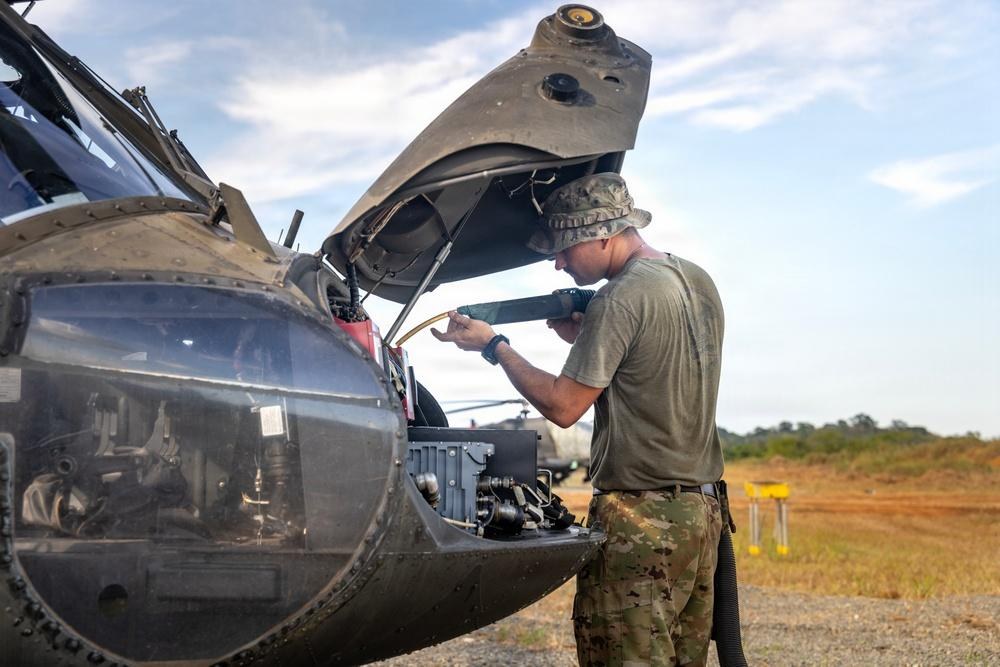
PHOTO CAPTION: U.S. Army Sgt. Tanner Guidry conducts a maintenance inspection on a UH-60 Black Hawk helicopter during Exercise Balikatan 2026 in the Philippines. Congress is considering legislation to expand the military's access to technical data and repair capabilities, while defense industry groups are seeking changes to protect proprietary technology. The photograph is illustrative and does not show the disputed $15 control knob or $47,000 display assembly. (U.S. Army file photo by Sgt. Olivia Cowart.)
A broken control knob on an Army Black Hawk helicopter can reportedly turn a $15 repair into a $47,000 replacement.
The problem is not necessarily that the part is technically difficult to fix. According to military officials and lawmakers, the Army lacks the rights needed to manufacture or replace certain components independently.
Instead, it can be forced to purchase much larger assemblies from the original manufacturer.
Now Congress is considering legislation intended to give military personnel greater control over repairing equipment the government already owns.
But major defense industry organizations are pushing back.
A November 9 investigation by Breaking Defense reveals that contractors and trade associations are lobbying against provisions in the 2027 National Defense Authorization Act that would expand the Pentagon's access to technical information, software and repair capabilities.
The companies argue the changes could expose valuable intellectual property and discourage investment in military technology.
Supporters say the restrictions can leave troops waiting for outside contractors, delay equipment repairs and increase costs to taxpayers.
How a $15 Part Becomes a $47,000 Problem
During a Senate Armed Services Committee hearing in May, Sen. Elizabeth Warren described a recurring maintenance problem involving the Army's UH-60 Black Hawk helicopter.
According to Warren, approximately four small display control knobs break each month across the fleet.
The Army could reportedly manufacture a replacement knob for about $15.
But because of restrictions on repairs and access to manufacturer-controlled technology, the military instead has to replace the larger screen assembly.
The reported cost: $47,000.
Warren raised the example while questioning then-Army Secretary Dan Driscoll about the military's dependence on defense contractors.
Driscoll supported expanding military repair rights and warned that without them, American forces could be placed at a disadvantage against adversaries.
The figures came from congressional testimony, not a newly discovered repair bill or an independent audit of every Black Hawk repair.
But the underlying issue extends beyond helicopters.
Military equipment can be difficult or expensive to maintain when service members lack technical drawings, manufacturing information, specialized software or permission to work on certain components.
Troops Can Be Dependent on Contractors
Military maintainers are trained to repair aircraft, vehicles, weapons systems and communications equipment.
But their ability to perform a repair does not always mean the military possesses the necessary contractual rights or technical information.
Some equipment is manufactured using proprietary designs, software and specialized tools.
When the Pentagon purchases a system without obtaining sufficient rights to maintain it independently, the original manufacturer may remain the only authorized provider for particular repairs.
That can create what acquisition officials call vendor lock.
The Government Accountability Office documented the problem in a September 2025 report examining five military weapon-system programs.
GAO found that all five relied on sole-source maintenance arrangements and lacked some of the technical data rights necessary for the military to perform certain higher-level repairs itself.
Officials told investigators that these limitations could increase costs, restrict access to replacement parts and lengthen repair timelines.
The problem can become especially significant when equipment is deployed overseas and service members cannot simply send it to a nearby commercial repair facility.
Congress Wants to Change the Rules
The House and Senate Armed Services Committees have advanced separate proposals intended to strengthen the military's right to repair.
Both would establish broader government-purpose rights to technical data and software under covered defense contracts.
That would allow the Pentagon to use certain information for government purposes and share it with other contractors performing authorized government work.
It would not automatically authorize commercial competitors to sell the original manufacturer's designs on the open market.
The House proposal, Section 861, was sponsored by Reps. Maggie Goodlander of New Hampshire and Pat Harrigan of North Carolina.
It was adopted through a voice vote.
The Senate Armed Services Committee approved its own provision, Section 804, by a 27-0 vote.
That language originated in legislation backed by Sens. Elizabeth Warren of Massachusetts and Tim Sheehy of Montana.
The bipartisan backing is significant because supporters from both parties argue that military maintenance requirements should not depend entirely on private contractors.
The House and Senate provisions are not identical.
The House version applies to future contracts, while the Senate committee's proposal contains additional provisions allowing the government to recover certain funds when a contractor improperly obtains more restrictive data rights.
Those differences will need to be resolved before any final legislation is enacted.
Defense Industry Groups Push Back
Defense industry organizations argue that the proposed changes reach too far.
The Aerospace Industries Association, National Defense Industrial Association and U.S. Chamber of Commerce are among the groups that have raised concerns.
In September, 15 industry organizations urged congressional leaders to adopt a narrower approach.
Then, on November 4, the Professional Services Council sent another letter opposing the broad right-to-repair provisions.
The council argued that the proposals lack adequate protections for privately developed technology and create additional administrative burdens for contractors.
Industry representatives say companies invest substantial private resources in developing new aircraft, software and weapons systems.
If those companies are required to give the government broader rights to their proprietary information, they argue, competitors could benefit from innovations they did not finance.
That concern could affect future investment, particularly among smaller companies developing specialized defense technology.
The industry groups are not necessarily opposing the military's ability to perform routine repairs.
Their objection centers on how broadly the government should be allowed to obtain, use and share proprietary technical information.
Contractors Propose an Alternative
Industry organizations have supported a different measure, Section 842 of the House Armed Services Committee's original proposal.
That provision would establish an intellectual property ombudsman to help resolve disagreements between the Pentagon and contractors.
It would also create a voluntary mediation process for disputes involving technical data and ownership rights.
Supporters argue that this approach would improve access to needed information without imposing sweeping default rights across defense contracts.
Critics say the proposal does not go far enough.
They contend that mediation and case-by-case negotiations would leave the military dependent on the same contractors that already control much of the repair information.
The dispute is therefore not simply about whether soldiers should be allowed to fix a broken component.
It concerns who controls the technical information required to make those repairs possible.
Pentagon Leaders Have Supported More Repair Authority
The push for military right-to-repair legislation has drawn support from senior defense officials.
During the May Senate hearing, Driscoll argued that allowing troops to use modern repair technology was important for military readiness.
The Army has also emphasized the need to maintain equipment in combat environments where access to contractors may be limited.
At an October 20 event, Army legislative liaison Jimmy Byrn said the service was working with industry on the issue.
He indicated that the Army wanted sufficient authority to repair its equipment while avoiding unnecessary harm to defense companies.
The White House also expressed support for addressing right-to-repair concerns in its July policy statement on the House defense bill.
However, it stopped short of endorsing every provision in the House legislation.
Instead, the administration called for balancing the military's need for technical data with protection of defense companies' intellectual property.
The Problem Goes Beyond Repair Costs
For deployed personnel, maintenance delays can affect operational readiness.
A military vehicle that cannot be repaired may be unavailable for a mission.
An aircraft waiting for a component or technical support may be grounded.
The Pentagon also spends enormous sums sustaining equipment long after its initial purchase.
According to figures cited by the Project on Government Oversight, sustainment can account for approximately 70% of the life-cycle cost of major defense programs.
Access to repair information can therefore influence not only individual maintenance bills, but the government's long-term bargaining position with contractors.
However, expanded technical data rights alone would not solve every maintenance problem.
Military readiness also depends on spare-parts inventories, qualified personnel, functioning logistics systems, tools and maintenance facilities.
Some procurement specialists argue that better contract planning and targeted licenses could address repair problems without requiring the broad rights contemplated by Congress.
What Happens Next?
Congress returned to Washington on November 9 with the 2027 defense authorization legislation still unfinished.
Both chambers have advanced right-to-repair language, but the final terms remain unsettled.
The provisions could be adopted, revised or removed during negotiations.
A similar effort failed in 2025 when proposed right-to-repair reforms were stripped from the final defense authorization legislation.
Industry groups are now working to shape this year's outcome, while reform advocates are urging lawmakers to preserve the broader government repair rights.
The debate ultimately comes down to competing concerns.
Military leaders want the ability to maintain and repair equipment without unnecessary delays or dependence on a single supplier.
Defense companies want to protect the proprietary technology they develop and the commercial value of their investments.
For taxpayers and service members, the practical question is easier to understand.
When a small part on a military helicopter breaks, should repairing it require replacing a much larger assembly at a cost thousands of times greater?
Congress has not yet decided how much control the military should receive over the answer.
(Source: OAF Nation)