ARMY TESTS DRONE-SHOOTING F-250
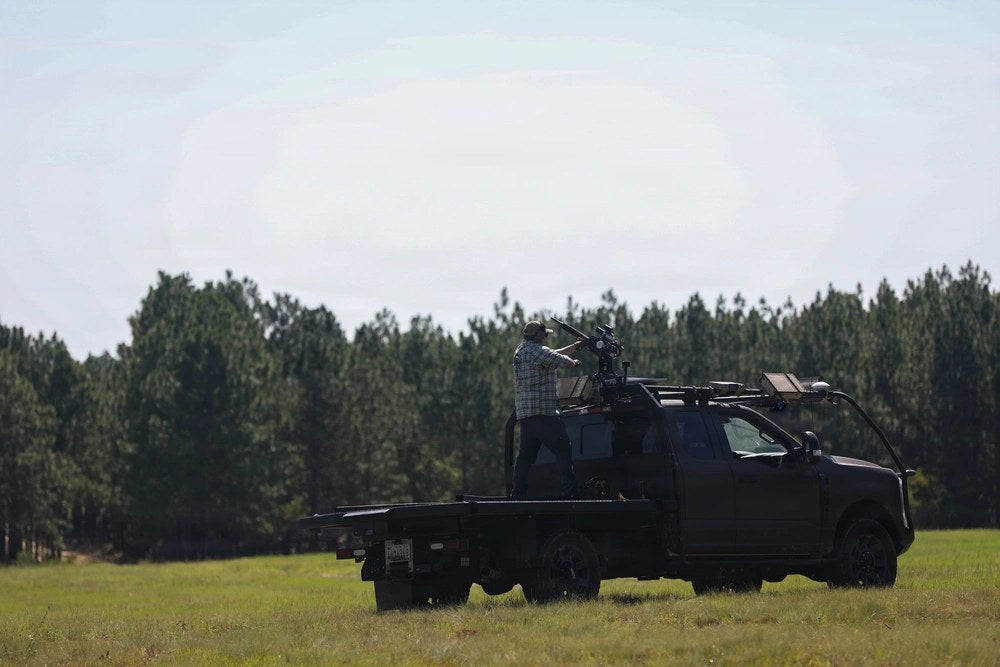
PHOTO CAPTION: An Edda counter-UAS turret mounted on a semi-autonomous Ford F-250 is tested during Project Sandhills 2.0 at Fort Bragg, North Carolina, on Aug. 18, 2026. The Army is evaluating the system as a mobile way to detect, track and shoot down drones. (U.S. Army photo)
The Army is testing a semi-autonomous Ford F-250 equipped with a rooftop counter-drone turret that can lock onto and shoot down drones during live-fire exercises at Fort Bragg.
The system was demonstrated during Project Sandhills 2.0, an Army-led experiment focused on autonomous systems, counter-drone technology and battlefield mobility. In one of the tests, the Army said the counter-UAS truck locked onto and shot down drones within seconds.
The truck uses Forterra’s AutoDrive system, allowing the vehicle to operate with reduced driver input while carrying equipment across the training area. Mounted on top is the Edda counter-UAS turret, which Army officials and outside reporting say uses a 12-gauge shotgun to destroy drones.
That combination gives the Army a relatively simple but highly visual answer to one of the biggest battlefield problems now facing troops: inexpensive drones that can surveil positions or attack formations.
Army officials say the system combines acoustic detection and visual tracking, while a human operator still authorizes the engagement. The goal is to give troops a mobile, lower-cost way to detect and defeat small drones quickly.
Project Sandhills 2.0 has featured a range of robotic and autonomous systems, but the semi-autonomous F-250 with the shotgun turret stands out because it looks less like a futuristic concept and more like something troops could immediately imagine using in the field.
The live-fire testing comes as the Army and other services look for faster and cheaper ways to counter the growing drone threat, especially as lessons from modern conflicts continue to show how dangerous small unmanned aircraft can be.
For soldiers and veterans, the image is hard to ignore: a self-driving pickup truck with a rooftop shotgun built to shoot drones out of the sky.
Sources: U.S. Army; DVIDS; Axios; Forbes
(Source: OAF Nation)