Air Force Won't Probe Dorm Failures
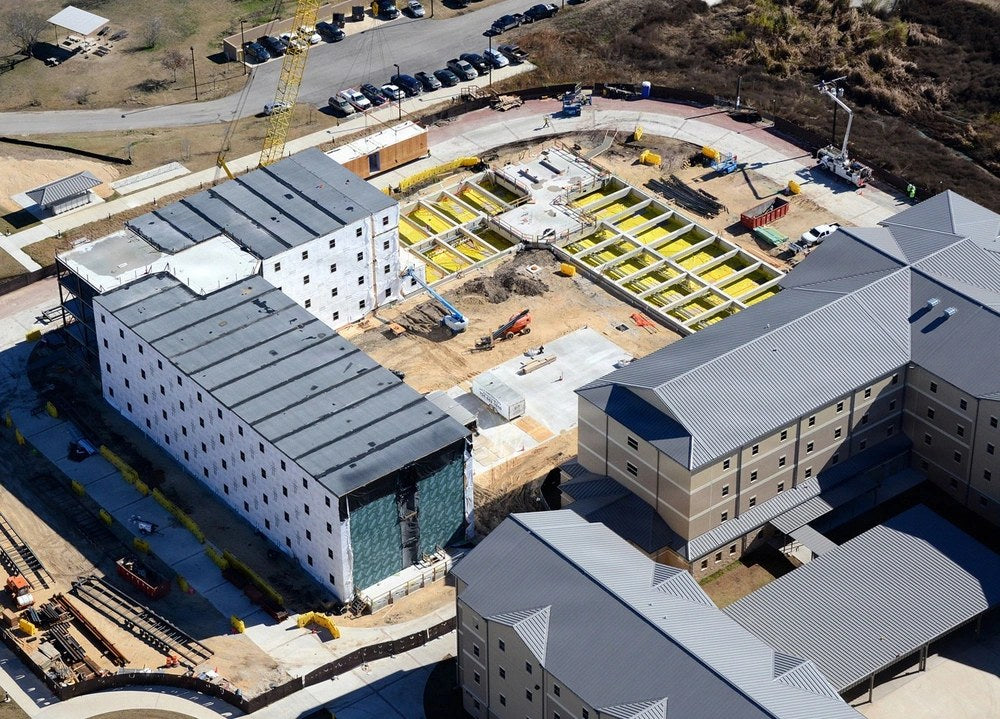
PHOTO CAPTION: Medical Education and Training Campus dormitories at Fort Sam Houston are shown in a 2014 Army photograph. More than 5,000 military medical trainees were relocated from the complex in July 2026 after serious building problems, and the Air Force now says it has not ordered an investigation into why the roughly $800 million facilities deteriorated so quickly. (U.S. Army photo)
The Air Force has not ordered an investigation into why a sprawling military dormitory complex deteriorated badly enough to force more than 5,000 service members from their rooms just 16 years after the facilities were built at a cost of roughly $800 million.
The Medical Education and Training Campus dormitories at Joint Base San Antonio-Fort Sam Houston were emptied in July after officials identified widespread problems involving climate control, building foundations and mold.
Approximately 5,200 Army, Navy and Air Force medical trainees had to be relocated.
Now, as the military prepares to demolish and replace the troubled facilities, the Air Force says it has not conducted a formal investigation into what caused them to fail so quickly and has not committed to launching one.
The development comes as the Department of the Air Force moves forward with a roughly $1.4 billion effort to replace the existing dormitories with five new buildings capable of housing about 6,000 military medical students.
The deteriorating buildings were commissioned around 2010 and 2011 as part of the consolidation of military medical training at Fort Sam Houston.
Problems emerged surprisingly early.
Budget documents prepared for the replacement effort describe repeated failures involving moisture, climate-control systems and building components. Millions of dollars have already been spent repairing and maintaining the facilities.
By July, conditions had deteriorated enough that thousands of trainees were moved elsewhere.
The scale of the failure is particularly notable because the dormitories were constructed using modular building techniques that military officials had promoted as a faster and more efficient method of construction.
As recently as March 2026, Army Materiel Command highlighted the Medical Education and Training Campus dormitories while discussing the benefits of modular construction.
The Army said modular construction could reduce on-site labor, shorten project timelines and provide consistent quality.
An official Army photograph accompanying that article showed the same Fort Sam Houston dormitories now slated for replacement.
The Department of the Air Force announced Aug. 18 that Layton/Gensler had been selected to lead the replacement project.
Officials say the project will use off-site manufacturing and an accelerated design-build process to construct five approximately 400,000-square-foot dormitories.
The Air Force says the approach could shorten the previously planned construction timeline by approximately 70 percent, with completion targeted within 24 months.
The new facilities are intended to house 6,000 students from across the military services who train at the Medical Education and Training Campus.
But questions remain over how dormitories built for hundreds of millions of dollars deteriorated to the point that thousands of troops had to be removed after little more than a decade of use.
Despite the scale of the failure and the cost of replacing the buildings, the Air Force has not committed to conducting a formal investigation into how the problems developed or whether construction, design, maintenance or other factors were responsible.
Sources: Department of the Air Force; U.S. Army Materiel Command; Military construction budget documents; San Antonio Express-News
(Source: OAF Nation)