Ukrainian Troops Aid U.S. Tank Tactics
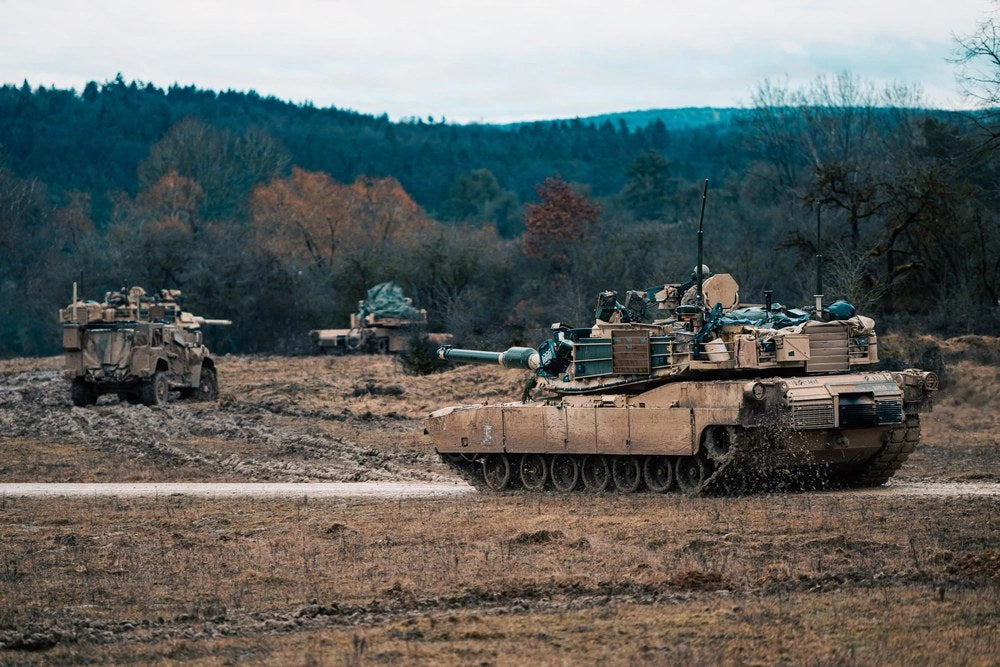
PHOTO CAPTION: A U.S. Army M1 Abrams tank maneuvers during Exercise Combined Resolve at the Joint Multinational Readiness Center in Hohenfels, Germany, on February 22, 2026. During a separate October exercise at the same training area, Ukrainian soldiers worked alongside American armored units to share battlefield lessons on drone surveillance, concealment and movement. This archival photograph does not depict the October training. (U.S. Army photo by Sgt. Scyrrus Corregidor)
An American Abrams tank crew briefly emerged from concealment to refuel during a military exercise in Germany. Within that period, the tank was struck by simulated indirect fire, demonstrating how dangerous even routine battlefield movements can become when drones are constantly searching overhead.
The incident occurred October 23 during Exercise Combined Resolve, where approximately 50 Ukrainian soldiers are helping American armored units adapt their tactics using lessons learned from the war against Russia.
Unlike previous exercises in which Ukrainian personnel primarily acted as simulated drone attackers, they are now working directly with American reconnaissance units and advising the opposing force.
The changes reflect a growing realization within the U.S. Army that traditional armored warfare tactics must evolve as drones make it increasingly difficult to move, conceal and resupply military vehicles without being detected.
Abrams Crew Hit After Leaving Concealment
Sgt. Sean Brenna, an Abrams tank gunner with the 1st Armored Division, described the incident to Stars and Stripes while sitting on his tank at the Army's Joint Multinational Readiness Center in Bavaria.
His crew had briefly left a concealed position in the woods to obtain fuel when simulated indirect fire struck the vehicle.
The tank returned to the exercise approximately an hour later, but the encounter reinforced a lesson American crews have repeatedly encountered during drone-focused training.
Finding cover is no longer enough to guarantee that a vehicle remains hidden.
Brenna said drones were constantly probing his unit's positions throughout the exercise.
"The moment you do get spotted, it is best to relocate quickly," Brenna told Stars and Stripes.
The simulated strike was part of a training scenario, not actual combat. The Army has not identified who conducted the simulated attack or established that Ukrainian personnel directly targeted Brenna's tank.
The lesson extended beyond the tank crew itself.
Soldiers were forced to reconsider their approaches to concealment, movement, communications and logistics as they tried to avoid detection.
Even activities such as refueling could expose an armored vehicle to observation and simulated attack.
Ukrainian Soldiers Take a Larger Role in Army Training
Approximately 50 Ukrainian soldiers are participating in the current exercise, according to Brig. Gen. Terry Tillis, commander of the 7th Army Training Command.
Instead of concentrating exclusively on simulated drone attacks against American formations, Ukrainian personnel are now operating alongside reconnaissance and counter-reconnaissance elements of the 1st Armored Brigade Combat Team.
They are also advising the training center's opposing force, the 1st Battalion, 4th Infantry Regiment, drawing on lessons from Ukraine's war against Russian forces.
The arrangement allows American soldiers to study battlefield adaptations developed during more than four years of large-scale fighting.
Ukrainian troops have extensive experience with reconnaissance drones, electronic warfare, artillery targeting and the difficulties of moving armored formations under persistent aerial surveillance.
The current exercise incorporates those experiences into realistic battlefield scenarios.
Combined Resolve includes more than 3,500 participants from the United States, Georgia, Italy, Poland, Slovenia, Ukraine and the United Kingdom.
The training is scheduled to continue through November 4.
The American armored brigade participating in the exercise is nearing the end of a nine-month rotation in Europe and is expected to return to Fort Bliss, Texas.
Modern Drones Change How Tanks Survive
The growing use of inexpensive reconnaissance and attack drones has changed the conditions under which armored vehicles operate.
In Ukraine, small unmanned aircraft are routinely used to identify troop movements, locate concealed equipment, direct artillery fire and conduct attacks.
Vehicles that might once have remained hidden for extended periods now face the possibility of repeated aerial observation.
During the October exercise, American crews concealed Abrams tanks and Bradley Fighting Vehicles beneath camouflage netting and thick foliage.
However, soldiers learned that remaining in a concealed position for too long could still allow an opposing force to discover their location.
Brenna said the training required his unit to move repeatedly, often with little sleep, to stay ahead of the simulated enemy.
The previous evening, he had engaged an opposing dismounted patrol using his tank's M240 machine gun.
The exercise demonstrated that crews must coordinate movement, concealment and resupply while accounting for persistent aerial surveillance.
That does not mean tanks or Bradleys have become obsolete.
Instead, the Army is testing how armored vehicles can continue providing firepower, protection and mobility while reducing their exposure to drones and artillery.
Earlier Exercise Exposed Heavy Simulated Losses
The latest training follows other exercises in Germany that revealed significant vulnerabilities in American armored formations.
During a separate Combined Resolve exercise in spring 2026, Ukrainian drone operators supporting the opposing force inflicted substantial simulated casualties on an American armored brigade.
According to an account published by U.S. Army officers in Military Review, drones were responsible for approximately 70% of the brigade's simulated casualties during the initial phase of that exercise.
The American formation adjusted its tactics as the training continued, reducing its vulnerability and improving coordination between drones and maneuver units.
That earlier exercise involved a different American armored brigade and is separate from the October training.
The current exercise places additional emphasis on integrating Ukrainian personnel directly into American formations and applying lessons to everyday armored operations.
Iran Conflict Also Influencing Army Tactics
Lessons from Ukraine are not the only influence on the Army's current training.
Tillis said the exercise also incorporates lessons from Iranian drone operations against American forces in the Middle East since fighting escalated in February 2026.
One adaptation involved moving the armored brigade's command-and-control functions underground.
The change reflects concerns that command posts, communications equipment and other critical facilities can become vulnerable when enemy drones continuously search for targets.
The Army is also evaluating how to integrate new equipment and battlefield observations into the way soldiers train and operate.
Tillis emphasized that modernizing the force requires more than simply introducing new technology.
The goal is to turn observed battlefield lessons into practical skills that troops can apply across formations.
What Happens Next
Combined Resolve continues through November 4, giving American and allied units additional opportunities to test their tactics against a simulated opposing force.
The exercise is intended to evaluate readiness and identify weaknesses before troops encounter similar threats in combat.
For the Abrams and Bradley crews participating in Germany, the experience reinforces a central lesson from modern warfare: armored vehicles must constantly account for threats that can observe them from above, even when they appear concealed from forces on the ground.
The involvement of Ukrainian soldiers gives American units access to recent battlefield experience as the Army works to adapt its training and tactics to those threats.
(Source: OAF Nation)