Trump Sued Over Border Land Control
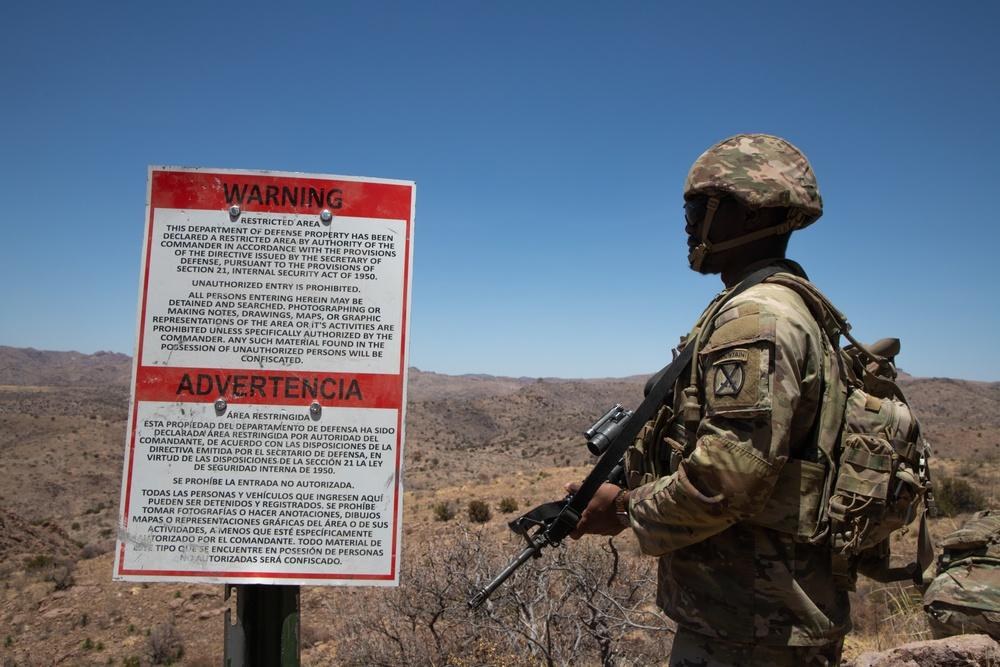
PHOTO CAPTION: A U.S. Army soldier provides security beside a warning sign marking the New Mexico National Defense Area near Cloverdale, New Mexico, in May 2025. Three organizations filed a federal lawsuit October 8, 2026, challenging the transfer of approximately 111,000 acres of public land to military control along the U.S.-Mexico border. The designation gives troops additional authority to protect the restricted area and temporarily detain unauthorized entrants. The lawsuit remains unresolved. (U.S. Army photo by Sgt. Griffin Payne)
Three organizations have filed a federal lawsuit challenging the Trump administration's decision to place approximately 111,000 acres of public land along the New Mexico-Mexico border under military control, arguing that the government improperly transformed civilian land into an extension of a U.S. Army installation.
The lawsuit, filed October 8 and highlighted in new Military Times reporting October 23, challenges a 2025 decision that designated the territory as the New Mexico National Defense Area.
Under that designation, the land became administratively part of Fort Huachuca, an Army installation in Arizona, allowing troops assigned to border security operations to exercise additional installation-security powers.
Those powers include temporarily detaining unauthorized entrants and transferring them to federal law enforcement authorities.
The administration says the arrangement strengthens border security. The plaintiffs argue it circumvents legal limits on military involvement in civilian law enforcement and improperly restricts public access to federal land.
No court has ruled that the designation itself is unlawful in this lawsuit.
More Than 110,000 Acres Placed Under Army Control
The dispute began in April 2025 after President Donald Trump directed federal agencies to expand military support for operations along the southern border.
The Department of the Interior subsequently transferred administrative jurisdiction over a large area of federal land to the Department of the Army.
The original land order identified 109,651 acres across Doña Ana, Luna and Hidalgo counties.
However, the Bureau of Land Management issued a correction in March 2026 establishing a revised total of approximately 110,967 acres.
The correction accounted for a narrow strip of federal land known as the Roosevelt Reservation that was included in the transfer but omitted from the original acreage calculation.
The withdrawal was authorized for three years.
The Army then designated the property as a restricted military area associated with Fort Huachuca, even though the installation itself is located more than 100 miles away in Arizona.
The designated land extends along approximately 170 miles of the border in a series of noncontiguous parcels.
Troops Given Additional Authority Over Restricted Area
The Department of Defense says the designation allows military personnel to protect federal property while supporting Customs and Border Protection.
Under the arrangement, troops can conduct installation-security operations, including temporarily detaining people accused of entering the restricted area without authorization.
Those individuals can then be transferred to appropriate civilian or federal law enforcement authorities.
Troops may also conduct limited security searches under applicable rules.
During an April 25, 2025, visit to the area, Defense Secretary Pete Hegseth defended the arrangement, arguing that people who unlawfully enter the designated military property can be detained.
The government maintains that protecting a military installation is different from directly enforcing civilian immigration laws.
That distinction is central to the legal dispute.
The Posse Comitatus Act generally restricts the use of federal armed forces to execute civilian laws unless authorized by the Constitution or Congress.
The plaintiffs argue that turning formerly public land into military property allows the administration to sidestep those restrictions.
The government has not been found to have violated the law in this case.
Lawsuit Challenges Federal Authority
The lawsuit was filed by the New Mexico Wildlife Federation, Battalion Search and Rescue, and Southern Border Communities Coalition.
The organizations are represented by Democracy Forward and the New Mexico law firm Peifer, Hanson, Mullins & Baker.
The complaint challenges actions taken by the Department of the Interior, Department of Defense and Department of the Army.
The plaintiffs argue that federal officials improperly relied on emergency authority under the Federal Land Policy and Management Act to transfer the territory.
They contend that the relevant emergency withdrawal provision was intended to protect public-land values facing immediate threats, not to expand immigration enforcement.
The complaint also challenges the Army's authority to establish a long-term national defense area for that purpose.
According to the plaintiffs, such designations were historically used to protect limited locations during specific emergencies, including military aircraft crashes.
They argue that applying the same mechanism to extensive public borderlands goes beyond the authority Congress provided.
The case also raises a separate constitutional challenge involving military spending.
The organizations contend that multiyear appropriations used to operate and maintain national defense areas violate the Constitution's restriction on appropriating money to support armies for periods longer than two years.
Those arguments remain allegations before the federal court.
Organizations Say Public Access Has Been Restricted
The plaintiffs say the designation has disrupted activities that previously took place on public land.
The New Mexico Wildlife Federation argues that its members have lost access to places used for hunting, hiking, birdwatching and conservation monitoring.
The Southern Border Communities Coalition says the restricted area interferes with community organizing, religious activities and the daily lives of people living near the border.
Battalion Search and Rescue says the restrictions have made it harder for volunteers to locate missing migrants and recover human remains in remote desert areas.
James R. Holeman, the group's founder, said volunteers have discovered more than 100 death sites during searches along the Arizona and New Mexico borders over the past three years.
He argues that closing additional stretches of land makes an already difficult humanitarian mission more challenging.
The groups also question whether warning signs and publicly available maps adequately inform people where the restricted military property begins.
Plaintiffs Cite Approximately 1,800 Criminal Cases
One of the most consequential allegations concerns criminal prosecutions arising from the military designation.
The complaint states that approximately 1,800 people have been charged with offenses associated with entering the New Mexico National Defense Area since its creation.
That figure is the plaintiffs' estimate and has not been independently established through a complete review of Justice Department records.
The organizations argue that some people have faced additional military-property trespass charges that would not have applied before the land transfer.
Federal judges have previously questioned whether prosecutors established that particular defendants knowingly entered restricted military property.
In some cases, courts found insufficient evidence that individuals knew they had entered a military installation or that their location was within the designated boundaries.
The complaint points to those rulings as evidence of problems with the area's boundaries and enforcement.
The existence of earlier court decisions concerning individual prosecutions does not, by itself, determine whether the underlying land designation is lawful.
Army Maintains That Access Is Available Through Screening
The Army's official guidance confirms that the New Mexico National Defense Area remains part of Fort Huachuca for installation-security purposes.
Military identification holders are generally permitted access under the published policy.
Other U.S. visitors aged 12 or older can request access through a background-check and identification process.
Applicants must provide identifying information, including REAL ID-compliant documentation, before receiving authorization to enter.
The Army says the screening requirements are intended to meet installation security standards.
The plaintiffs argue that applying those restrictions to formerly public land creates unreasonable burdens for people who use the area.
The administration's stated position is that the land arrangement supports border security while allowing troops to perform installation protection duties.
What Happens Next
The case, New Mexico Wildlife Federation v. U.S. Department of the Interior, is pending in the U.S. District Court for the District of New Mexico.
The plaintiffs are asking the court to invalidate the land-transfer and military-designation orders, prevent further implementation of the challenged arrangement and restrict spending they contend is unconstitutional.
The publicly available records reviewed do not establish a final judgment on those claims.
A ruling could affect how federal agencies use public-land withdrawals to expand military security operations along the border.
For now, the New Mexico National Defense Area remains the subject of a dispute over presidential authority, military involvement in border security and public access to federal land.
The case asks whether the federal government can transform extensive stretches of civilian-managed public property into restricted military territory as part of an ongoing domestic border mission.
(Source: OAF Nation)