Ukraine's Publishing Industry Hit Hard
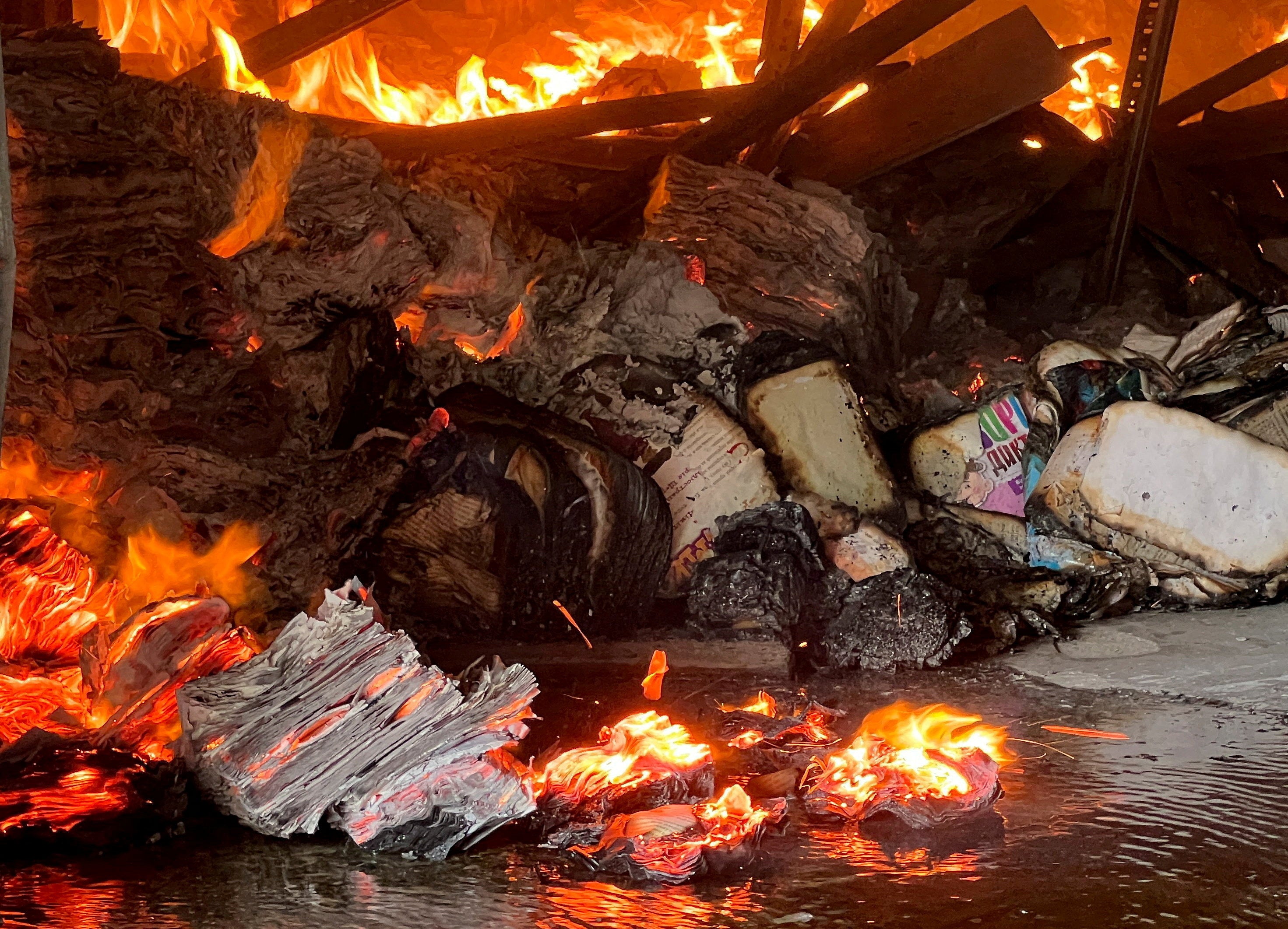
PHOTO CAPTION: FILE PHOTO: Books burn at the site of a book warehouse hit by a Russian drone strike, amid Russia's attack on Ukraine, in Kharkiv, Ukraine, August 1, 2026. REUTERS/Volodymyr Pavlov/File Photo
KYIV, Aug. 10 — Viktor Kruhlov, director of Ranok, one of Ukraine’s largest children’s publishers, struggled to hold back tears as he watched piles of books burn after a Russian drone strike hit the company’s warehouse in Kharkiv.
“It’s a terrible sight to see books burning,” Kruhlov said.
The Aug. 1 strike destroyed about 8 million books, the largest blow yet to Ukraine’s publishing industry during the four-year-old war. Publishers say more than 10 million books have been destroyed in attacks on warehouses in recent months, threatening an industry that initially benefited from rising demand for Ukrainian-language literature after the conflict began.
As firefighters battled the blaze, Kruhlov said an initial explosion at the warehouse was followed moments later by another at the same location. “This was a deliberately planned attack against the book warehouse,” said Kruhlov, whose company prints about one-third of the textbooks used in Ukrainian schools.
Russia’s Defence Ministry did not respond to a request for comment.
The attacks on book warehouses and printing facilities have carried particular symbolism in a country where many Ukrainians view the war as a fight for national survival and identity. Education Minister Andrii Butenko described them as an attempt to destroy the Ukrainian language, history and memory — “everything from which the identity of our children grows.”
Russian President Vladimir Putin has repeatedly questioned Ukraine’s separate statehood and argued that Russians and Ukrainians are one people.
Economic losses mount
Beyond the symbolic impact, attacks on publishers highlight the growing economic cost of a war increasingly defined by endurance, economists and business leaders say.
“There are signs of a crisis in the market. We don’t yet know how the situation will develop,” said Yevhen Shyrynos, chief editor of publisher BookChef.
BookChef lost about 800,000 books, most of its inventory, in a Russian attack on Kyiv on July 2. Another 100,000 books were destroyed when its backup warehouse was struck in a Russian attack this week.
Ukraine’s economy has shown resilience during the war, adapting to power outages, labour shortages and repeated attacks on infrastructure while remaining afloat with support from Western allies. But annual economic output, at about $215 billion, remains roughly one-fifth below its pre-invasion level.
Ukraine has also increased strikes on the Russian economy, targeting oil facilities, logistics warehouses and weapons-production sites in an effort to bring more of the war’s cost to Moscow. Economists and executives increasingly describe the conflict as a test of which side can endure the economic pressure longer.
“Essentially, it’s a struggle for survival – whoever can hold out the longest,” said Olga Pindyuk of the Vienna Institute for International Economic Studies.
Growth slows as war costs rise
Most economists expect Ukrainian economic growth to weaken further in 2026 as Russia intensifies attacks on infrastructure and logistics. A survey released Wednesday by the Kyiv-based Centre for Economic Strategy cut the median growth forecast for next year to 1.1% from 2.4%.
Ukraine’s economy grew by about 1.8% in 2025.
“I meet businesses every day and there has not been such despair over losses ... since 2022,” Danylo Hetmantsev, head of parliament’s tax committee, told Ukrainian television. “The economy is currently experiencing significant losses.”
The defence industry remains one of the few major growth areas because of intense battlefield demand. About 60% of government spending this year is devoted to defence, while the central bank expects the sector to contribute about 1.4 percentage points of Ukraine’s projected 1.8% economic growth this year — leaving the rest of the economy essentially stagnant.
Agriculture, which accounts for most of Ukraine’s exports, is also struggling. Agriculture Minister Taras Vysotskyi has said Russian attacks on Black Sea port infrastructure could cost the farm sector between $1.5 billion and $3 billion this year.
Publishing faces a long recovery
The publishing industry faces particular difficulty because replacing destroyed books can take six to 18 months. After an early wartime boost driven by demand for Ukrainian-language titles and bans on Russian imports, publishers are now dealing with rising production costs, lengthy replacement times and repeated losses from attacks.
BookChef has considered reducing risks around its storage facilities and expanding its network of printers. But printing costs have increased about 40% over the past two years, while fewer Ukrainians can afford to buy books regularly, Shyrynos said.
He expects the industry to stagnate as long as the war continues.
“In fact, all our sectors will stagnate and decline until the war is over,” Shyrynos said. “The war is a vast, bottomless abyss that devours whatever funds you allocate to it.”
(Source: Reuters)