U.S. Probes Cyber Threats to Ships
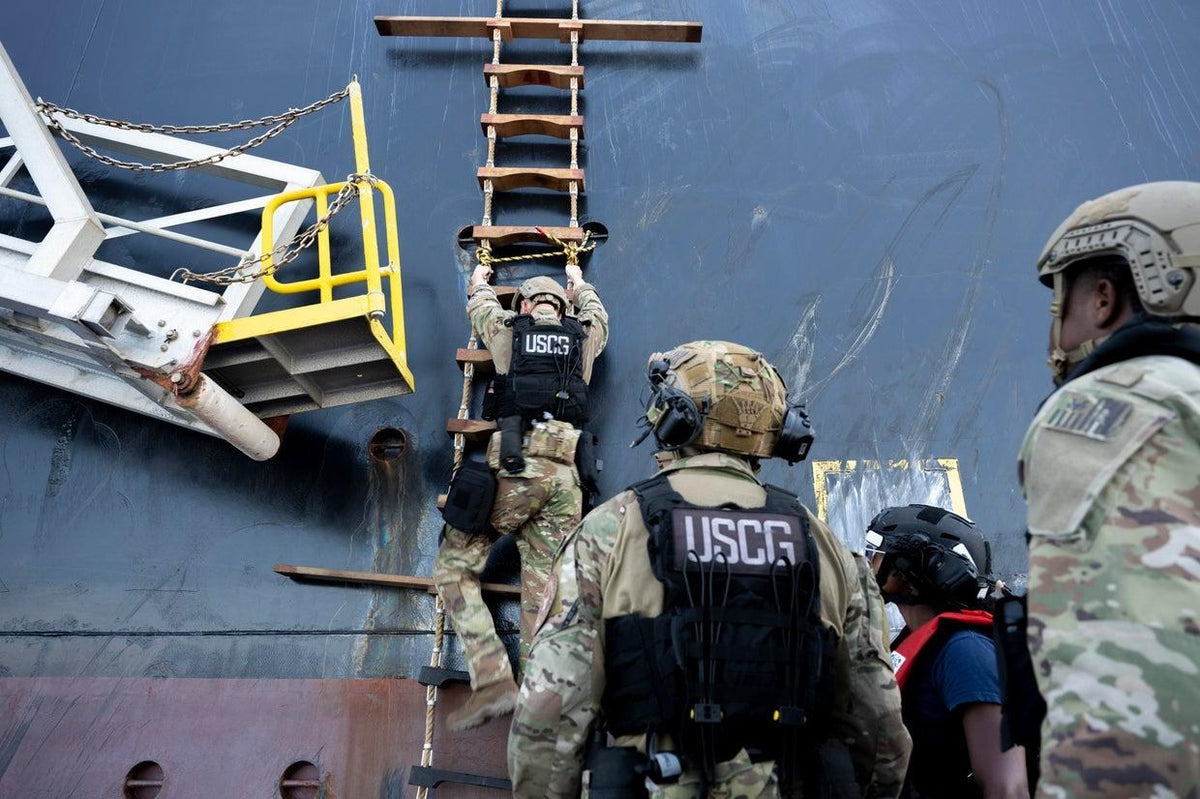
PHOTO CAPTION: U.S. Coast Guard Petty Officer 2nd Class John Wheatman boards an oil tanker during a maritime security operation off San Pedro, California, on April 8, 2026. U.S. authorities are investigating suspected cyber intrusions involving as many as 50 commercial vessels, including tankers carrying hazardous cargo. The photograph shows a separate routine security boarding and is not connected to the investigation. (U.S. Coast Guard photo by Petty Officer 3rd Class Roberto A. Nieves Felix.)
The United States is investigating suspected cyberattacks against as many as 50 commercial ships carrying oil, gas and other potentially hazardous cargo, raising concerns that foreign hackers could gain access to systems responsible for operating the vessels.
Iran is among the suspected sources of the attacks, according to new reporting from The Wall Street Journal and NPR. However, American authorities have not publicly established who is responsible.
The investigation has already prompted the Coast Guard and FBI to board commercial vessels approaching American ports, with specialized cybersecurity teams examining potential breaches.
Some of the affected ships reportedly experienced communications failures, while investigators believe hackers may have reached networks connected to critical onboard equipment.
There is an important distinction: Officials have not confirmed that attackers successfully took control of a ship, caused an accident or endangered its crew.
But the investigation is revealing how a vulnerability in a ship's computer network could potentially become a problem far beyond stolen information.
As Many as 50 Vessels May Have Been Compromised
The Wall Street Journal first reported the broader investigation November 23, citing American officials and other people familiar with the matter.
The suspected incidents involve vessels transporting crude oil, liquefied petroleum gas, chemicals and other hazardous materials.
NPR subsequently confirmed that U.S. intelligence suggests as many as 50 commercial ships may have experienced network intrusions.
The vessels were not all operating near Iran or in the Strait of Hormuz.
Some were approaching American ports, while others were operating in waters near Europe and Asia.
Investigators are examining whether the incidents are connected and whether Iranian hackers played a role.
Russia has also been raised as a possible source in the reporting.
Neither country has been publicly identified by U.S. authorities as the confirmed perpetrator of these particular attacks.
Coast Guard Cyber Teams Board Ships Approaching America
The investigation builds on incidents that first became public in September.
On August 21 and August 24, the Coast Guard and FBI responded to suspected cybersecurity breaches involving two foreign-flagged commercial tankers bound for the United States.
The vessels were identified in subsequent reporting as the VL Prosperity and Kohaku.
Federal teams boarded the ships to examine their information technology and operational systems.
The operation involved Coast Guard law enforcement personnel, vessel inspectors, cybersecurity specialists and FBI cyber investigators.
Now, The Wall Street Journal reports that Coast Guard cyber protection teams have responded to at least four additional vessels approaching the United States in recent weeks.
The response reflects a growing concern that cyber threats aboard commercial ships could pose risks not only to their operators, but also to American ports and surrounding communities.
The Coast Guard and FBI said they had no reports of ships becoming unstable, crews being placed in physical danger or environmental damage resulting from the incidents.
Hackers Exploited a Known Security Weakness
According to a U.S. official who spoke with NPR, attackers exploited known vulnerabilities in Fortinet FortiGate networking devices used in the maritime industry.
These devices are commonly used for firewalls and secure remote connections.
The reported intrusions initially involved computer networks used for ordinary business operations, including communications.
In some cases, crew members noticed problems when email stopped working or they could no longer log in to their accounts.
At least one vessel experienced an extended communications blackout.
More concerning, investigators believe attackers were able to move from information technology systems into networks associated with operational equipment.
Those systems can connect to propulsion, steering, navigation and cargo management.
An intruder reaching such networks does not automatically mean they can remotely steer a ship or disable its engines.
But access creates opportunities for disruption, particularly when systems are poorly protected or interconnected.
Officials did not provide NPR with a confirmed example of an attacker actually manipulating a ship's physical controls.
Why a Cyberattack on a Tanker Matters
A commercial vessel is more than a floating cargo container.
Modern ships rely on interconnected electronics to manage navigation, machinery, communications and cargo handling.
Some transport products that must remain within specific temperature or pressure limits.
A serious failure affecting those systems could create dangers ranging from interrupted deliveries to collisions, groundings, spills or fires.
The Coast Guard has warned that cyber intrusions can create significant risks to maritime safety.
However, cybersecurity specialists also caution against assuming that accessing a ship's network is equivalent to taking complete physical control.
Ships have multiple operational safeguards, and many critical functions retain manual controls.
The current investigation concerns suspected access and potential vulnerabilities, not confirmed reports of dozens of ships being hijacked or disabled.
Part of a Wider Cybersecurity Concern
The maritime investigation follows other reported cyber incidents affecting critical infrastructure.
NPR has previously reported on suspected Iranian hacking activity involving American water treatment systems and refrigeration equipment.
Some disruptions reportedly affected food storage operations at U.S. military installations overseas.
Those incidents provide context for why American investigators are examining possible Iranian involvement in the shipping attacks.
They do not establish that every incident was conducted by the same group or coordinated as part of one operation.
The Coast Guard and FBI have also warned maritime operators about exploiting unpatched networking equipment, urging companies to update vulnerable systems and report suspicious activity.
A compromised commercial vessel could create consequences for shipping companies, military logistics, ports and the communities that depend on them.
What Investigators Still Need to Determine
Federal authorities are continuing to investigate the suspected breaches and determine who conducted them.
Several major questions remain unanswered.
It is not publicly established how many of the suspected 50 vessels experienced confirmed intrusions, whether all the incidents were connected, or whether any attacker successfully manipulated a ship's propulsion, steering or cargo controls.
The reported Iranian connection remains under investigation.
For now, the most significant development is the scale of the suspected activity.
What began publicly with two tankers investigated by federal teams in August has expanded into reports of possible intrusions involving dozens of commercial vessels worldwide.
And unlike a computer outage in an ordinary office, a serious malfunction aboard a tanker can potentially threaten far more than the data stored on its network.
(Source: OAF Nation)