U.S. Military Recruiting Rebounds Strongly
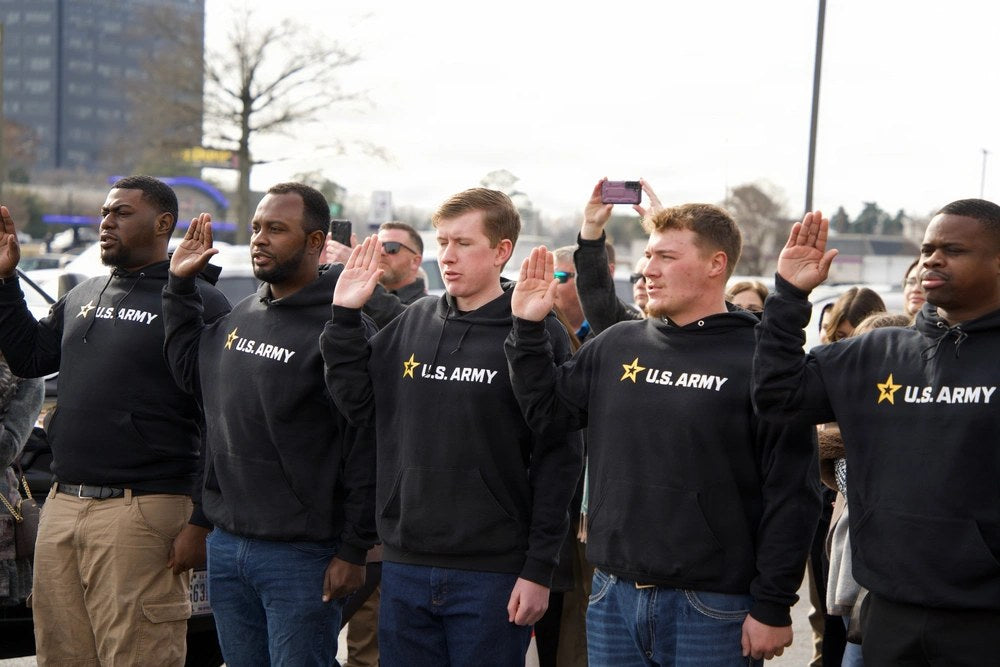
PHOTO CAPTION: Future service members take the oath of enlistment during a multi-service swear-in ceremony in Newport News, Virginia, Jan. 5, 2026. U.S. military recruiting has rebounded sharply after years of recruiting challenges.
U.S. military recruiting has staged a major turnaround after several years of shortages, with multiple services reaching their fiscal 2026 enlistment targets months ahead of schedule.
The Army signed contracts with more than 61,500 future soldiers, reaching its active-duty goal four months before the Sept. 30 end of the fiscal year. The Air Force reached its target of 32,750 active-duty airmen in April, while the Space Force reached its goal of 730 enlisted Guardians.
The Navy has also reached its active-duty target, while Marine Corps officials say the service is on pace to meet its goal.
The turnaround is dramatic compared with 2022, when the Army recruited fewer than 45,000 soldiers against a goal of 60,000 amid one of the military's worst recruiting environments in decades.
What's driving the rebound is now becoming a debate of its own.
Defense Secretary Pete Hegseth has repeatedly credited renewed confidence in the military and changes in culture, standards and leadership under the Trump administration. He said in July that the recruiting turnaround began around Election Day 2024.
But the numbers show the recovery had already begun before then.
The active-duty services met their fiscal 2024 recruiting objectives before the November 2024 election, and the Army subsequently expanded its training capacity to accommodate a growing pipeline of recruits.
A new ABC News investigation published Aug. 17 found another explanation repeatedly emerging from conversations with young people actually considering military service: money, education and careers.
ABC interviewed nearly 40 recruits and prospective recruits at different points in the enlistment process, along with roughly two dozen recruiters and current and former defense officials. Prospective troops frequently cited steady pay, college benefits, technical training and civilian career opportunities when explaining why they were considering military service.
Pentagon survey data points in the same direction.
Pay and financial compensation, education benefits and career opportunities consistently rank among the main reasons young Americans consider serving. About 80% of recruits also have a family member who served, illustrating how heavily the military continues to draw from families already familiar with military life.
Economic conditions may also matter.
Historically, military recruiting becomes easier when civilian employment opportunities weaken. Pentagon survey data cited by ABC shows young Americans' willingness to consider military service has tended to move alongside changes in youth unemployment.
That doesn't mean every recruit is making a purely financial decision. Some cite patriotism, family tradition, adventure or the desire to serve, while others specifically seek military occupations that can translate into civilian careers.
The recruiting turnaround also reflects changes the services made after the post-pandemic crisis.
One of the Army's most significant changes was the Future Soldier Preparatory Course, launched in 2022 for applicants who want to enlist but initially fall short of academic or body-composition standards.
Rather than immediately rejecting those applicants, the Army gives them additional academic instruction, physical training or nutrition assistance before basic training. More than 90% of participants eventually qualify, and roughly a quarter of new Army enlistees now pass through the program, according to ABC's review.
Former Army Secretary Christine Wormuth has argued that the program did not lower the standards recruits ultimately must meet. Instead, it created a path for motivated applicants to reach those standards before entering basic training.
The eligibility problem remains significant.
The Pentagon estimates roughly three-quarters of Americans ages 17 to 24 are not immediately eligible for military service, with obesity, medical issues and academic deficiencies among the major obstacles.
Recruiting reforms have therefore focused not only on convincing more young people to serve, but also on getting interested applicants through medical processing and helping otherwise promising recruits become eligible.
The Air Force has expanded its recruiting workforce and offers enlistment bonuses reaching $40,000 for some critical specialties, including maintenance, cyber and special operations. The Army says enhanced career incentives and a focus on technical skills also contributed to its early success this year.
The result is a recruiting environment that looks dramatically different from the crisis military leaders faced only a few years ago.
What's less clear is whether any single political, cultural or economic change deserves the credit.
For veterans, the question may be more personal: Why did you join — and would the same thing convince you to enlist today?
(Source: OAF Nation)