U.S. Faces Global Military Strain
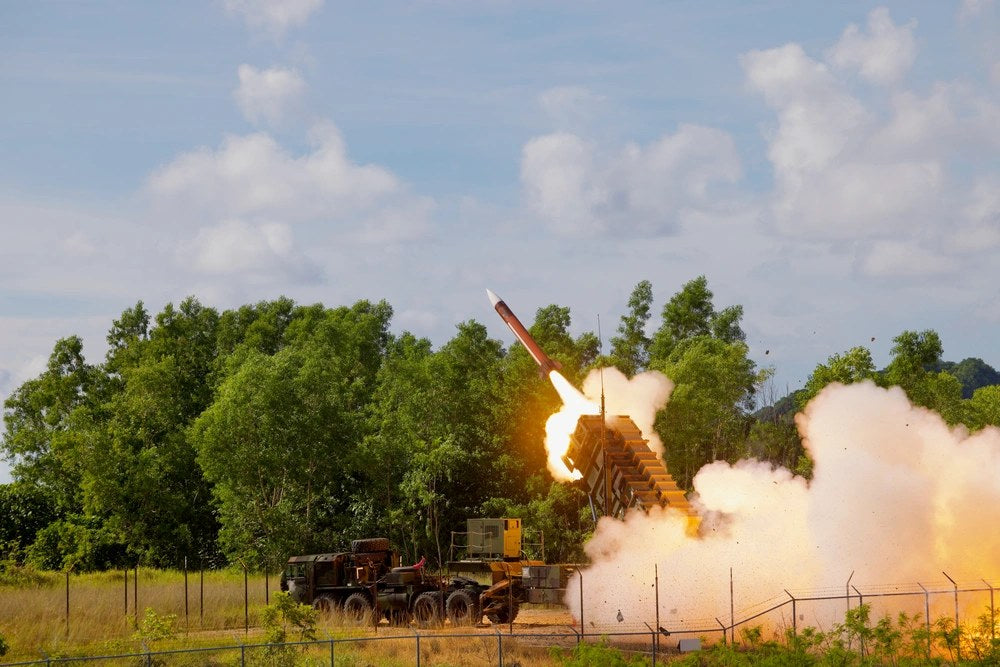
PHOTO CAPTION: A Patriot Advanced Capability 2 interceptor launches from an M903 Patriot system during Exercise Tenacious Archer 25 in Palau on Aug. 21, 2025. U.S. Army photo by Capt. Frank Spatt.
The biggest military stories this week came from different parts of the world, but many pointed toward the same question.
The U.S. is still fighting Iran. Ukraine needs more air-defense missiles. North Korea is expanding its military support for Russia. An explosive-equipped drone was discovered at a major German logistics hub. New defense partnerships are forming in the Middle East.
Taken together, they raise a broader issue: How many military challenges can the United States and its allies manage at the same time?
That question became harder to ignore after Reuters reported this week that the U.S. has used “virtually all” of two types of Army long-range precision missiles during more than five months of war with Iran.
The weapons — ATACMS and the newer Precision Strike Missile, or PrSM — allow U.S. forces to strike important targets from long distances.
Reuters also reported that the United States has used a little less than half of its global Tomahawk cruise missile supply since the war began, according to one source familiar with the figures. Reuters said it could not independently verify that number.
The exact number of weapons remaining is classified, and the figures do not mean the United States has run out of long-range strike options.
The Pentagon says U.S. forces still have the capabilities needed to protect American interests. President Donald Trump has also rejected concerns about ammunition shortages and pointed to increased weapons production.
There is also a straightforward argument for using the missiles.
Long-range weapons can allow commanders to strike heavily defended targets without putting American pilots directly into some of the most dangerous airspace. Reuters reported that the heavy use of the weapons partly reflected efforts to avoid riskier attacks using piloted aircraft.
Stockpiles exist to be used when they are needed.
The harder question is what happens afterward.
Those same weapons could become critical in another major conflict, particularly in the Pacific, where long distances and sophisticated air defenses would make long-range missiles especially valuable.
A missile used against Iran today must eventually be replaced before it can be available somewhere else tomorrow.
The pressure may be even clearer when it comes to air defense.
Patriot interceptors are being used to protect U.S. forces and allies in the Middle East while Ukraine continues seeking more of them to defend against Russian ballistic missiles.
The Center for Strategic and International Studies estimates that roughly 65% of the U.S. Patriot interceptor inventory was expended between February and July. Reuters reported that two sources familiar with internal government data said the estimate was broadly consistent with U.S. figures.
Saudi Arabia is estimated to have used about 86% of its PAC-3 interceptor inventory during the first 38 days of fighting.
Those are estimates, not publicly released Pentagon inventory totals.
Production is increasing, but sophisticated missiles that took years to accumulate cannot be replaced immediately.
That creates a difficult tradeoff.
Should additional interceptors go to Ukraine?
Should they remain with U.S. forces and allies already facing Iranian missiles?
Should European countries retain more for their own defense?
Or should Washington preserve larger reserves for a potential future conflict in the Pacific?
There is no answer that satisfies every requirement at once.
At the same time, America’s adversaries are increasingly helping one another.
Ukrainian military intelligence said this week that a North Korean missile unit is deploying to western Russia and could eventually operate additional ballistic missiles against Ukraine.
Reuters has not independently verified all of Ukraine’s claims, although a source familiar with the matter said the United States was aware of the North Korean deployment.
North Korea has already supplied Russia with troops, artillery ammunition and ballistic missiles during the war.
That cooperation creates another problem for Western planners: more ballistic missile threats against Ukraine mean greater demand for high-end interceptors at the same time those systems are being heavily used elsewhere.
Europe also received a reminder this week that threats do not always look like conventional warfare.
German authorities said a drone equipped with professional explosives and a detonator was discovered at Leipzig/Halle Airport, a major cargo hub that also supports NATO logistics.
A German lawmaker said it was possible that a bus driver who knocked the low-flying drone down prevented its intended attack.
Authorities have not publicly identified who launched the drone, and no country or organization has been established as responsible.
The incident nevertheless highlights a problem NATO countries increasingly face: how to respond to drones, sabotage, cyberattacks and other actions that can cause serious damage without resembling a traditional military invasion.
Meanwhile, some U.S. partners are building new security arrangements of their own.
Saudi Arabia, Turkey and nuclear-armed Pakistan signed a joint defense agreement Friday stating that an armed attack against one would be considered an attack against all three.
The agreement does not clearly define what military response each country would be required to provide.
It can be viewed in two very different ways.
U.S. partners may simply be taking more responsibility for their own regional defense — something Washington has encouraged allies to do for years.
Or regional powers may be building additional security structures because they are less comfortable relying on the United States alone.
Then there is the Strait of Hormuz.
Iran and Oman have been discussing a possible arrangement tied to reopening the waterway and efforts to end the Iran war.
One proposal described to Reuters would give Tehran control over ships entering the Gulf through the Strait of Hormuz. Significant issues remain unresolved, and the proposal faces legal, sanctions and insurance complications.
Supporters of a negotiated settlement may see reopening the strait as a practical way to reduce the fighting and restore a critical route for global energy supplies.
Critics may ask whether Iran should emerge from months of war with greater influence over one of the world’s most important maritime chokepoints.
Americans themselves appear divided over where the current course is leading.
A Reuters/Ipsos poll released this week found that 35% of Americans approved of the war with Iran.
Half said U.S. military action would make the Middle East less stable over the next year, while 17% believed it would make the region more stable.
The same poll found 58% concerned that the Russia-Ukraine war could worsen and 55% concerned about a conflict involving China and Taiwan.
None of this establishes that the United States is incapable of managing several threats at once.
The U.S. maintains military forces and alliances around the world, and the Pentagon says American forces retain the capabilities needed to protect U.S. interests. Weapons production is also being expanded.
But this week showed how quickly decisions in one theater can affect the options available in another.
A Patriot interceptor used in the Middle East cannot also defend Ukraine.
A long-range missile fired against Iran has to be replaced before it can be available for a future conflict.
And supporting the wars being fought today can affect how prepared the United States is for the conflict that has not started.
That may be the larger military question emerging from this week:
Is the United States becoming stretched across too many fronts — or is managing multiple threats at once exactly what a global power is supposed to be able to do?
(Source: OAF Nation)