TRUMP ORDERS NAVY TO RETURN TO STEAM CATAPULTS
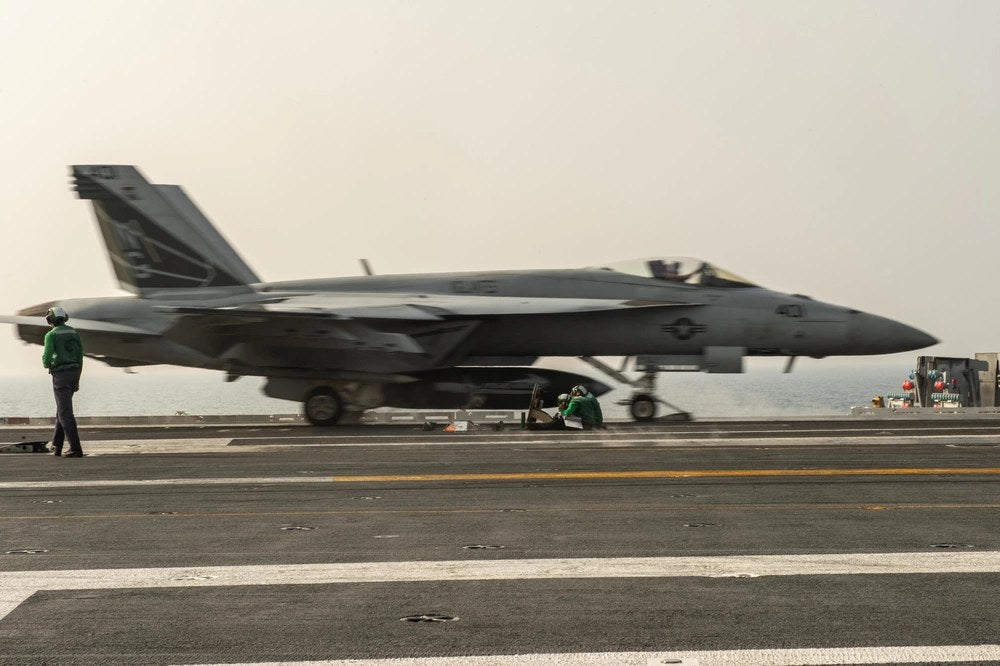
PHOTO CAPTION: An F/A-18E Super Hornet launches from a steam-powered catapult aboard USS John C. Stennis in the Indian Ocean, Dec. 6, 2018. Illustrative file photo. (U.S. Navy photo by Mass Communication Specialist 3rd Class Jake Greenberg)
President Donald Trump has ordered the Navy to abandon electromagnetic aircraft-launch catapults on the future USS Doris Miller and return to the steam-powered system used aboard older U.S. aircraft carriers.
Trump issued the directive Aug. 13, 2026, as part of a broader national security memorandum focused on rebuilding U.S. naval shipbuilding capacity. The change would begin with Doris Miller, the fourth Gerald R. Ford-class aircraft carrier.
The first three Ford-class carriers use the Electromagnetic Aircraft Launch System, or EMALS, which uses electromagnetic energy rather than steam to accelerate aircraft down the flight deck.
Trump has criticized EMALS for years, arguing that the newer system is unnecessarily complicated and that traditional steam catapults are more reliable.
The decision represents a major reversal for the Navy, which selected EMALS for the Ford class in 2009. Navy documents have said the electromagnetic system was designed to reduce maintenance requirements, require fewer sailors and place less physical stress on aircraft compared with steam catapults.
The system has also moved well beyond its early testing problems. As of March 2026, USS Gerald R. Ford had completed 36,863 EMALS launches, according to Pentagon figures reported by Reuters.
Changing course on Doris Miller will not be as simple as swapping one piece of equipment for another.
General Atomics, which builds EMALS and the carrier's Advanced Arresting Gear, says production of the launch and recovery equipment for Doris Miller is already nearly 50% complete. The company warned that switching systems now could create significant cost, schedule and engineering risks.
The administration's directive requires the Pentagon and Navy to develop a plan for the change. It also calls for replacing the Ford class's electromagnetic weapons elevators with hydraulic systems on Doris Miller.
Steam catapults have launched Navy aircraft for decades and remain in service aboard the Nimitz-class carrier fleet. They use high-pressure steam to drive a piston beneath the flight deck, accelerating aircraft to flying speed over a very short distance.
EMALS instead uses a linear electromagnetic motor. The Navy has promoted the newer system as easier to maintain, less manpower-intensive and more flexible for launching aircraft of different weights, including future unmanned aircraft.
The manpower difference is significant. Associated Press reported that launching aircraft with EMALS aboard Gerald R. Ford reduced the catapult crew requirement from roughly a dozen sailors to about two.
Supporters of returning to steam point to a system with decades of operational history and familiarity throughout naval aviation. Critics of the change argue that redesigning a Ford-class carrier around steam after years of investment in electromagnetic launch technology could add cost and delay while reversing capabilities the Navy specifically designed the new class to provide.
For now, the order does not remove EMALS from USS Gerald R. Ford or the next two Ford-class carriers. The major test will be Doris Miller, where the Navy will now have to determine how to integrate steam catapults into a carrier class originally designed around an all-electric launch system.
(Source: OAF Nation)