SOLDIER DEVELOPS DRONE DETECTOR
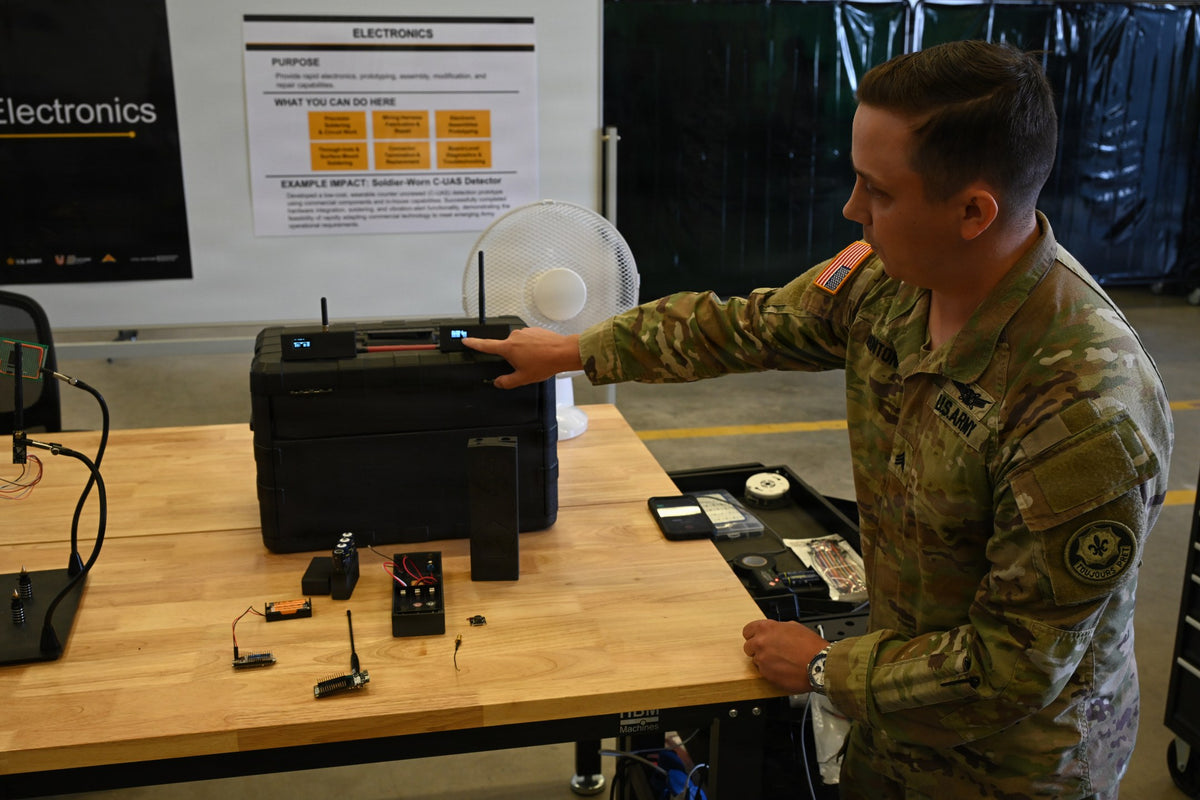
PHOTO CAPTION: U.S. Army Sgt. Ryan Minton, assigned to the 2nd Cavalry Regiment, displays a custom wearable drone-detection device he designed and built at the 7th Army Training Command’s DIRT Lab in Germany, July 31, 2026. (U.S. Army photo by Kevin Sterling Payne)
An Army soldier in Germany has built a wearable device designed to warn troops when drones may be operating nearby — using components that cost less than $120 and can be assembled in under an hour.
Sgt. Ryan Minton, assigned to the 2nd Cavalry Regiment, developed the portable detector after becoming concerned about how vulnerable troops could be on battlefields increasingly dominated by small unmanned aircraft. Stars and Stripes reported on the project Aug. 4, 2026, after Minton demonstrated it at the Army’s Design Innovation Research and Testing Lab in Germany.
The device scans for radio-frequency signals associated with nearby drones. When it detects one, it can alert the soldier by producing a sound or vibrating.
Minton has built several versions. One is small enough to fit in a pocket with a single battery, while larger versions fit inside a pouch and can carry three batteries. He also 3D-printed housings that make some versions resemble military radios.
According to Stars and Stripes, the electronic components cost under $120, and a detector can be assembled in less than an hour. One version is designed to focus on Wi-Fi signals used by many first-person-view drones similar to those increasingly seen in combat.
The Army has not announced that the detector will be issued service-wide. As of early August, the device was still a soldier-developed prototype and was expected to undergo additional testing at the Grafenwoehr Training Area in Germany.
Minton originally began experimenting with the concept on his own before his leadership connected him with the 7th Army Training Command’s DIRT Lab, which gives soldiers access to tools and technical support for rapidly developing battlefield solutions.
The Army formally photographed Minton demonstrating the custom detector at the lab on July 31. U.S. Army Europe and Africa describes the DIRT Lab as a place where soldiers, engineers and researchers can use technologies including 3D printing, electronics, robotics and advanced manufacturing to turn field problems into working prototypes.
The project comes as the Army places increasing emphasis on both operating drones and protecting troops against them. Small unmanned aircraft can be used to locate positions, direct weapons, conduct surveillance or carry explosives, creating threats that individual soldiers may encounter far below the level of traditional air-defense systems.
For Minton, the idea is comparatively simple: give an individual soldier an inexpensive warning that something may be flying nearby before the drone becomes an immediate threat.
Whether his design ultimately becomes an Army capability remains to be seen. But the prototype demonstrates how inexpensive commercial electronics and soldier-level experimentation are increasingly being used to address problems emerging from modern drone warfare.
(Source: OAF Nation)