Senators Seek AI Investigation
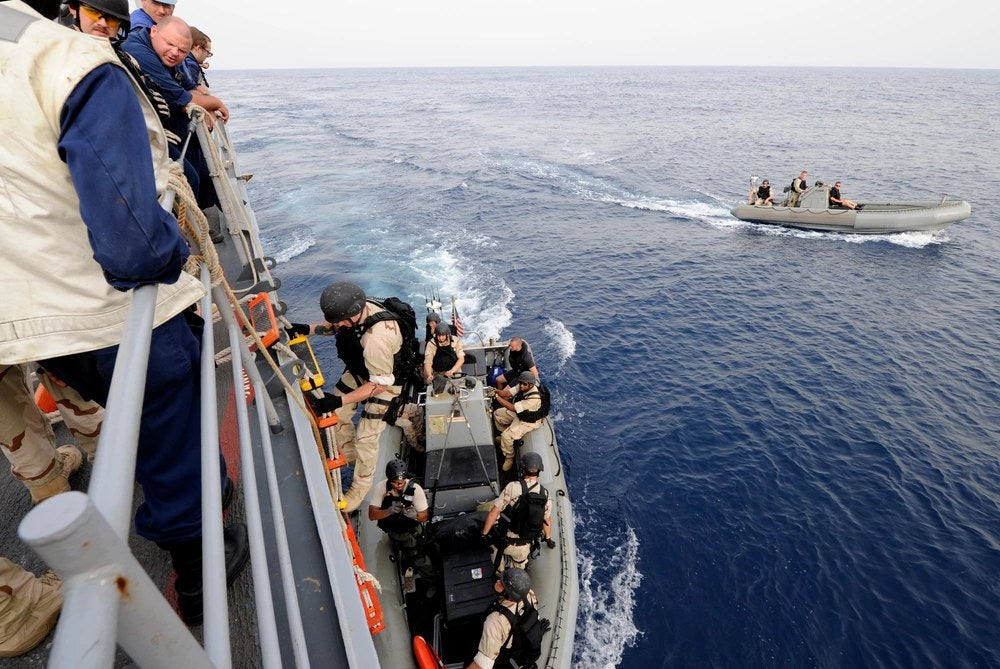
PHOTO CAPTION: Illustrative file photo. A U.S. Navy visit, board, search and seizure team prepares to inspect a vessel in the Gulf of Aden in July 2011. New reporting says false intelligence produced with help from an AI chatbot led the U.S. military to prepare an armed boarding of a Chinese vessel earlier this year before officials discovered the intelligence was wrong and stopped the operation. (U.S. Navy photo by Senior Chief Petty Officer Melissa Weatherspoon)
Three U.S. senators are calling for an investigation after new reporting revealed that false intelligence produced with the help of an artificial intelligence chatbot nearly triggered a U.S. military operation against a Chinese vessel.
Sens. Mark Warner of Virginia, Jack Reed of Rhode Island and Chris Coons of Delaware sent a letter Monday to Defense Secretary Pete Hegseth and Director of National Intelligence Jay Clayton asking them to investigate reported failures involving artificial intelligence in military and intelligence operations.
They also asked that the relevant inspectors general receive unrestricted access to examine the incidents.
The request follows a CNN report published Friday describing an incident earlier this year during the war with Iran.
According to four sources familiar with the episode, an intelligence report circulated within the U.S. military warning that a Chinese vessel traveling through the Middle East was carrying material connected to a nuclear weapons program.
Military officials began preparing to intercept the vessel.
Two sources told CNN that armed U.S. personnel were preparing to board the ship.
Military aircraft were already in the air, according to two sources familiar with the operation.
The operation was stopped before the boarding occurred.
Officials examined the intelligence more closely and discovered that the report had been produced with assistance from an AI chatbot that had incorrectly identified material listed on the vessel's cargo manifest.
CNN reported that it could not determine what the cargo actually was.
One source described the intelligence report as entirely false.
The intelligence originated with an analyst working within U.S. special operations.
According to CNN, the analyst queried an AI chatbot using intelligence concerning the vessel's manifest that originated with U.S. Special Operations Command Pacific.
The system combined open source information with classified signals intelligence available to the government.
It then reached the incorrect conclusion that the vessel was transporting components connected to a nuclear weapons program.
The analyst subsequently used artificial intelligence again to format the findings into a standard intelligence product.
That report was then distributed through military channels, where officials treated the information seriously enough to begin preparations for an armed interdiction.
It remains unclear whether the chatbot involved was a commercial product or a system developed for government use.
U.S. Special Operations Command Pacific and the Pentagon did not respond to CNN's requests for comment on the original report.
The senators' new letter raises questions about whether safeguards surrounding military use of artificial intelligence are keeping pace with the speed at which the technology is being adopted.
Warner is the vice chairman of the Senate Intelligence Committee. Reed is the ranking member of the Senate Armed Services Committee. Coons is the ranking member of the Senate Appropriations defense subcommittee.
Their letter asks for an investigation not only into the Chinese ship incident, but also into separate reporting involving the use of outdated geospatial information by an AI targeting system connected to a strike in Minab, Iran.
The senators said artificial intelligence can have legitimate uses in intelligence analysis, but argued that normal intelligence standards still need to prevent AI generated errors from entering reports that could lead to military action.
They specifically highlighted the danger of incorrect intelligence being used as the basis for action against a nuclear armed country.
The Chinese vessel incident occurred as the Defense Department has been pushing to expand the use of artificial intelligence throughout military operations.
In January, Hegseth announced an Artificial Intelligence Acceleration Strategy intended to increase experimentation and broaden access to AI tools across the department.
CNN reported that different military and intelligence organizations currently use different systems and standards, and that there is no single verification process applied across all AI generated information.
The Chinese vessel incident shows why those verification steps can carry unusually high stakes.
This was not an incorrect chatbot answer that remained on an analyst's computer.
The information entered an official intelligence process, circulated through military channels, and contributed to preparations for a real operation involving armed personnel and aircraft.
The boarding was stopped only after officials took another look at the intelligence and determined that the conclusion about the ship's cargo was wrong.
The senators are now asking inspectors general to examine how that happened and determine whether similar AI related failures have occurred elsewhere without becoming public.
(Source: OAF Nation)