Senators Demand Hearing on Iran Deployments
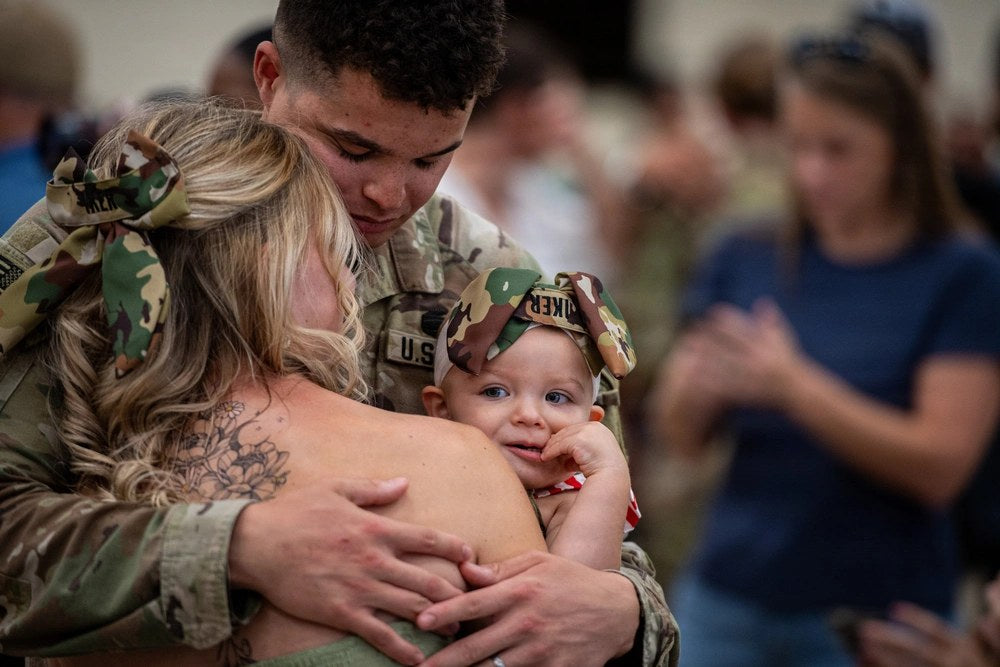
PHOTO CAPTION: An Oklahoma Army National Guard soldier embraces family after returning from a nine-month deployment to the Middle East on Aug. 20, 2026. The image is illustrative of the strain extended deployments can place on service members and their families. Oklahoma National Guard photo by Staff Sgt. Anthony Jones.
Senate Armed Services Committee Democrats are demanding a public hearing into extended U.S. military deployments tied to the war with Iran, warning that the strain is reaching beyond Navy ships to Soldiers, Airmen, National Guard members and Reservists stationed across the Middle East.
In an Aug. 24 letter to committee Chairman Sen. Roger Wicker, R-Miss., the lawmakers called for Pentagon leaders to explain how long troops could remain deployed, how relief rotations are being planned and how the military intends to sustain personnel if operations continue indefinitely.
The letter comes amid mounting scrutiny of lengthy deployments and reported supply and quality-of-life problems involving U.S. forces supporting Iran operations.
While much of the recent attention has focused on the USS Abraham Lincoln, the senators said the problem is broader.
Their offices have heard repeated accounts of Soldiers and Airmen, including Guard and Reserve members, having deployments extended without certainty about when replacement units will arrive or when they will return to their families, according to the letter.
The lawmakers also said some bases in the Middle East that were designed to accommodate smaller numbers of personnel are now supporting significantly larger forces.
They alleged that overcrowding and logistical problems have left too many troops competing for limited space and supplies, and said some service members have faced difficulty receiving food, medication and other necessities.
The senators asked the Armed Services Committee to examine how the Pentagon determines deployment extensions, plans relief rotations and evaluates the effect prolonged missions have on military readiness, recruiting and retention.
They also raised concerns about the consequences for military families, particularly when deployment dates repeatedly change.
Unplanned extensions can create problems with civilian employment, childcare, finances and family schedules for Guard and Reserve personnel and their spouses.
The USS Abraham Lincoln has become one of the most visible examples of that strain.
The carrier left San Diego in November 2025 for what began as an Indo-Pacific deployment before being redirected to support operations involving Iran. Its deployment ultimately stretched beyond 250 days amid reports from sailors and family members of food and supply shortages, plumbing problems, disrupted mail and significant fatigue.
Defense Secretary Pete Hegseth has disputed portrayals of conditions aboard the Lincoln, calling reports of severe problems “completely misrepresented.”
Hegseth said the Pentagon provides deployed ships and crews with everything it can and praised sailors serving under difficult conditions with fewer opportunities for port calls.
Acting Navy Secretary Hung Cao has also pushed back on some accounts. He said meal plans aboard the Lincoln were adjusted when fresh resupply was unavailable but that no meals were missed, and he accused some coverage of portraying sailors as victims rather than emphasizing their performance during the deployment.
The Lincoln is now being relieved by the USS George Washington, which recently arrived in the Middle East. The Lincoln is expected to return to San Diego after one of the longest U.S. carrier deployments in decades.
The senators also cited the USS Gerald R. Ford as another example of the pressure created by extended operations.
Ford completed an approximately 11-month deployment earlier this year after being redirected between missions in Europe, the Caribbean and the Middle East. During that deployment, the carrier dealt with plumbing problems and a non-combat laundry-room fire that injured sailors and damaged berthing spaces.
The Aug. 24 letter argues that similar strains are now appearing across a wider portion of the force as the Iran conflict continues.
The lawmakers want Pentagon officials to testify publicly about how the military plans to sustain extended deployments, provide replacement forces and prevent current operational demands from damaging long-term readiness.
As of Tuesday morning, the Senate Armed Services Committee had not announced the requested hearing.
Sources: U.S. Senate; Department of Defense; U.S. Navy; Reuters; Associated Press
(Source: OAF Nation)