AIR FORCE AWARDS $131B F-15 CONTRACT
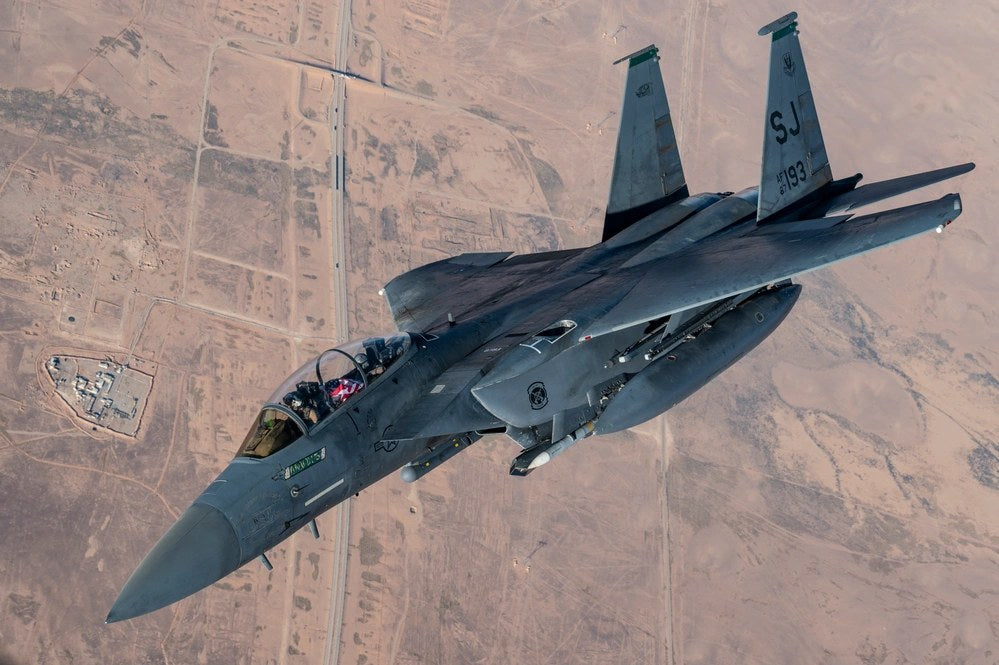
PHOTO CAPTION: A U.S. Air Force F-15E Strike Eagle flies over the U.S. Central Command area of responsibility on Aug. 28, 2024. The Air Force awarded Boeing a new F-15 contract Aug. 24, 2026, with a maximum ceiling of $131.23 billion for production, modernization and sustainment work. U.S. Air Force photo by Senior Airman Rachel Pakenas
The U.S. Air Force has awarded Boeing a massive new contract covering the production, modernization and long-term support of F-15 fighter aircraft, with a maximum potential value of $131.23 billion.
The contract was announced Aug. 24 and supports the F-15 Eagle Crest program, which encompasses work on the F-15 fleet for the Air Force, Air National Guard and other military customers.
The eye-catching $131.23 billion figure is a contract ceiling, not an immediate $131 billion purchase.
The award is an indefinite-delivery, indefinite-quantity contract, commonly called an IDIQ. That structure allows the government to place individual orders for aircraft, upgrades, maintenance and other work over time, up to the maximum ceiling.
At the time the contract was awarded, only $343,740 in fiscal 2026 research, development, test and evaluation funding was obligated.
According to the Department of War, the contract can cover new aircraft production, systems integration, modernization, upgrades, retrofits and sustainment of the F-15 weapon system.
It also includes establishing additional government-operated depot maintenance capabilities intended to keep F-15s available and mission-ready.
Boeing will perform the work in St. Louis, Missouri.
The initial ordering period runs through Aug. 24, 2031, with an option that could extend ordering through Aug. 24, 2036. Work placed under the contract could continue through August 2037.
The award also includes potential Foreign Military Sales involving Japan, Israel, Saudi Arabia, South Korea, Singapore, Indonesia and Poland.
The contract was awarded to Boeing on a sole-source basis through the Air Force Life Cycle Management Center at Wright-Patterson Air Force Base, Ohio.
The size and duration of the agreement underscore how much life remains in a fighter family whose roots stretch back more than half a century.
The original F-15 first flew in 1972 and entered Air Force service in the 1970s, but newer versions bear little resemblance internally to the earliest Eagles.
The Air Force is currently fielding the F-15EX Eagle II, a modernized version featuring updated avionics, electronic warfare systems, digital flight controls and the ability to carry large weapons loads alongside the service's stealthier F-35 fleet.
The new Eagle Crest contract is broader than simply buying F-15EX aircraft. It creates a framework through which the Air Force and other customers can order production, upgrades, sustainment and other F-15 work for years to come.
That means the $131.23 billion ceiling should not be interpreted as the price of a single aircraft purchase or as money Boeing is guaranteed to receive.
Instead, it represents the maximum amount that could potentially be ordered under the contract over its lifespan.
Still, the unusually large ceiling makes clear that the Pentagon expects the F-15 family to remain an important part of U.S. and allied airpower well into the next decade.
(Source: OAF Nation)