Senate Bill Eyes Concealed-Carry for Vets
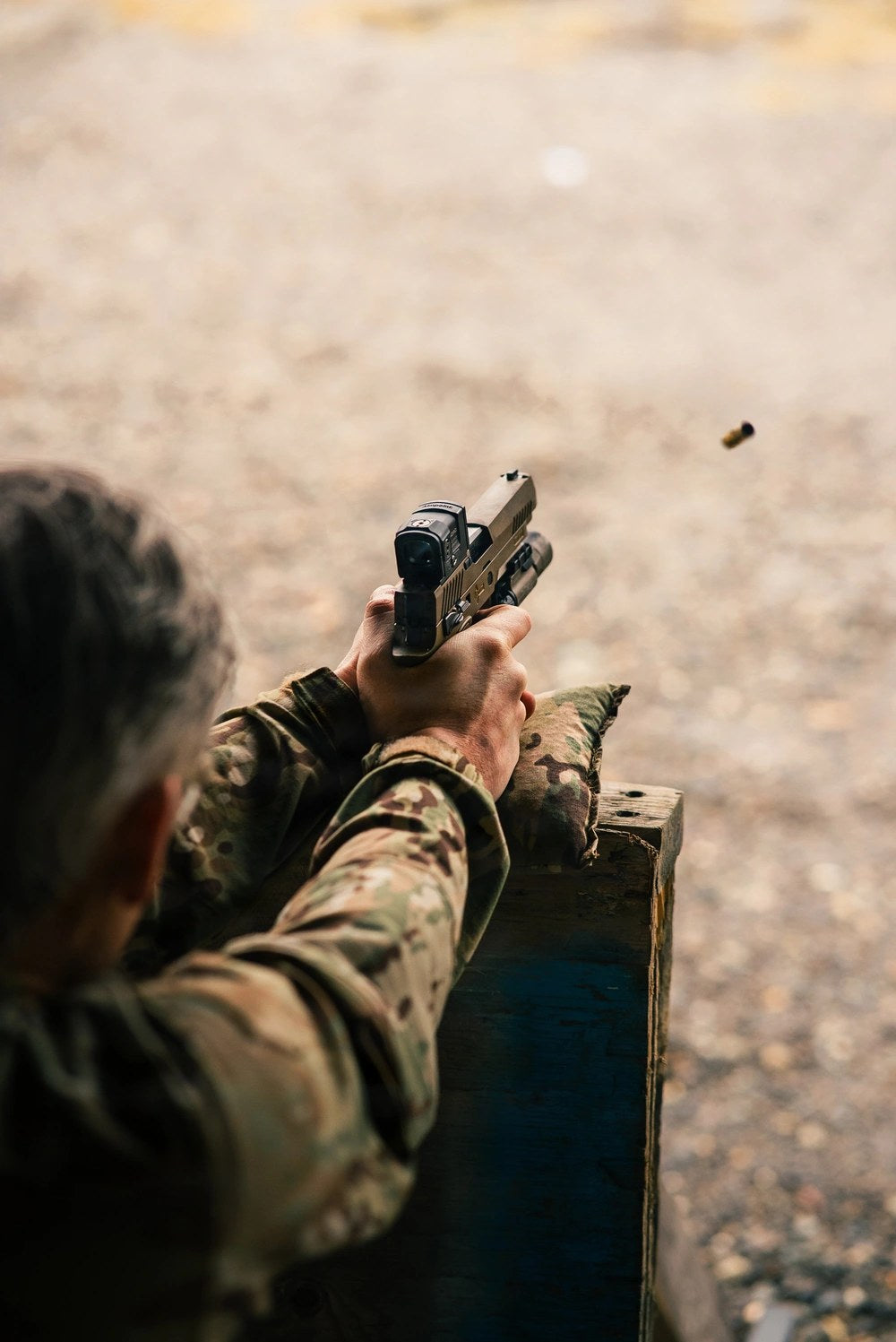
PHOTO CAPTION: A Green Beret assigned to 1st Special Forces Group (Airborne) fires an M17 pistol during combat marksmanship training at Joint Base Lewis-McChord, Washington, Feb. 2, 2026. Illustrative file photo. (U.S. Army photo by Spc. Noah Martin)
Qualified former U.S. special operations troops could carry concealed firearms across state lines under a Senate bill that would extend federal concealed-carry protections currently available to certain retired law enforcement officers.
Sen. Tim Sheehy, R-Mont., introduced the Special Operations Forces Concealed Carry Act, S. 5208, on Aug. 3, 2026. The bill was read twice and referred to the Senate Judiciary Committee, where it remains pending. It has not passed Congress and does not change current gun laws unless enacted.
The proposal would amend the Law Enforcement Officers Safety Act framework to include a new category of “qualified special operator.”
Under the Senate bill, that would mean a former member of the U.S. armed forces who went through special operations assessment and selection, completed qualification training and held a special warfare or special operations occupational specialty or skill designator recognized by U.S. Special Operations Command.
The nationwide carry privilege would not be automatic simply because someone previously served in special operations.
Eligible veterans would have to maintain an honorable discharge status, remain legally eligible under federal law to possess a firearm and complete recurring firearms qualification. The bill requires qualification to active-duty standards at the individual's expense within the previous year, based on standards determined by the state where the veteran resides.
Veterans would also have to complete a Justice Department-certified course covering civilian use-of-force law, reasonable-belief standards and de-escalation before exercising the proposed carry authority.
The legislation specifically says the new authority would not override existing federal firearm restrictions. Carry privileges would also immediately end if a participant no longer satisfied the bill's eligibility requirements.
Qualified veterans would be required to carry documentation proving their identity and special-operations status. If the bill becomes law, the Defense Department and Department of Veterans Affairs would have 180 days to establish a joint photographic identification program for eligible veterans.
Until those cards became available, official military service documentation could serve as proof of qualification. The attorney general would also be directed to provide guidance to law enforcement agencies nationwide on accepting the documentation.
Sheehy, a former Navy SEAL, has argued that specially trained veterans should receive treatment similar to qualified retired law enforcement officers because of their extensive firearms training and experience.
A related House bill was introduced April 16 by Rep. Pat Harrigan, R-N.C., a former Green Beret. The House and Senate versions are not identical: the House proposal defines eligible special operators more broadly and uses different firearms-training requirements.
For now, neither proposal has become law. The Senate bill's next step would require action in the Judiciary Committee before it could advance further through Congress.
(Source: OAF Nation)