Army Awards $10B Pilot Training Contract
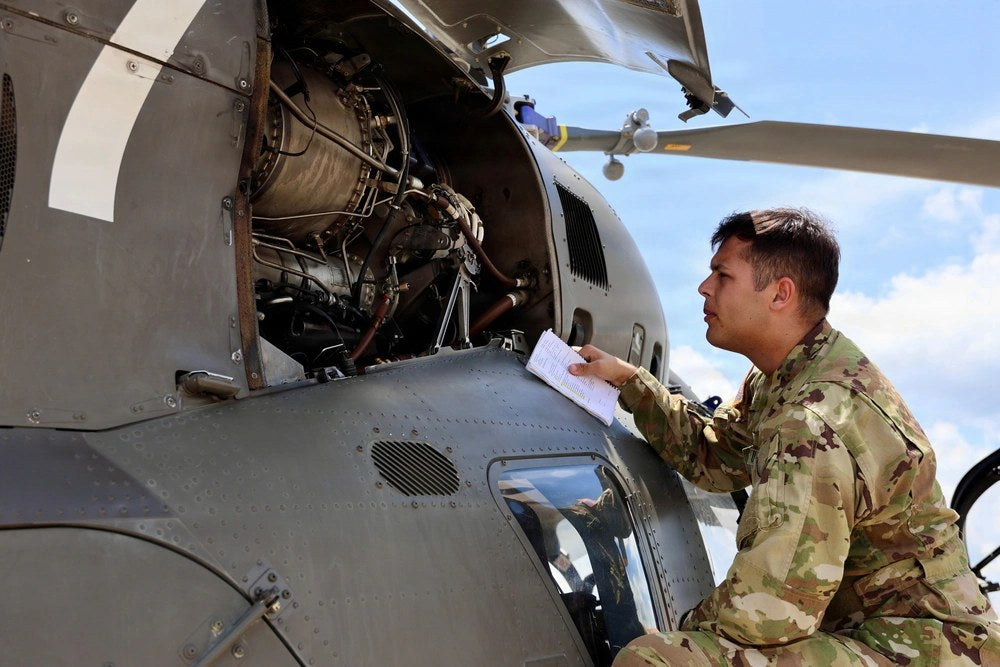
PHOTO CAPTION: 2nd Lt. Blaine Dolin, a student pilot with the 1st Battalion, 145th Aviation Regiment, inspects an LUH-72 Lakota before a solo cross-country flight near Fort Rucker, Alabama, July 10, 2026. Illustrative file photo. (U.S. Army photo by Leslie Herlick)
The Army is overhauling how it trains new helicopter pilots at Fort Rucker, Alabama, awarding a private company a contract potentially worth up to $10 billion to provide aircraft, instructors, simulators and maintenance for the service’s initial flight-training program.
The Army announced Aug. 13, 2026, that M1 Support Services had been selected for its new Flight School Next program, which will train roughly 800 to 1,500 new Army rotary-wing pilots each year.
Under the new model, the contractor will own and operate the aircraft used for initial training and provide maintenance, flight simulators, academic instruction and flight instructors.
The Army will retain oversight of training standards, safety requirements and operational outcomes.
The firm-fixed-price, indefinite-delivery/indefinite-quantity contract has a maximum cumulative face value of $10 billion and could remain in place for as long as 26 years. That figure represents the contract’s potential ceiling over its full duration, not a guaranteed $10 billion expenditure.
The first task order will cover the transition to the new system and is expected to run for roughly three to four years.
Fort Rucker is the home of the Army’s Initial Entry Rotary-Wing Flight Training program and currently produces about 1,250 new aviators each year.
For more than 50 years, the program has trained Army helicopter pilots who later move into operational aircraft and missions across the force.
Army officials say Flight School Next is intended to consolidate multiple existing training contracts into a single system while making greater use of commercially available aircraft, equipment and training practices.
Maj. Gen. Clair Gill, commanding general of the U.S. Army Aviation Center of Excellence, said the Army expects the new approach to give new helicopter pilots stronger foundational flying skills while producing long-term savings.
Students will still be required to demonstrate core military aviation skills, including safe flight under visual and instrument conditions, terrain flight, navigation and tactical mission planning.
The arrangement represents a significant role for private industry in one of the most fundamental stages of becoming an Army aviator.
Instead of the Army owning and maintaining all of the aircraft and training infrastructure used during initial flight instruction, M1 Support Services will provide much of that training ecosystem while the Army establishes the standards and monitors performance.
Army officials say the approach will allow the service to modernize training faster, improve efficiency and prepare future aviators for increasingly complex combat environments.
If all contract options are ultimately exercised, Flight School Next could shape how generations of Army helicopter pilots receive their first military flight training well into the 2050s.
(Source: OAF Nation)