Pentagon Probes Iran Wedding Strike
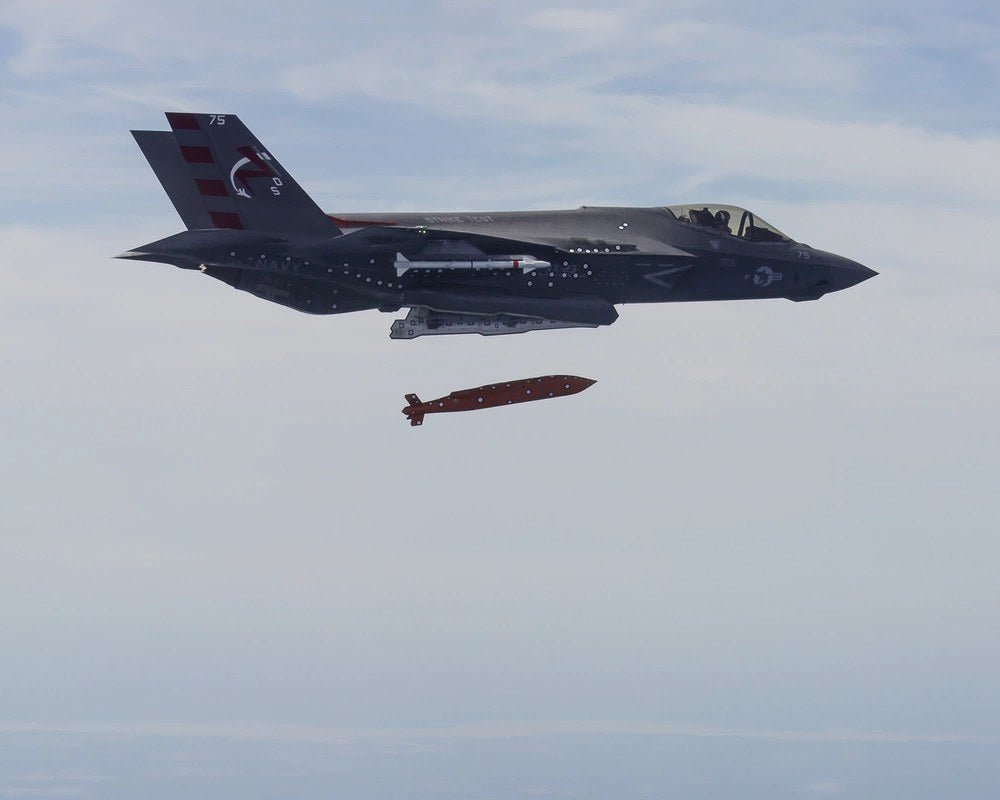
PHOTO CAPTION: An F-35C releases an inert AGM-154 Joint Standoff Weapon during testing over the Atlantic Test Ranges in 2016. The Pentagon is investigating whether a JSOW employed during U.S. strikes in Iran on Sept. 1 missed its intended target and struck a nearby home hosting a wedding. U.S. Navy photo by Dane Wiedmann.
The Pentagon is investigating whether a U.S. Navy Joint Standoff Weapon missed its intended target during strikes in southern Iran and instead hit a nearby home where a wedding was taking place.
Six AGM-154 Joint Standoff Weapons, or JSOWs, were dropped by U.S. Navy aircraft toward a communications complex in the coastal town of Kuhestak on Sept. 1, according to new reporting from The Washington Post. Five reportedly struck the target area while one appeared to go astray.
An explosion tore through the roof of a home about 440 feet from the communications site, where dozens of people had gathered for a wedding celebration. Iranian officials and media have reported multiple civilian deaths and dozens of injuries, although casualty counts have varied as information has emerged.
U.S. Central Command has acknowledged carrying out strikes in southern Iran that day. In its Sept. 1 announcement, CENTCOM said American forces targeted Iranian Revolutionary Guard Corps air-defense sites, radar systems, maritime assets, mine-laying capabilities and communications sites after attempted attacks against commercial shipping and U.S. service members.
CENTCOM has not publicly accepted responsibility for the wedding strike. Navy Capt. Tim Hawkins, a CENTCOM spokesman, told The Washington Post that the command was aware of reports of civilian casualties and was looking into them, adding that the U.S. military does not target civilians.
Vice President JD Vance also confirmed last week that the United States was investigating the incident.
“We’re investigating it because obviously we care. We want to know,” Vance told reporters Thursday. He said that when the U.S. military makes mistakes, it works to learn from them.
Reuters had independently examined verified imagery from the scene before the latest details emerged. Four weapons experts told Reuters that damage to the home was consistent with a munition detonating directly on or immediately above the roof rather than debris ricocheting from the nearby communications tower. Three said the evidence favored a U.S. weapon over an errant Iranian air-defense missile.
Reuters also reported that former Army explosive ordnance disposal technician Trevor Ball identified some weapons remnants shown by Iranian media as parts associated with a JSOW. Reuters could not verify that those particular fragments had actually been recovered from the wedding site.
The Washington Post's subsequent reporting went further. Citing a person familiar with the operation, it reported that the weapons used against the communications complex were JSOWs and that one of the six apparently deviated from the path followed by the others.
The AGM-154 is an air-launched precision glide weapon designed to allow aircraft to attack targets while remaining farther from enemy air defenses. The Navy has integrated variants of the weapon on aircraft including the F/A-18, and the weapon has also been tested and carried by the F-35C.
It remains unclear why one weapon may have missed. The Post reported that investigators are examining the incident and that an Iranian air-defense interceptor remains among the possibilities being considered, although the person familiar with the strike and outside weapons specialists considered that explanation significantly less likely.
The investigation will ultimately have to determine whether a U.S. weapon struck the home, what caused it to deviate from the intended target, and whether anything in the targeting or weapons-employment process contributed to the civilian casualties.
(Source: OAF Nation)