Pentagon Faces $285B Maintenance Backlog
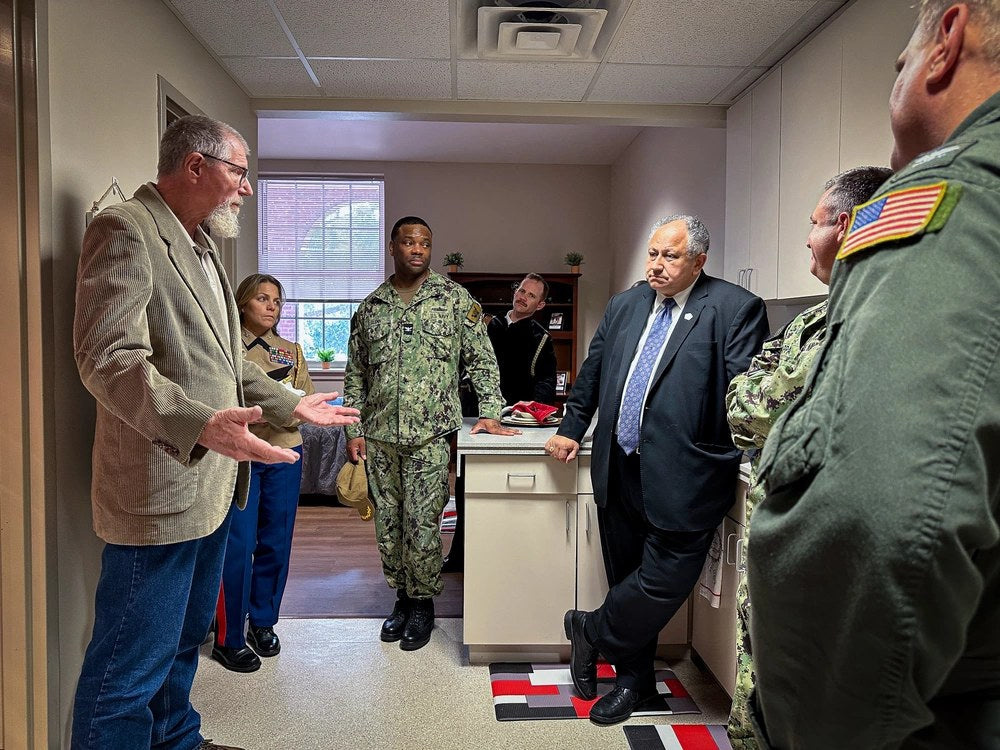
PHOTO CAPTION: Secretary of the Navy Carlos Del Toro inspects unaccompanied housing at Naval Station Norfolk, Virginia, Nov. 9, 2023, as part of a visit focused on improving quality of life for Sailors and their families. Credit: U.S. Navy photo by Capt. Patrick Evans
The Pentagon is facing an estimated $285 billion backlog in deferred maintenance across military installations, as a new federal watchdog report details troops dealing with moldy barracks, broken air conditioning, overcrowded dining facilities and aging infrastructure.
The Government Accountability Office released the report Friday, finding the Department of Defense has repeatedly funded installation maintenance below its own targets while the backlog has grown dramatically. DOD reported $137 billion in deferred maintenance in fiscal year 2020, compared with an estimated $285 billion in fiscal 2025.
The problem stretches across a massive military real estate portfolio. DOD reported more than 736,000 buildings and other facilities worldwide worth an estimated $2.6 trillion, with roughly one-third of its buildings more than 50 years old.
GAO said inadequate maintenance can affect both military readiness and troops' quality of life. Problems with heating, air conditioning, plumbing and other building systems can affect health and safety, while neglected runways, maintenance facilities and other mission infrastructure can interfere with operations.
At Naval Station Norfolk, GAO investigators observed suspected mold covering portions of a barracks closet. Housing officials told investigators the growth had been identified in late 2023 but that the installation maintenance office declined a request to test it for mold because of the potential cost of testing and remediation.
Officials said they treated the area with cleaning products and closed the affected room and an adjacent room to protect residents and prevent further spread. As of February 2026, however, the suspected mold had still not been addressed.
It was not the first significant mold problem GAO had documented at Norfolk. In a previous investigation, the watchdog reported another barracks had extensive mold that left more than half its rooms uninhabitable; officials told GAO that building has since been completely condemned because of mold.
At Fort Benning, Georgia, installation officials described cases in which failed air-conditioning systems and lengthy repairs resulted in soldiers sleeping outdoors to escape extreme heat. Officials said those conditions affected soldiers' ability to get adequate rest before training.
GAO also documented serious problems inside a Fort Benning dining facility. During an August 2024 visit, investigators found nearly all of the facility's HVAC units had failed, contributing to suspected mold and mildew and kitchen temperatures exceeding 105 degrees with nearly 100% humidity.
An installation official told GAO the conditions led multiple employees to resign. Fort Benning officials said HVAC repairs and mold-abatement work have to be prioritized over other maintenance needs because of the installation's hot and humid environment.
In Alaska, soldiers at Fort Wainwright face a different quality-of-life problem. The main dining facility serving troops who live in the barracks was designed for about 800 soldiers even though roughly 3,000 soldiers live there.
Officials told GAO that the dining facility cannot serve soldiers quickly enough, causing some troops to buy less-healthy food at their own expense and eat in their rooms. The problem can become particularly difficult during the Alaska winter, when waiting outside in line is impractical.
Installation leaders had repeatedly pushed for an expansion of the dining facility, according to GAO, but the project had not been selected for military construction funding as of March.
Maintenance problems extend well beyond barracks and dining facilities.
At Twentynine Palms in California, GAO documented an aging vehicle maintenance building that officials said was already in poor condition and would not be large enough for future Marine Corps vehicles without modification. At Minot Air Force Base in North Dakota, investigators photographed standing water in the foundation of a 1960s-era building the Air Force eventually plans to demolish.
Officials at Naval Base Guam reported frequent air-conditioning failures and roof leaks that contributed to heat, water damage and possible mold in aging workspaces. Minot officials said broken furnaces can contribute to frozen pipes bursting, while leaking roofs and melting snow frequently cause water damage.
The backlog has grown in part because the military services have consistently spent less on routine facility sustainment than DOD itself says is needed.
DOD established a goal of funding at least 90% of calculated facility sustainment requirements. GAO found that the Army, Navy and Air Force generally requested around 80% of recommended funding from fiscal 2021 through 2025, while none of the eight installations examined by GAO reported receiving funding that met the Pentagon's 90% goal.
Some individual installations received considerably less.
Across the five-year period examined, Naval Station Norfolk received an average of 61% of its recommended sustainment funding, Twentynine Palms received 59%, Andersen Air Force Base received 37% and Minot Air Force Base received 40%.
GAO also found the Pentagon does not have a complete picture of how severe its maintenance workforce shortages are. Installation officials cited competition with private-sector employers, federal hiring practices and difficulty recruiting workers in remote locations, while recent workforce reductions and a hiring freeze have added pressure.
The watchdog made 13 recommendations aimed at improving how DOD evaluates maintenance risks, identifies workforce shortages, tracks maintenance data and oversees installation conditions.
The Pentagon agreed with seven recommendations, partially agreed with five and disagreed with one. GAO said DOD should fully implement all 13.
The findings add to years of warnings about deteriorating military housing and infrastructure, but the size of the latest estimate puts the scale of the problem into sharper focus: an estimated $285 billion in deferred maintenance across installations where troops still live, eat, work and train every day.
(Source: OAF Nation)