NSA Network Down for Four Days
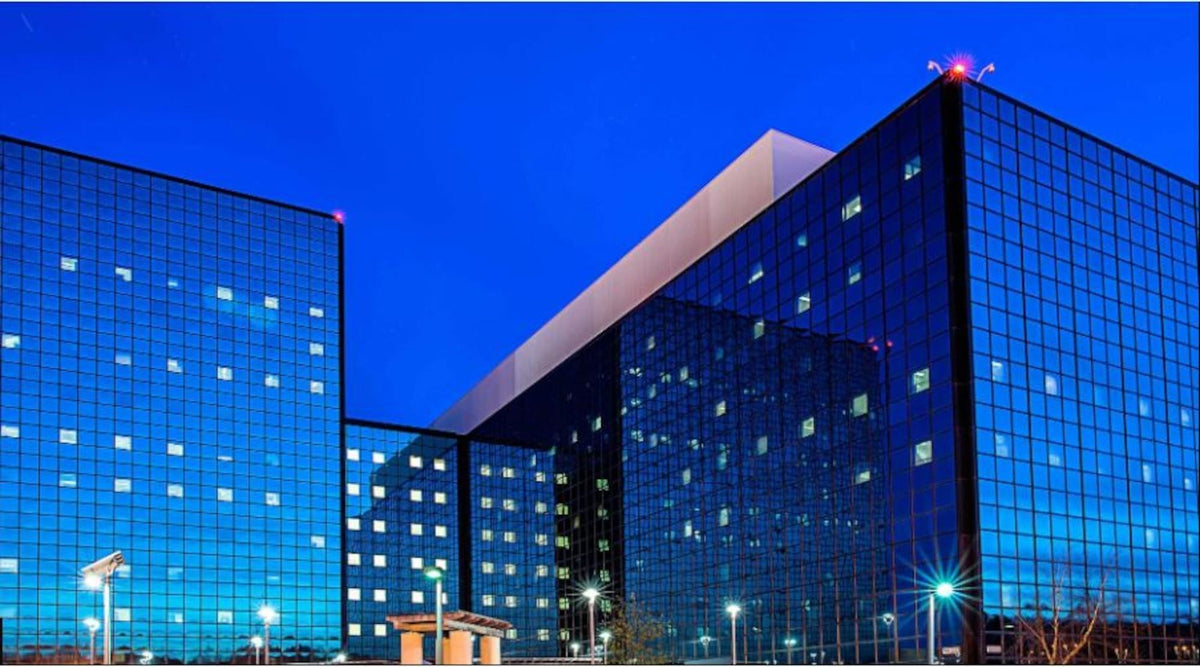
PHOTO CAPTION: The National Security Agency headquarters at Fort Meade, Maryland, photographed at night on November 5, 2021. A disruption of the agency's highly classified internal communications network affected employees at Fort Meade and a Georgia intelligence facility from approximately November 17 to November 20, 2026. The photograph is illustrative and does not depict the outage. (National Security Agency file photo.)
One of America's most important intelligence agencies spent nearly four days dealing with a major outage of its highly classified internal network, leaving large numbers of employees unable to access systems they needed for their jobs.
The National Security Agency's network disruption began around November 17 and continued through November 20, affecting personnel at its headquarters at Fort Meade, Maryland, and an intelligence facility in Georgia that supports operations involving the Middle East.
The agency eventually restored the network Friday, although some operational restrictions remained.
According to officials familiar with the incident, the disruption appears to have been caused by software maintenance rather than a cyberattack.
The outage was unusually prolonged for an agency whose mission includes collecting foreign intelligence and protecting some of the government's most sensitive communications.
Employees Sent Home as Classified Network Failed
The trouble involved NSANet, the highly classified network used by NSA personnel to communicate and share intelligence internally.
The system is not an ordinary office internet connection. It supports secure work involving classified information that cannot simply be transferred to personal devices or commercial email systems.
When employees couldn't access the network, many were unable to perform their normal assignments.
At Fort Meade, where the NSA employs thousands of military and civilian personnel, officials began staggering employee arrival times to limit the number of people attempting to connect simultaneously.
As the outage continued, those restrictions became more significant.
By November 17, the agency had directed many nonessential employees to remain home, keeping only personnel needed for essential operations and recovery work on site.
The restrictions continued into November 18, when employees received instructions not to report unless directed by supervisors.
The nearly four-day disruption was longer than typical maintenance interruptions and created significant difficulties for employees who rely on classified network access.
Critical Georgia Intelligence Facility Also Affected
The disruption wasn't limited to NSA headquarters.
CNN reported that operations at a major NSA facility in Georgia were also affected.
That facility supports signals intelligence and cybersecurity activities involving the Middle East, including work relevant to ongoing American military operations in the region.
Four sources familiar with the situation told CNN the outage disrupted personnel and operations at the Georgia location.
That connection makes the incident particularly noteworthy.
The NSA supports military commanders and national security officials through foreign intelligence collection, communications analysis, and cybersecurity capabilities.
But an important distinction remains: Reports of disrupted employee access do not establish that all NSA intelligence operations stopped.
The agency maintains redundant systems, separate operational capabilities, and backup procedures intended to preserve critical functions during technical failures.
The NSA publicly maintained that its mission-critical capabilities remained operational throughout the incident.
The full operational impact has not been publicly disclosed.
A Software Update Appears to Have Triggered the Problem
When the outage first became public November 17, the NSA described the problem as a temporary degradation associated with scheduled maintenance.
Officials familiar with the incident subsequently pointed to software updates involving security vulnerabilities.
Director of National Intelligence Jay Clayton also attributed the problems to internal software patching and maintenance.
According to CNN, some officials believed the disruption was connected to efforts to address vulnerabilities in PHP, a widely used programming language.
That explanation is important because an extended outage of a classified intelligence network naturally raises concerns about a possible cyberattack.
However, officials briefed on the incident said there was no evidence that the network failure resulted from hostile hacking.
The exact technical failure has not been fully explained publicly.
The available reporting points toward problems arising during maintenance rather than a confirmed intrusion by a foreign adversary.
Network Restored November 20, With Restrictions
By Friday, November 20, the NSA had restored its internal classified communications network.
CNN confirmed the restoration through a source familiar with the matter and an internal employee voicemail recording.
Employees were told headquarters was returning to normal operations, subject to some exceptions.
Officials continued staggering arrival times to avoid overwhelming the restored network as personnel returned.
The prolonged disruption had left many workers unable to perform their usual duties for much of the week.
Although the network was restored, the agency had not publicly released a complete technical explanation or detailed assessment of the disruption's operational consequences.
Was This Connected to the Other Major Outages?
The NSA incident happened during a week when several other major American systems experienced technical failures.
Microsoft services, banking operations, United Airlines, and the Federal Aviation Administration all faced disruptions that attracted national attention.
The proximity of those events prompted speculation that the failures might be connected.
But federal officials told Congress on November 18 that investigators had found no evidence of a coordinated cyberattack or a common malicious source.
Homeland Security, FBI, and intelligence officials described the incidents as separate technical problems involving maintenance, software, and infrastructure.
The NSA outage therefore should not be presented as evidence that the country's networks were under a coordinated attack.
What the episode does demonstrate is how disruptive a failed software update can become when employees depend on highly secured systems that cannot easily be replaced with ordinary commercial tools.
The NSA was able to maintain its mission-critical functions, according to the agency, while working to restore its internal network.
But for many of the people responsible for supporting those missions, nearly four days passed before they could return to normal operations.
The network came back online November 20. The full cost of the interruption, and whether the agency will change its maintenance procedures as a result, remain unknown.
(Source: OAF Nation)