Navy Reports Decade-High Mishaps
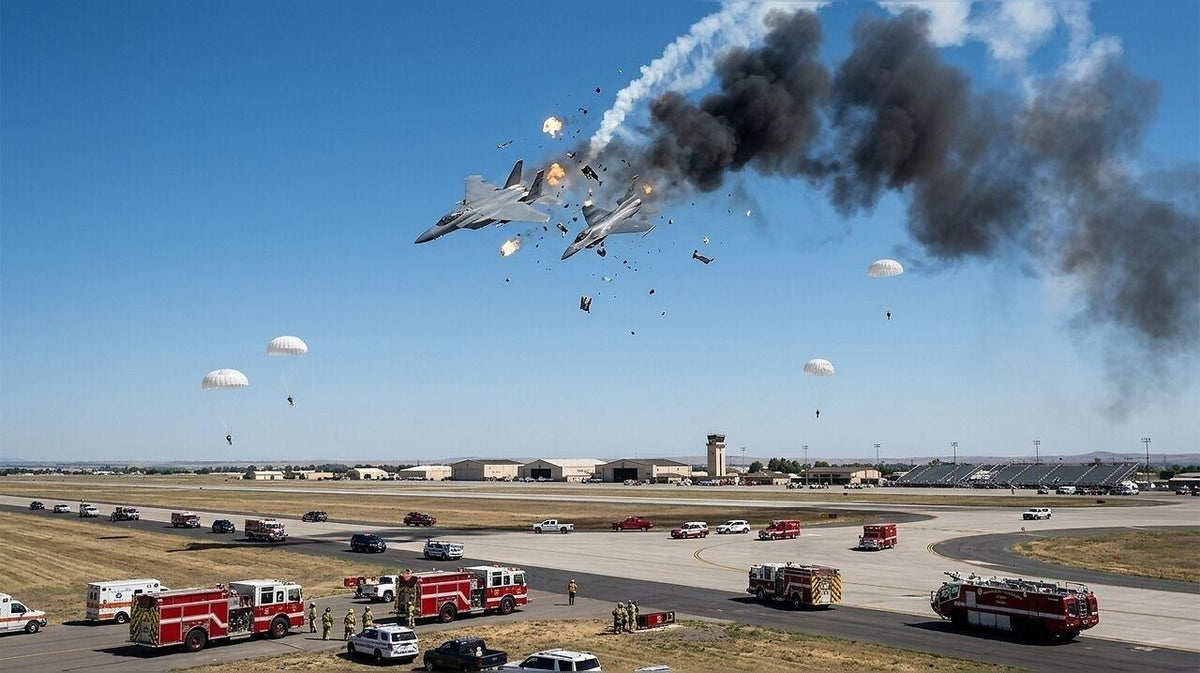
PHOTO CAPTION: Four Navy aviators eject from two EA-18G Growlers following a midair collision at the Gunfighter Skies Air Show in Idaho on May 17, 2026. All four survived. The accident was among 16 major Navy aviation mishaps recorded in fiscal year 2026, the highest annual total since 2014. (Photo by Henk Zuurbier / Handout via Reuters)
The U.S. Navy recorded its highest number of major aviation and afloat mishaps in at least a decade during fiscal year 2026, with aircraft crashes, shipboard fires, collisions and fatal incidents contributing to a troubling year for naval safety.
Newly reported Naval Safety Command data show 16 Class A aviation mishaps and 11 Class A afloat mishaps between October 1, 2025, and September 30, 2026.
Both categories reached their highest annual totals since at least fiscal year 2014, according to an October 27 report by USNI News.
The Navy recorded 30 total on-duty Class A mishaps during the year, matching the total reported in fiscal year 2022.
Class A mishaps are the military's most serious accident classification. An incident qualifies if it results in at least $2.5 million in damage, the destruction of an aircraft, a fatality or permanent total disability.
The latest figures include two Navy electronic warfare jets destroyed during an airshow, separate aircraft crashes in the South China Sea, a fatal helicopter incident in the Middle East and major accidents aboard American warships.
Navy Records 16 Major Aviation Mishaps
The Navy's 16 Class A aviation mishaps represent the highest annual total since fiscal year 2014, when the service recorded 17.
The previous fiscal year ended with 14 major aviation mishaps.
Of the 16 incidents in fiscal year 2026, 14 involved manned aircraft and two involved unmanned aircraft.
Eleven of the manned-aircraft mishaps occurred during flight operations, while three occurred on the ground.
One of the year's earliest incidents happened on October 26, 2025, when an F/A-18F Super Hornet and an MH-60R Seahawk helicopter crashed into the South China Sea in separate incidents.
Both aircraft were operating from the aircraft carrier USS Nimitz.
The incidents added to concerns about aircraft safety during the Navy's demanding carrier operations, which involve launches, recoveries, maintenance and around-the-clock flight activity.
Two Growlers Destroyed at Idaho Airshow
Among the most dramatic incidents was the May 17 collision of two EA-18G Growler electronic warfare aircraft during a demonstration at Mountain Home Air Force Base in Idaho.
The aircraft, assigned to Electronic Attack Squadron 129, were performing at the Gunfighter Skies Air Show when they collided in midair.
Video recorded by spectators showed the jets descending after the collision as all four aviators ejected.
Both aircraft were destroyed, but all four crew members survived.
The accident prompted the Navy to suspend tactical demonstration flights while safety reviews were conducted.
Other tactical demonstration teams were subsequently cleared to resume performances, although the Growler demonstration team remained grounded as of late August.
Another major Growler accident occurred September 28 aboard USS Dwight D. Eisenhower.
That incident involved a landing mishap that injured multiple personnel.
The two incidents demonstrate the different circumstances covered by the Navy's aviation safety statistics, from public aerial demonstrations to flight operations aboard aircraft carriers.
Fatal Helicopter Crash in Arabian Sea
The year's major aviation incidents also included the loss of an MH-60S Seahawk helicopter assigned to the aircraft carrier USS George H.W. Bush.
The helicopter ditched in the Arabian Sea on July 1 while operating in the Middle East.
Three crew members were rescued, but another aviator went missing and was later presumed dead.
Navy officials said the incident was not caused by hostile action.
The accident occurred as American naval forces maintained a substantial operational presence in the Middle East during the ongoing confrontation with Iran.
The incident underscored the dangers of military flight operations even when aircraft are not directly engaged in combat.
Shipboard Mishaps Reach Decade High
The Navy also recorded 11 Class A afloat mishaps during fiscal year 2026, the most in at least a decade.
That compares with five afloat mishaps reported during fiscal year 2025.
The incidents included a February 11 collision involving guided-missile destroyer USS Truxtun and fast combat support ship USNS Supply.
Two major shipboard fires also contributed to the total.
On March 12, a fire broke out aboard aircraft carrier USS Gerald R. Ford while it was operating in the Red Sea.
The blaze began in a laundry area, injured sailors and damaged living spaces aboard the ship.
The carrier later underwent repairs and maintenance in Split, Croatia.
Another fire occurred April 19 aboard the guided-missile destroyer USS Zumwalt at HII Ingalls Shipbuilding in Mississippi.
Three people were injured in that incident.
The afloat statistics also include fatal and presumed-fatal personnel incidents.
Marine Lance Cpl. Chukwuemeka Oforah was presumed dead after falling overboard from USS Iwo Jima on February 7.
Marine Lance Cpl. Armando Ortiz Canseco went missing at sea June 25 while attached to USS Anchorage.
Those cases illustrate that the Navy's afloat mishap category extends beyond damage to warships and includes serious accidents involving personnel.
Total Navy Mishaps Did Not Set an Overall Record
Although the aviation and afloat categories reached decade highs, the Navy's overall on-duty Class A mishap total did not establish a new record.
The service recorded 30 on-duty mishaps in fiscal year 2026, the same number reported in fiscal year 2022.
The broader total includes additional categories beyond aviation and afloat operations.
The Navy also recorded 48 off-duty Class A mishaps resulting in 45 fatalities.
That was an improvement from fiscal year 2025, when 54 off-duty mishaps resulted in 53 deaths.
The distinction is important because the latest figures show increased mishap counts in specific operational categories, rather than a uniform increase in every measure of naval safety.
What the Numbers Mean for Military Readiness
Major aviation and shipboard mishaps can affect military readiness well beyond the immediate cost of repairing damaged equipment.
Destroying an aircraft removes a valuable military asset from service. Serious accidents can also require investigations, safety reviews, additional training and temporary restrictions on operations.
In some cases, the consequences include injured personnel, damaged facilities or the loss of service members.
The Naval Safety Command collects and analyzes mishap data to identify hazards, preserve resources and reduce risks to personnel and combat readiness.
However, the newly reported annual figures do not establish a single cause for the increase.
Aircraft flight hours, operational tempo, maintenance demands, training conditions and other factors would need to be examined before determining what contributed to the changes.
The total number of mishaps alone does not establish whether the underlying accident rate per flight hour or other measure of operational exposure also increased.
Navy Faces Questions After Difficult Safety Year
The fiscal year 2026 data provide a new picture of the scale of serious accidents affecting American naval aviation and fleet operations.
The Navy lost aircraft in crashes, dealt with damaging shipboard fires and experienced fatal incidents involving personnel at sea.
The 16 aviation and 11 afloat mishaps represent the highest annual totals in their respective categories in at least a decade.
What remains unclear is whether the numbers reflect a temporary concentration of serious incidents or a longer-term trend requiring changes to Navy operations, maintenance or training.
The Naval Safety Command's findings provide a basis for examining those questions as the service enters the new fiscal year.
(Source: OAF Nation)