NAVY PLANS NEW AIR-LAUNCHED TORPEDO
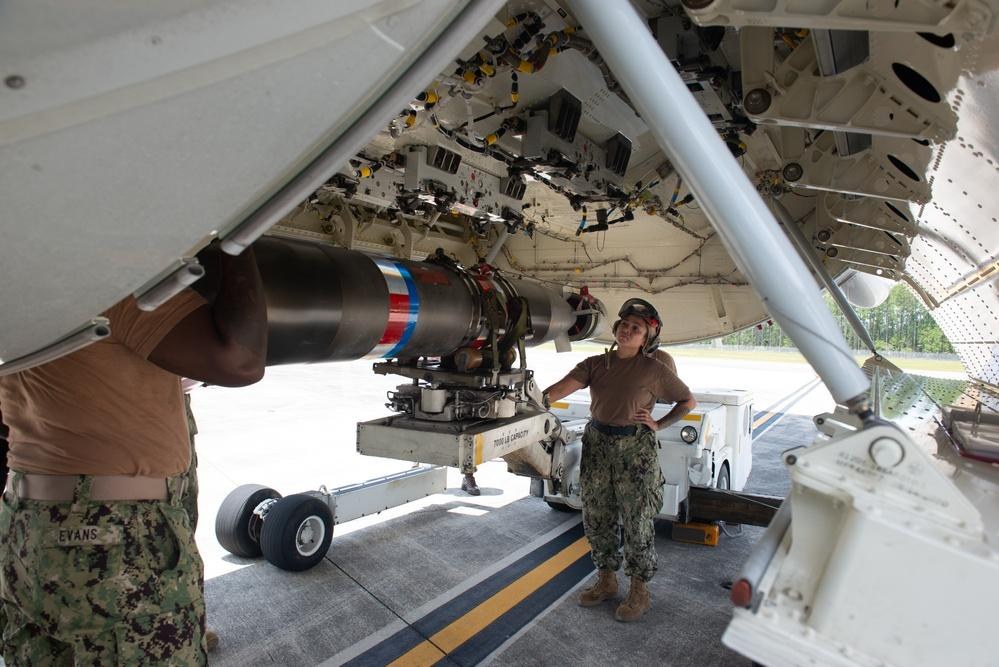
PHOTO CAPTION: U.S. Navy sailors load a Mark 54 lightweight torpedo onto a P-8A Poseidon at Kadena Air Base, Japan, May 7, 2026. The image is illustrative of the Navy’s Silent Anvil concept, which remains in the industry-information stage.
The U.S. Navy is asking industry for ideas for a new anti-submarine weapon that could glide through the air toward a target area, plunge into the ocean and then begin hunting a submarine underwater.
Naval Air Systems Command posted a request for information Aug. 25 for the Silent Anvil Air-Launched Torpedo, a concept intended to give a wider range of manned and unmanned aircraft the ability to launch anti-submarine weapons from farther away.
The Navy is considering two approaches.
One would create an entirely new air-launched weapon combining a gliding delivery system and torpedo into a single package. After traveling through the air, the weapon would enter the water and use acoustic guidance to locate its underwater target.
The second approach would develop an unpowered glide-wing kit capable of carrying a government-furnished torpedo, allowing an existing underwater weapon to travel a significant distance through the air before entering the water.
The Navy wants Silent Anvil to be compact enough to increase the number and types of aircraft capable of carrying anti-submarine weapons.
According to the request, the weapon could potentially be launched internally or externally from aircraft and should be compatible with the BRU-61/A bomb rack used to carry weapons such as the Small Diameter Bomb.
The Navy is looking at an unusually broad launch envelope.
Industry was asked to consider launches at speeds ranging from approximately Mach 0.25 to Mach 0.85 and altitudes stretching from just 10 feet above the surface to as high as 60,000 feet.
The Navy did not specify how far Silent Anvil must glide. Instead, it asked companies to provide the maximum standoff range their designs could achieve.
Once it reaches its destination, the weapon would transition from aerial flight to underwater operation. The Navy wants designs that maximize the time spent traveling through the air while minimizing the amount of time the torpedo has to spend searching underwater before reaching its target area.
Silent Anvil would not be the Navy's first attempt to give an anti-submarine torpedo wings.
The existing High Altitude Anti-Submarine Warfare Weapon Capability, or HAAWC, pairs a glide kit with the Mark 54 lightweight torpedo, allowing P-8A Poseidon crews to release a torpedo from high altitude rather than descending close to the ocean before launch.
Silent Anvil, however, is intended to expand that capability to a wider variety of aircraft, including unmanned platforms.
The Navy is moving quickly if the concept advances.
NAVAIR's request calls for an end-to-end prototype demonstration within 18 months of an agreement award. Following a successful demonstration, the program could move toward delivery of approximately 180 prototype all-up rounds within three years.
Those figures do not represent a production contract. The Aug. 25 notice is a request for information intended to determine what industry can build, and the Navy has not yet selected a design or committed to buying Silent Anvil.
Companies have until Sept. 29 to respond.
The concept comes as anti-submarine warfare is becoming increasingly important to the Navy, particularly as China continues expanding and modernizing its submarine fleet and both nations invest heavily in unmanned systems.
If Silent Anvil moves beyond the concept stage, aircraft and drones that previously lacked a practical way to carry conventional torpedoes could potentially join the submarine-hunting mission from much greater distances and altitudes.
Sources: Naval Air Systems Command; U.S. Navy; Navy Times
(Source: OAF Nation)