NAVY PLANS FLEET-WIDE LASER DEPLOYMENT
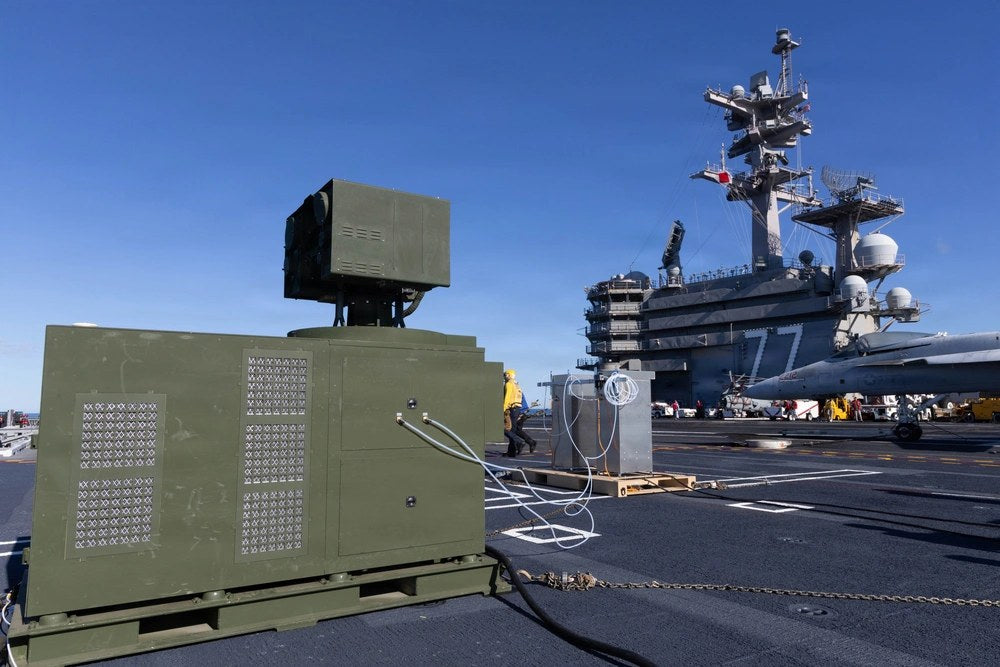
PHOTO CAPTION: A containerized LOCUST Laser Weapon System sits on the flight deck of the aircraft carrier USS George H.W. Bush during Navy live-fire testing in the Atlantic Ocean, Oct. 6, 2025. The system detected, tracked, engaged and neutralized multiple unmanned aerial vehicles during the test. (U.S. Navy photo)
The Navy’s top officer says laser weapons are no longer a futuristic experiment and is calling for directed-energy systems to be pushed into operational use across the Fleet much faster.
Chief of Naval Operations Adm. Daryl Caudle issued a new service-wide message Wednesday declaring that the question is no longer whether directed-energy weapons work, but how quickly the Navy can get them onto ships and into sailors’ hands. The Sept. 2 NAVADMIN specifically calls for high-energy lasers and high-power microwave systems to become a larger part of naval warfare.
“For decades, directed energy has been described as a ‘future capability.’ That future has arrived,” Caudle wrote in NAVADMIN 206/26.
The Navy sees the weapons as one answer to a growing problem at sea: relatively cheap drones and other expendable threats can force warships to burn through limited stocks of expensive defensive missiles. Caudle said directed energy could allow commanders to preserve those interceptors for more dangerous targets while using a ship’s electrical power against lower-cost threats.
Depending on the system and target, the Navy says directed energy can disrupt sensors, interfere with missile seekers, disable unmanned aircraft, damage small boats and destroy aerial threats. Caudle identified point and terminal defense as the most important near-term role, including defense against drones, small boats, surveillance platforms and some cruise-missile threats.
Directed-energy systems would not replace missiles, naval guns or electronic warfare. Instead, Caudle said they would become another layer of ship defense, particularly during sustained combat where missile magazines cannot simply be replenished on demand.
That changes the economics of defending a ship. Instead of firing a limited interceptor at every incoming drone, a laser can draw primarily from the ship’s electrical system, prompting Caudle to describe electrical power itself as an increasingly important form of combat power.
The CNO also wants the Navy to move away from treating every directed-energy installation as a lengthy, ship-specific acquisition project.
His message directs the service to “aggressively pursue” containerized directed-energy systems that can be rapidly placed aboard multiple classes of ships. The concept could shorten installation timelines and allow the Navy to move and test new weapons without waiting through traditional ship modernization cycles.
The Navy already has several directed-energy systems in service or testing. The Optical Dazzling Interdictor, Navy, or ODIN, uses lasers primarily to interfere with electro-optical and infrared sensors, including those carried by unmanned aircraft.
The Navy said earlier this year that eight ODIN systems exist, with seven currently aboard ships and another being used at its directed-energy training facility at Point Mugu, California, while USS Kidd undergoes maintenance. Sailors can now receive formal training and earn a Navy enlisted classification for operating laser weapon systems.
USS Preble is also equipped with HELIOS — the High Energy Laser with Integrated Optical-dazzler and Surveillance system — another step beyond the Navy’s earlier laser demonstrations.
The service has also tested containerized systems at sea. A LOCUST laser weapon system placed aboard the aircraft carrier USS George H.W. Bush detected, tracked, engaged and neutralized multiple unmanned aerial vehicles during a Navy live-fire test.
Caudle’s new message makes clear that the Navy does not want those systems confined to demonstrations and limited deployments.
“We cannot be satisfied with demonstrations or limited deployments,” he wrote.
The next challenge, according to the CNO, is getting the technology into regular Fleet training, planning and layered ship defense — and doing it fast enough that sailors are already comfortable using it before the next major conflict.
(Source: OAF Nation)