Lawmakers Question Army Drone Decision
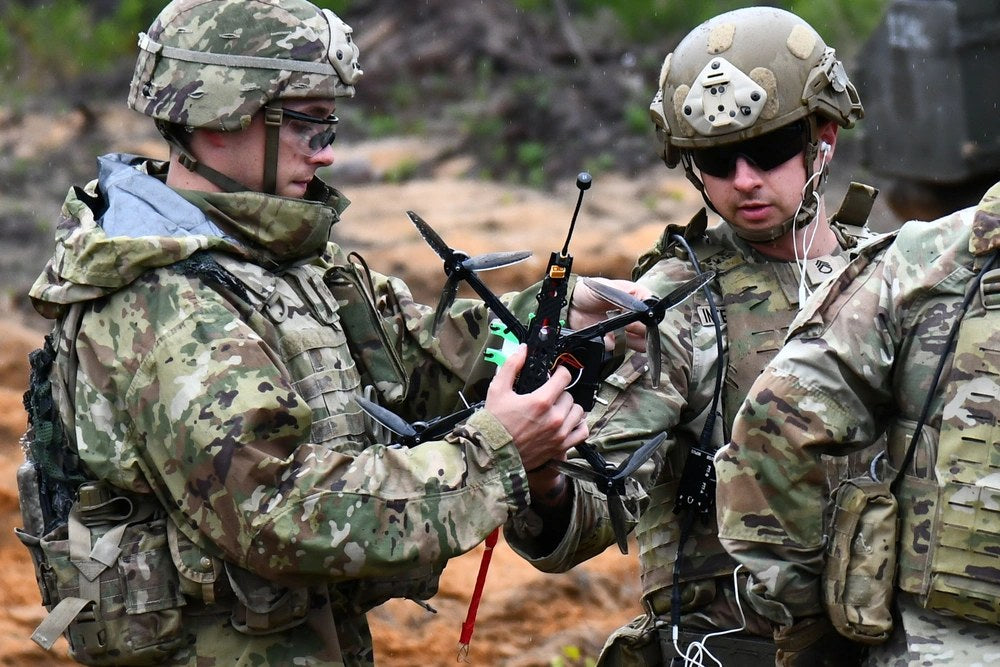
PHOTO CAPTION: U.S. Army soldiers assigned to the 173rd Airborne Brigade conduct first-person-view drone training during Swift Response 2025 at Pabradė Training Area, Lithuania, May 18, 2025. The brigade tested purpose-built FPV drones against autonomous moving targets. (U.S. Army photo by Elena Baladelli)
A bipartisan group of lawmakers is demanding answers from Army leadership over a decision to end the specialized drone-warfare mission of a roughly 600-soldier airborne battalion in Europe less than a year after the experimental force was created.
Sens. Jeanne Shaheen, Thom Tillis and Angus King and Rep. Mike Turner sent a letter Tuesday requesting an Army briefing on the decision involving the 173rd Airborne Brigade. Their challenge became public Wednesday as drones continue to reshape fighting in Ukraine and the Middle East.
The unit, formally established this year as the 3rd Battalion, 504th Parachute Infantry Regiment, had been turned into an experimental Unmanned Assault Battalion. Its soldiers were building and testing drones, experimenting with unmanned warfare and studying battlefield lessons emerging from Ukraine.
Acting Army Chief of Staff Gen. Christopher LaNeve has since ordered the battalion to refocus on its traditional mission as an airborne infantry formation. The Army has said the unit will complete its current exercises and provide what it learned to help shape future force design and experimentation.
The lawmakers say they want to know why the specialized approach is being ended so soon.
“We have deep concerns that eliminating this specialized drone unit will limit our ability to learn from allies,” they wrote, specifically pointing to lessons from the Ukrainian Armed Forces.
Their letter asks the Army to explain the data, analysis and decision-making process behind the change. They also want to know whether the order came from Pentagon leadership or originated within the Army itself.
The timing has drawn attention because the 173rd had already become a highly visible Army test bed for small unmanned systems.
During Swift Response 2025 in Lithuania, 173rd paratroopers tested purpose-built FPV drones against moving targets. Army imagery showed soldiers preparing live FPV drones during field operations, while official video documented the brigade using self-built systems against simulated troops and vehicle-sized targets.
The brigade was also exploring ways to integrate drones with conventional infantry and armored formations rather than treating unmanned systems as a separate battlefield capability. Those experiments came as both Russia and Ukraine demonstrated how inexpensive FPV drones can be used for reconnaissance, attacks and strikes against vehicles and personnel.
The specialized battalion grew out of an Army effort to absorb those lessons faster. Roughly 600 soldiers were organized for the mission, with the concept envisioning a dedicated formation that could develop unmanned-warfare expertise and deploy where that capability was needed.
Drone warfare has since become increasingly relevant to American forces as well. Iranian one-way attack drones have targeted U.S. forces and installations in the Middle East, adding urgency to military efforts involving both offensive drones and counter-drone defenses.
The Army has not said it is abandoning drones across the force. Its position is that lessons from the 173rd experiment can inform future units even as the battalion returns to its core airborne mission.
For the lawmakers challenging the decision, however, the question is whether dismantling a dedicated drone formation could sacrifice expertise at precisely the moment armies around the world are racing to develop it.
They have asked Army leaders for a briefing explaining why the change was made and how the service intends to maintain momentum in drone warfare after the 173rd battalion returns to traditional airborne infantry duties.
Sources: Associated Press; U.S. Army/DVIDS
(Source: OAF Nation)