Navy Families Face Extended Separation
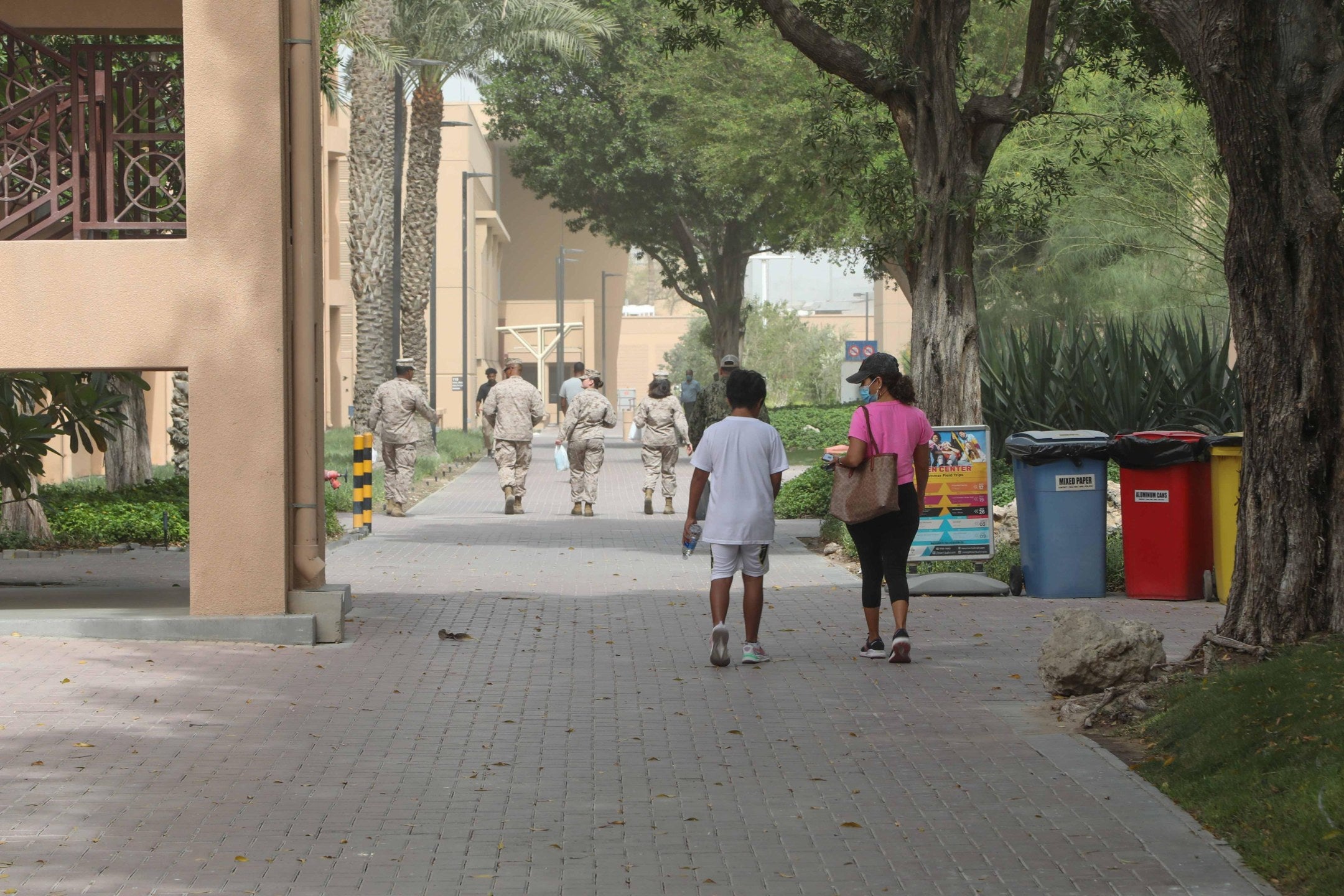
PHOTO CAPTION: U.S. Navy family members walk through Naval Support Activity Bahrain. Nearly 1,300 military family members evacuated from Bahrain are being told they should not expect to return for the foreseeable future. U.S. Navy photo.
Nearly 1,300 military family members evacuated from Bahrain at the start of the Iran war are being told they cannot return for the foreseeable future, leaving families facing new moves, mounting expenses and continued uncertainty nearly six months after they fled.
Navy officials told families last week that conditions in Bahrain still do not allow the full return of U.S. Naval Forces Central Command personnel or their dependents, according to a message obtained by Stars and Stripes. The Navy is now directing many displaced families to establish new home bases, usually in the United States.
The evacuation began after the State Department authorized the departure of eligible family members from Bahrain on Feb. 28 and ordered their departure days later as fighting escalated. The Pentagon designated locations in the United States and U.S. territories as safe havens, while Germany was later approved as an alternate location for some families.
What was designed as a temporary evacuation has stretched far beyond what many military support programs were built to handle.
“We literally have been making this up as we go, because nothing is conceived to go on this length of time,” Vice Adm. Curt Renshaw, commander of U.S. Naval Forces Central Command, told nearly 600 people during a virtual town hall Wednesday, according to an audio recording obtained by Stars and Stripes.
Some families remain without furniture, vehicles and other household goods that were left behind in Bahrain or delayed by disruptions in the region. Others have moved repeatedly between temporary housing while trying to decide where children will attend school, how to access medical care and where their families will ultimately live.
One active-duty Navy family told Stars and Stripes it had spent nearly $40,000 out of pocket after falling into a gap between permanent-change-of-station and evacuation policies.
The family had already been preparing to leave Bahrain before the war began. Its household goods were packed before the first strikes but were delayed for months, and because the family departed under PCS orders rather than safe-haven authorization, it did not automatically qualify for some of the financial assistance available to evacuees.
Another Navy spouse said she and her children are living in a short-term rental without their vehicle or furniture, which remain in Bahrain with her husband. She said the repeated moves have also taken a toll on her children while the family remains separated.
Military officials have adjusted benefits and created workarounds as the evacuation has continued, but some forms of assistance are reaching limits that were never designed around a displacement lasting this long.
Civilian safe-haven allowances are scheduled to reach their 180-day limit this week unless the State Department approves extensions. Different rules apply to military families, and officials have said individual cases are being handled based on each family's circumstances.
Even basic logistical questions have remained unresolved for months.
An official NAVCENT evacuation FAQ published earlier this year acknowledged that the Navy was still working through questions involving household goods and vehicles left in Bahrain. The command also established processes for displaced families to file travel claims, request advances and access medical care while living at safe-haven locations.
The uncertainty now extends beyond individual families.
Bahrain normally hosts the headquarters of U.S. Naval Forces Central Command and the U.S. 5th Fleet, along with thousands of service members, civilians and dependents. The Navy sharply reduced its presence after Iranian drone and missile attacks began, maintaining personnel needed for critical operations.
Officials told families that plans are being developed for where NAVCENT headquarters will operate over the medium and long term. U.S. Central Command has not publicly announced whether the headquarters or evacuated dependents will eventually return to Bahrain.
For families, the Navy's latest guidance provides at least one answer: they should no longer plan around an imminent return.
Instead, many are being told to establish new homes while their service members remain overseas — turning what began as an emergency evacuation into a long-term family separation with no clear end date.
(Source: OAF Nation)