Marine Corps Enforces Barracks Safety Standards
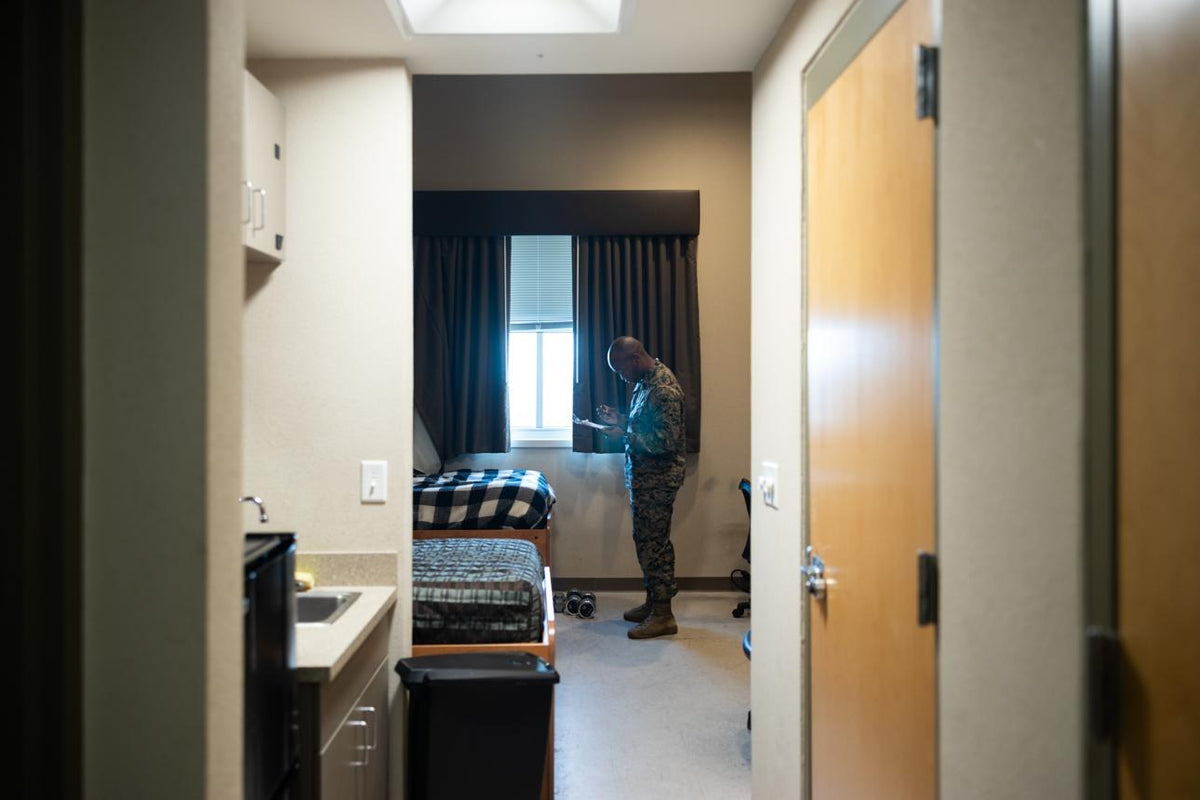
PHOTO CAPTION: Gunnery Sgt. Michael Adams inspects a barracks room at Camp Lejeune, North Carolina, on February 27, 2024. A new Marine Corps directive establishes stricter housing standards, emergency repair deadlines and protections for Marines who refuse unsafe living conditions. (U.S. Marine Corps file photo.)
Marines living in barracks across the world are now covered by stricter housing standards, including protections against retaliation for refusing unsafe rooms and mandatory deadlines for fixing dangerous maintenance problems.
The Marine Corps issued MARADMIN 546/26 on November 4, establishing detailed requirements for living conditions, room assignments, emergency repairs, and command accountability.
Under the directive, Marines cannot be assigned rooms with visible mold, pest infestations, broken heating or cooling systems, faulty locks, inoperable plumbing, or no functioning hot water.
The new rules also require emergency maintenance requests to receive an initial response within one hour. If an emergency hazard cannot be contained within 24 hours, the Marine must be moved to alternate lodging.
And perhaps most significantly for troops who have spent months dealing with unresolved barracks problems, the directive explicitly protects Marines who refuse uninhabitable housing or use their chain of command to challenge unsafe conditions.
Marines Can Refuse Rooms That Fail Housing Standards
Under the new policy, incoming Marines must inspect their assigned barracks room alongside the building manager before signing an occupancy agreement.
If the room meets the Marine Corps' definition of uninhabitable, the service member has the right to refuse it.
The directive specifically identifies six conditions that make a room unfit for assignment:
Visible mold or mildew.
Evidence of pest infestation.
Inoperable heating or air conditioning.
Broken door or window locks.
Inoperable plumbing or sewage systems.
No functioning hot water.
The policy prohibits retaliation, harassment, reduced services, or other adverse treatment because a Marine exercises that right.
Importantly, the right to refuse uninhabitable quarters was recognized in earlier Marine Corps housing guidance. The November 4 directive reinforces that protection while spelling out specific conditions and accountability procedures.
The new rules also prohibit assigning Marines to rooms that fail established baseline standards or have outstanding maintenance work orders.
Emergency Repairs Must Receive a Response Within One Hour
The directive establishes mandatory timelines for maintenance requests, replacing uncertainty about how quickly serious problems are supposed to be addressed.
For emergency repairs, maintenance personnel must provide an initial response within one hour.
The immediate hazard must then be eliminated or contained within 24 hours.
A permanent repair must generally be completed within 15 business days.
If the emergency cannot be contained within the first 24 hours, the affected Marine must be relocated immediately and cannot return until the emergency condition has been addressed.
Examples of emergencies include dangerous electrical problems, gas leaks, carbon monoxide hazards, major water leaks, nonfunctioning fire alarms, blocked emergency exits, and significant mold contamination.
The directive also establishes temperature thresholds.
A complete loss of heating becomes an emergency when the outside temperature falls below 50 degrees Fahrenheit. A complete loss of air conditioning is classified as an emergency when the outside temperature exceeds 85 degrees.
Less severe problems are categorized as urgent or routine maintenance, with separate response deadlines.
The distinction matters because the one-hour response requirement applies specifically to emergency conditions, not every minor maintenance request.
Commanders Must Be Notified When Repairs Fall Behind
The policy also creates new accountability procedures for maintenance problems that remain unresolved.
If an emergency condition is not contained within 24 hours, the work order must be escalated directly to the installation commander.
Other repairs that exceed their required response or completion deadlines by five business days must also be escalated.
Installation commanders are authorized to reprioritize maintenance contracts, redirect available local funding, or arrange commercial lodging when government housing options are exhausted.
Overdue maintenance requests must also be included in reports provided every two weeks to senior Navy infrastructure officials and the Pentagon's Barracks Task Force.
That creates a process for identifying problems that remain unresolved beyond the installation level.
The directive further requires maintenance work to be physically verified before a work order can be marked complete.
Marines will be able to report problems using the QSRmax maintenance system, including QR codes posted in barracks buildings.
Marines Can Use Request Mast Over Unsafe Housing
Another major provision concerns Marines who believe their housing complaints are being ignored.
If a Marine is ordered to occupy a room that fails established standards, the directive explicitly authorizes the use of Request Mast.
The same process is available when maintenance requests are repeatedly ignored, delayed, or left unresolved beyond established deadlines.
Request Mast allows a Marine to formally seek assistance through the chain of command, potentially reaching a commander with general court-martial convening authority.
The new directive states that leaders cannot prevent, discourage, or retaliate against Marines for exercising this right.
These protections do not mean Marines can reject any room simply because they dislike its appearance or layout.
They apply to unsafe conditions and deficiencies covered by the housing standards.
But they do provide a documented process for challenging housing problems when ordinary maintenance channels fail.
New Standards Cover Everything From Hot Water to Internet Access
The directive goes beyond emergency repairs.
It establishes detailed minimum expectations for barracks rooms, including working locks, dependable electrical service, sanitary plumbing, functional heating and cooling, and access to high-speed Wi-Fi.
Hot water must reach at least 110 degrees Fahrenheit at fixtures, while the policy specifies an indoor climate-control range of 70 to 74 degrees.
The Marine Corps' standard 2+0 housing design includes a living and sleeping area of at least 180 net square feet for a maximum of two occupants, along with individual secured storage, a bathroom, and a kitchenette area.
Required furnishings include beds, desks, chairs, nightstands, refrigerators, and microwaves.
Not every existing barracks building necessarily has that layout today. The directive establishes the standard but does not claim that all installations have already completed the improvements.
The Marine Corps has not announced that every older barracks building will be replaced immediately.
Civilian Housing Managers Will Take on More Responsibility
The policy also advances the Marine Corps' Barracks 2030 initiative, which is intended to improve living conditions and professionalize barracks management.
Under the directive, day-to-day housing administration will increasingly fall under civilian housing officials and contracted building managers.
Those personnel will oversee room assignments, maintenance requests, inspections, and facility records.
Unit commanders will retain responsibility for discipline, welfare, cleanliness, and routine field day inspections.
The goal is to reduce the amount of time active-duty Marines spend performing building-management duties while placing more responsibility for repairs on dedicated housing and maintenance professionals.
The directive also requires barracks maintenance to take priority over maintenance at other types of installation facilities.
The Real Test Will Be Enforcement
Poor military housing conditions have received increased attention in recent years.
Complaints about mold, water damage, broken air conditioning, pest problems, and delayed maintenance have prompted inspections and congressional scrutiny across multiple military branches.
The Marine Corps previously ordered extensive barracks inspections and launched efforts to improve housing management.
The November 4 directive attempts to strengthen those efforts by setting measurable deadlines, defining unacceptable conditions, and requiring commanders to address repeated failures.
However, issuing a policy does not automatically fix aging buildings or eliminate maintenance backlogs.
The effectiveness of the new rules will depend on whether installations have the personnel, funding, and housing capacity necessary to meet the requirements.
For Marines who have dealt with broken air conditioning, mold, unreliable plumbing, or maintenance requests that seemed to disappear, the new standards provide a clearer basis for demanding action.
The Marine Corps is now explicitly requiring safe housing, deadlines for repairs, and protections for service members who challenge unacceptable living conditions.
Whether those requirements produce lasting improvements will depend on what happens inside the barracks after the policy takes effect.
(Source: OAF Nation)