Article: Judge Dismisses DOJ Gun Lawsuit
Judge Dismisses DOJ Gun Lawsuit
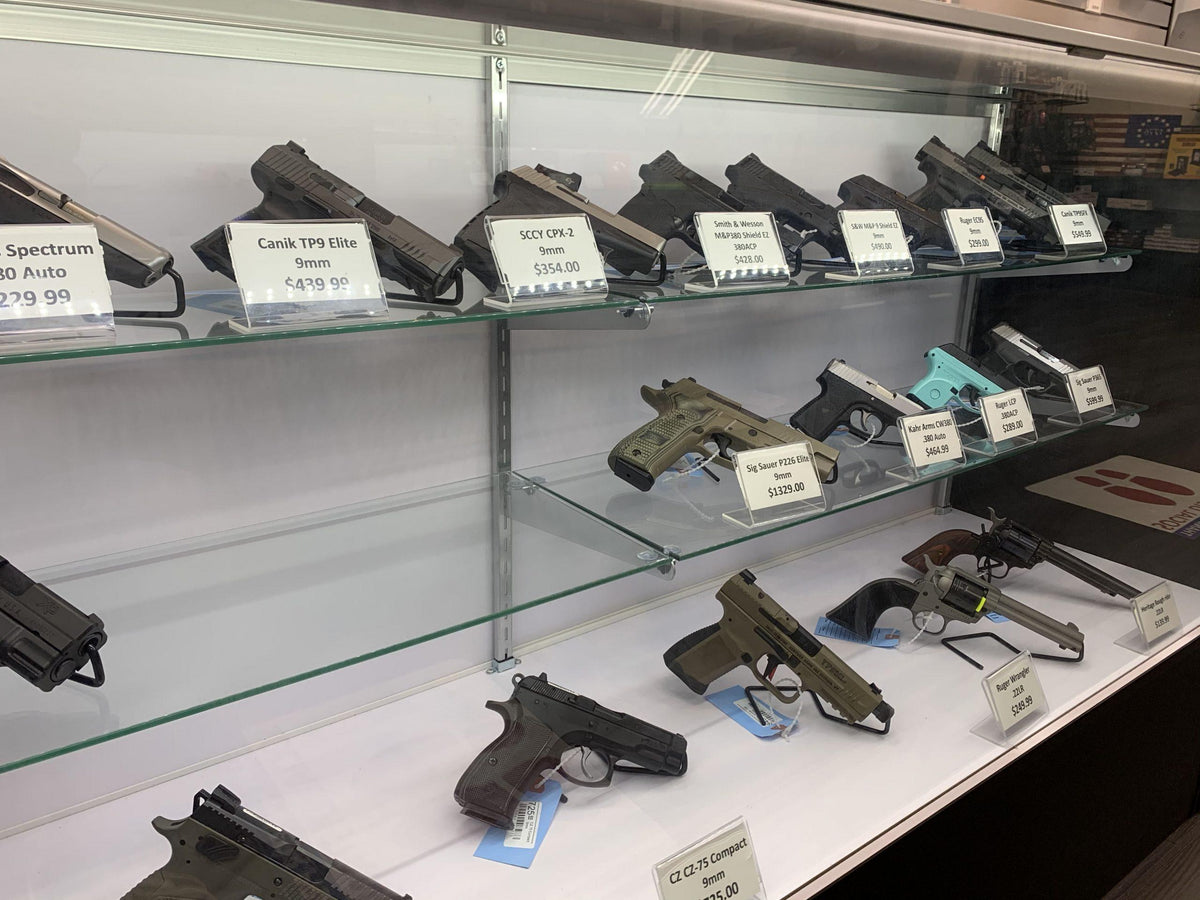
PHOTO CAPTION: Handguns are displayed at United Gun Shop in Rockville, Maryland, in April 2021. A federal judge dismissed the Justice Department's lawsuit challenging Montgomery County restrictions on carrying firearms within 100 yards of certain public places. The November 9, 2026, ruling addressed the federal government's legal authority to bring the case, not whether the county's restrictions violate the Second Amendment. (Capital News Service file photo by Jonathan Bennett.)
A federal judge has dismissed the Justice Department's lawsuit challenging a Maryland county's restrictions on carrying firearms within 100 yards of schools, parks, houses of worship and other public locations.
The November 9 ruling ends the federal government's initial attempt to block Montgomery County's firearm restrictions, which the Trump administration argues violate the Second Amendment.
But the decision did not settle the constitutional dispute.
U.S. District Judge Theodore Chuang concluded that the Justice Department had relied on a federal civil rights statute that did not authorize its particular challenge.
The judge did not rule that Montgomery County's gun restrictions were constitutional. He instead determined that the government failed to establish the legal basis necessary to pursue the case under the statute it selected.
For now, the county's restrictions remain in effect, while separate legal challenges continue.
What Does the 100-Yard Restriction Prohibit?
Montgomery County, located outside Washington, D.C., prohibits carrying or possessing firearms in or within 100 yards of several categories of designated public places, subject to exceptions.
Those locations include schools, parks, libraries, places of worship, polling places, courthouses, legislative assemblies and certain recreational facilities.
The restrictions can apply to individuals who possess Maryland permits to carry handguns.
The law also includes exceptions, including provisions allowing certain concealed-carry permit holders to travel along public highways passing through restricted areas.
The Justice Department argues that the overlapping 100-yard zones create serious obstacles for lawful gun owners attempting to move through the county.
Federal officials contend that residents may have difficulty navigating ordinary streets and public spaces without entering a restricted area.
Montgomery County officials defend the restrictions as a public safety measure designed to reduce the presence of firearms around locations where people gather.
The dispute centers on how broadly local governments may designate sensitive locations where firearms are restricted.
DOJ Filed Suit Just Days After the Law Changed
Montgomery County's latest legislation, Expedited Bill 23-26E, was approved by the County Council on July 21 and signed into law on July 27.
The measure updated existing firearms restrictions after Maryland's highest court ruled that the county had exceeded its state-law authority in certain areas.
The county preserved restrictions around schools, parks, places of worship and other locations while removing or modifying provisions involving hospitals, childcare facilities and some government buildings.
On August 3, the Justice Department sued Montgomery County, its police department and Sheriff Maxwell Uy.
The department argued that the 100-yard restrictions violated constitutional protections recognized in recent Supreme Court decisions concerning the right to carry firearms for self-defense.
Federal officials sought a preliminary injunction to prevent enforcement of the law while the case proceeded.
But the legal authority DOJ selected became the central problem.
Judge Says DOJ Used the Wrong Federal Law
The Justice Department brought its case under 34 U.S.C. Section 12601, a provision allowing the federal government to take action against patterns or practices of unconstitutional conduct by law enforcement officers.
The statute is generally used to address systemic police misconduct.
The government's argument was that enforcing Montgomery County's allegedly unconstitutional firearm restrictions would itself amount to a prohibited pattern or practice.
Chuang rejected that interpretation.
In his 33-page opinion, the judge explained that the federal government had not identified actual conduct by county law enforcement officers enforcing the new ordinance that would establish the required pattern or practice.
The lawsuit primarily challenged the existence of the county law and its potential enforcement, rather than documented misconduct by officers.
The judge concluded that allowing the federal government to use this provision to challenge state or local legislation without showing qualifying law enforcement misconduct would substantially expand federal authority over local governments.
He emphasized that Congress, rather than the executive branch, determines the circumstances in which federal enforcement actions may intrude on state and local government authority.
The result was dismissal of the Justice Department's lawsuit.
The Court Did Not Decide the Second Amendment Question
The distinction between dismissal and a constitutional ruling is important.
The Justice Department asked the court to decide whether Montgomery County's restrictions unlawfully burden the Second Amendment rights of licensed firearm carriers.
Chuang did not resolve that question.
Because the government failed to establish a valid claim under the statute it invoked, the court did not need to evaluate the underlying constitutional arguments.
The judge also denied DOJ's request for a preliminary injunction.
That means the ruling did not strike down the ordinance, narrow the 100-yard zones or create a new exemption for concealed-carry permit holders.
It also did not establish that the county's restrictions would necessarily survive a properly presented constitutional challenge.
The legal question remains unresolved in this particular case.
Montgomery County Welcomes the Decision
Montgomery County Executive Marc Elrich welcomed the dismissal.
In a public statement, Elrich said the decision supported the county's responsibility to protect residents and public spaces through lawful safety measures.
He reiterated the county's position that constitutional rights and public safety protections can coexist.
County officials maintain that the restrictions are within the authority granted to local governments under Maryland law.
The Justice Department has taken a different position.
DOJ spokesperson Kiersten Pels told Maryland Matters on November 10 that the department was evaluating the ruling and its available next steps.
The department also reaffirmed its commitment to protecting Second Amendment rights in Maryland.
An appeal could bring the dispute before the U.S. Court of Appeals for the Fourth Circuit.
No reversal of the November 9 dismissal has been established.
Other Gun-Rights Challenges Are Still Active
The federal government's defeat does not end litigation over Montgomery County's firearms restrictions.
Separate lawsuits brought by individual gun owners, firearms-rights organizations and religious plaintiffs challenge aspects of the same county law.
One case involves the Silver Spring Jewish Center and Rabbi Menashe Shapiro, who argue that the restrictions affect their ability to provide armed security at their place of worship.
That dispute includes Second Amendment and religious-freedom claims.
In September, a different federal judge declined to block the county's 100-yard restriction through a preliminary injunction in the Jewish Center case. Subsequent motions and appellate proceedings have continued.
Other plaintiffs are also pursuing challenges to the restrictions.
Those lawsuits involve different legal claims and procedural requirements from the Justice Department's dismissed action.
Their outcomes could ultimately determine whether some restrictions are narrowed or invalidated.
A Broader Dispute Over Where Firearms May Be Carried
The Maryland case reflects an ongoing national disagreement over the reach of public-carry protections.
The Supreme Court's 2022 decision in New York State Rifle & Pistol Association v. Bruen recognized that ordinary, law-abiding Americans have a constitutional right to carry handguns publicly for self-defense.
The Court also acknowledged that firearms may be restricted in certain sensitive locations.
Subsequent litigation has focused on how far those exceptions can extend.
Gun-rights advocates argue that broad buffer zones around commonly visited locations can effectively prevent licensed residents from carrying firearms during normal daily activities.
Supporters of restrictions argue that schools, parks and other public gathering places warrant additional protections and that local governments have a responsibility to reduce risks associated with firearms.
The disagreement is particularly significant when restricted areas extend beyond a building or property boundary into surrounding public space.
A 100-yard buffer covers roughly 300 feet from a designated location, potentially affecting nearby sidewalks, streets and neighboring properties, subject to applicable exceptions.
Whether that geographic approach is constitutional remains a separate question from the procedural issue decided on November 9.
What Happens Next?
The Justice Department must decide whether to appeal the dismissal or pursue another legally available approach.
Montgomery County can continue defending the ordinance in the separate cases already moving through the courts.
For licensed gun owners, the November 9 ruling does not provide new authorization to carry in the county's restricted areas.
The county law remains in place, subject to its exemptions and developments in other litigation.
The federal judge's ruling is significant because it rejected the Justice Department's chosen method of challenging the ordinance.
But the larger constitutional question, whether a county may prohibit firearms within 100 yards of so many commonly visited public places, remains unsettled.
(Source: OAF Nation)