Judge Blocks Connecticut Gun Law
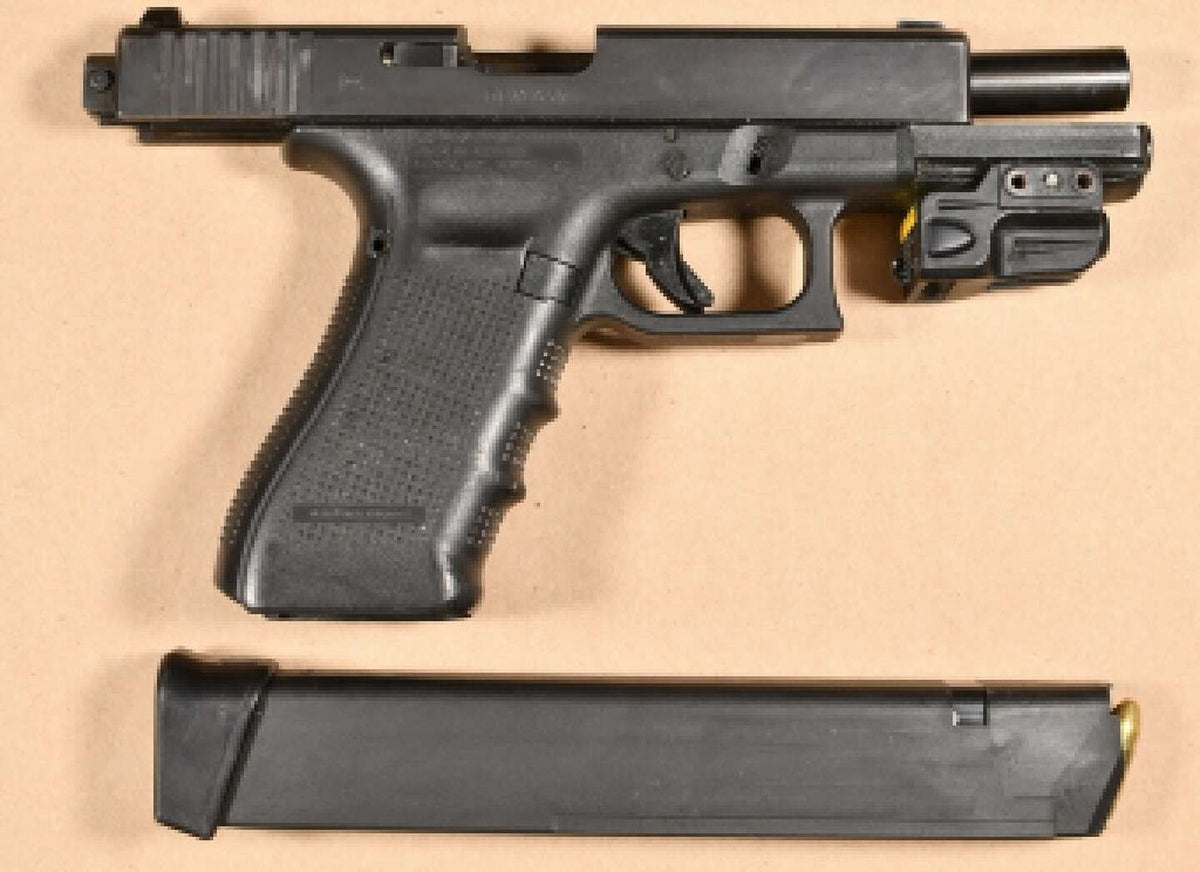
PHOTO CAPTION: A Glock pistol equipped with a machine gun conversion device. Connecticut’s blocked law targeted the future sale of certain unconverted pistols the state considers readily convertible to automatic fire. Machine gun conversion devices themselves remain generally illegal under federal law.
A federal judge blocked Connecticut from enforcing a new restriction on certain semiautomatic pistols Wednesday night, about seven hours before the law was scheduled to take effect.
U.S. District Judge Kari Dooley issued preliminary injunctions in lawsuits brought by Glock and a separate group that includes the National Shooting Sports Foundation, Shadow Systems and a Connecticut firearms retailer.
The challenged portion of Public Act 26-41 was scheduled to take effect Oct. 1.
It would prohibit the future importation, advertising or sale of certain newly manufactured semiautomatic pistols that Connecticut defines as “convertible pistols.”
The law focuses on pistols equipped with a particular type of trigger system that the state says allows the firearm to be readily converted into a machine gun by installing an illegal conversion device commonly called a Glock switch.
The restriction applies to covered pistols manufactured on or after Oct. 1, 2026.
It does not require owners to surrender previously purchased handguns, and pistols manufactured before that date were treated differently under the law.
Violating the provision could result in a class D felony.
Glock and the other challengers sued before the effective date, arguing that Connecticut was restricting otherwise lawful semiautomatic handguns because of the possibility that someone could later illegally modify them.
Dooley held a hearing Tuesday and issued her ruling Wednesday.
In a separate injunction order, she said the challenged provisions are “likely unconstitutional under the Second Amendment.”
The court found that the challengers had shown a likelihood of succeeding on their constitutional claim and would suffer irreparable harm if enforcement began.
For purposes of the preliminary-injunction proceedings, Connecticut did not dispute that the handguns at issue fell within conduct protected by the text of the Second Amendment.
That placed the burden on the state to show that its restriction was consistent with the nation’s historical tradition of firearm regulation.
Connecticut pointed to historical firearm-safety regulations and the longstanding regulation of machine guns.
Dooley concluded that the state had not yet met that burden.
The judge noted that the affected handguns, while unconverted, are widely used for lawful purposes including self-defense.
She also distinguished the pistols themselves from the illegal devices used to turn semiautomatic firearms into fully automatic weapons.
Machine gun conversion devices are already generally illegal to possess under federal law and are themselves treated as machine guns under federal firearms law.
Connecticut officials argue the additional restriction is necessary because conversion devices have become increasingly common and because some pistols can be modified quickly using small, easily installed components.
When Gov. Ned Lamont signed the legislation in June, his office cited ATF data showing more than 31,000 machine gun conversion devices had been recovered nationwide between 2019 and 2023. Hartford police reported seizing 51 switches during 2023 and 2024.
Lamont criticized Wednesday’s ruling and said the state would continue defending the law.
Attorney General William Tong said his office was reviewing the decision and evaluating its legal options.
The injunction is not a final ruling permanently striking the law down.
It prevents Connecticut from enforcing the challenged provisions while the lawsuits continue, and Dooley noted that the legal and factual record could develop further as the cases proceed.
For now, however, the restrictions that were scheduled to begin Oct. 1 cannot be enforced.
(Source: OAF Nation)